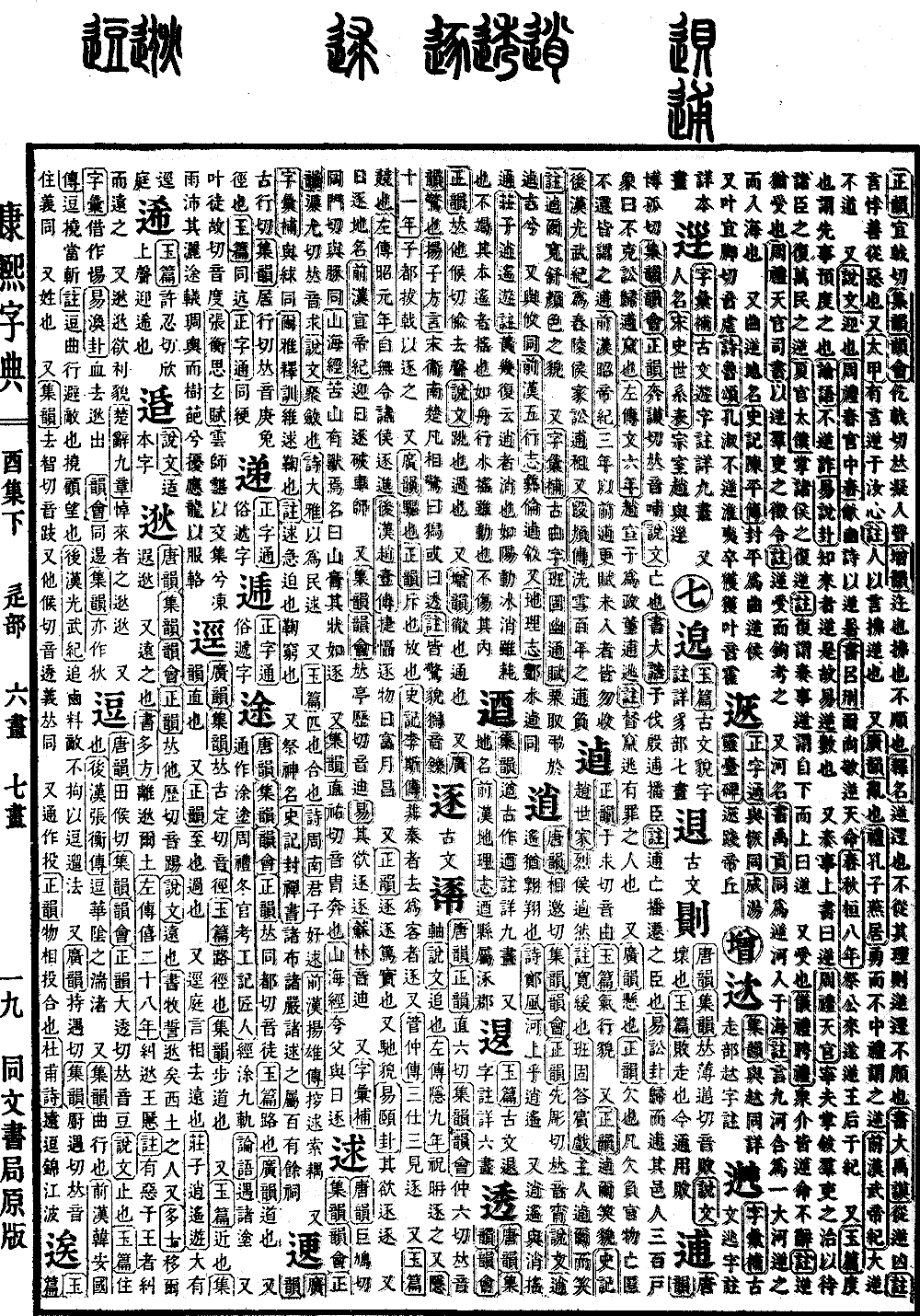
You Collection, Lower Volume
Radical: Walk (chuò)
17 strokes
Page 1257, Entry 18
Correction of Standard Characters (Zhengzitong): This is the vulgar form of the character (di).
(di)
Guangyun: Pronounced ti (rising tone)
Jiyun, Yunhui, Zhengyun: Pronounced dai (rising tone), homophonous with (ti).
Shuowen: Meaning to change or alternate.
Guangyun: (di) means to replace.
Zhengyun: Meaning to take turns or alternate.
Erya, Interpretation of Words (Ershigu): (di) means to alternate.
Annotation: Refers to the meaning of taking turns, intervals, or mutual replacement.
History of the Former Han Dynasty (Qianhan), Hymns for the Suburban Sacrifices (Jiaosige): The four seasons arise and alternate, with winds from the eight directions arising in succession.
Also, Zhengyun: Tiaodi, meaning remote or distant.
Also, Zengyun: Chuandi (transmission), referring to relay transport.
Also, Dijian (a type of bell-chime): The name of a musical instrument.
History of the Former Han Dynasty (Qianhan), Biography of Wang Bao: Bo Ya played the Dijian chime.
Also, Guangyun: Pronounced te (falling tone)
Jiyun, Yunhui, Zhengyun: Pronounced da (falling tone), homophonous with (di). Meaning is the same.
Also, pronounced dang (falling tone), homophonous with (dai). Meaning to surround.
History of the Former Han Dynasty (Qianhan), Biography of Wang Mang: The Marquis of Jiang relied on the surrounding presence of the various generals, occupying a position of mutual support.
Annotation: This means the generals were of one heart, surrounding and supporting him.
Also, rhyming with tie (falling tone), homophonous with (die).
Inscription on the Stele of Wang Jian and Chu Yuan: Fine strategies are left with no successors, and models of conduct are gone forever. My heart is melancholic, leaving lingering thoughts; the resounding and far-reaching achievements will endure.
Annotation: Changdi (ever distant), implies a permanent departure from which one does not return. This also carries the meaning of tiaodi (remote).
Jiyun: Sometimes written as (di). The vulgar form is written as (di).
Textual Research:
History of the Former Han Dynasty (Qianhan), Biography of Wang Mang: The Marquis of Jiang relied on the surrounding presence of the various generals, occupying a position of mutual support.
Annotation: Refers to the generals being of one heart, surrounding and supporting him.
Carefully checked against the original text, (fu) replaced with (fu).