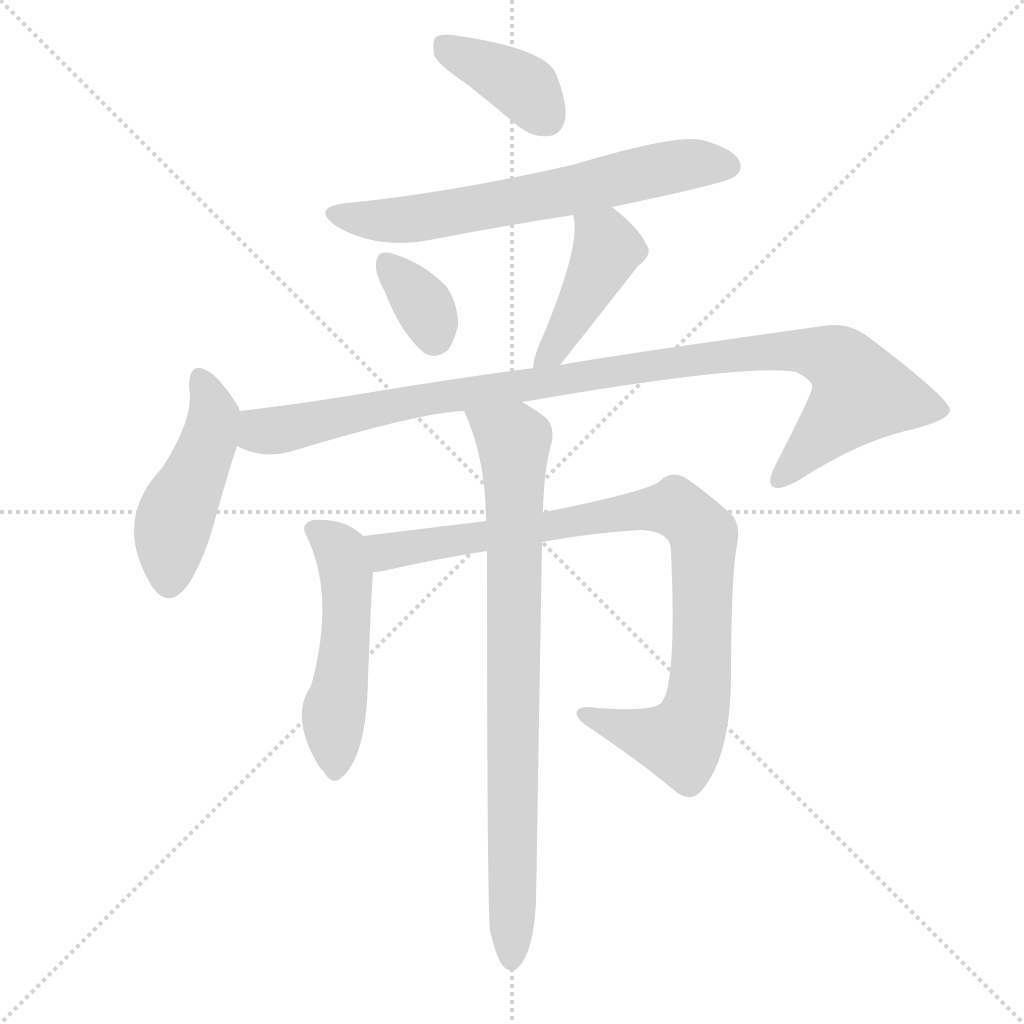
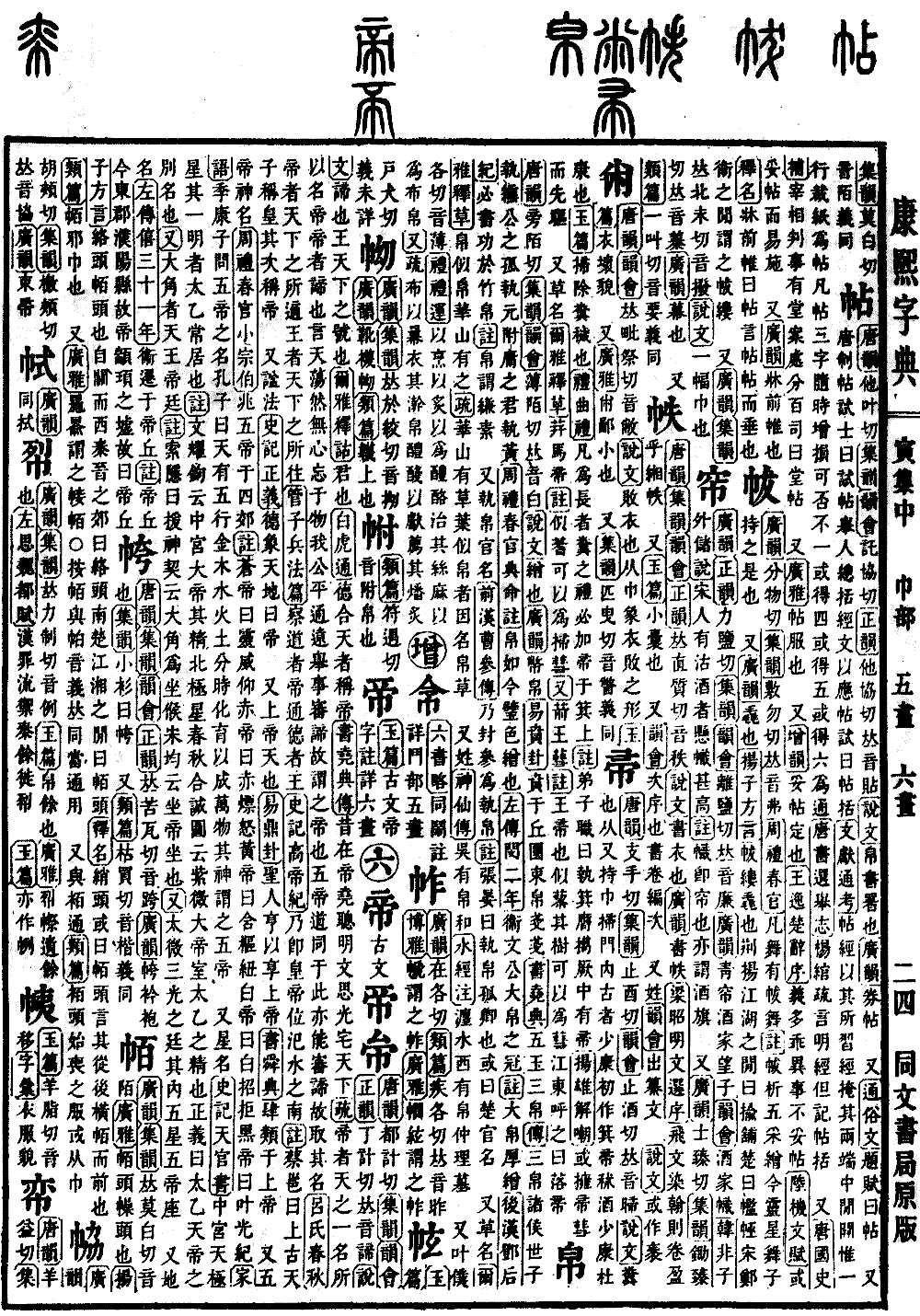
Yin Collection, Middle Volume. Radical: Cloth (jīn). Kangxi stroke count: 9. Page 330, Entry 14.
Ancient form. Pronounced di (falling tone). According to the Shuowen Jiezi (Explaining Graphs and Analyzing Characters), it means to scrutinize. It is a title for one who rules all under heaven. According to the Erya (Approaching Elegance), it means a ruler. According to the Baihu Tong (Comprehensive Discussions in the White Tiger Hall), one whose virtue matches Heaven is called an emperor. According to the Book of Documents (Shujing), Yao Dian preface: In the past, there was Emperor Yao, intelligent, wise, and virtuous, who brought light to all under heaven. The commentary states: Emperor is a name for Heaven; hence the name is given to the ruler. To be an emperor means to scrutinize. It means Heaven is vast and selfless, forgetting distinctions between object and self, being fair and far-reaching, and acting with scrutiny; thus it is called emperor. The Five Emperors shared this way, being able to scrutinize, hence the name was adopted. According to the Lüshi Chunqiu (Master Lü's Spring and Autumn Annals), the emperor is the one to whom the world turns; the king is the one to whom the world goes. According to the Guanzi (Book of Master Guan), Military Strategy chapter: One who examines the Way is an emperor; one who understands virtue is a king. According to the Records of the Grand Historian (Shiji), Biography of Gaozu: He ascended the throne as Emperor south of the Si River. The commentary by Cai Yong states: In ancient times, the Son of Heaven was called sovereign, and subsequently was called emperor. Furthermore, according to the posthumous title laws, the Records of the Grand Historian (Shiji), Correct Meaning: One whose virtue resembles Heaven and Earth is called an emperor. Also, Supreme Emperor refers to Heaven. According to the I Ching (Book of Changes), Ding hexagram: The sage cooks to offer to the Supreme Emperor. According to the Book of Documents (Shujing), Shun Dian: He made offerings to the Supreme Emperor. Also, the Five Emperors are names of deities. According to the Rites of Zhou (Zhouli), Spring Offices, Small Minister of Ancestral Temples: He divined for the Five Emperors in the four suburbs. The commentary states: The Azure Emperor is called Lingweiyang, the Red Emperor is called Chibiaonu, the Yellow Emperor is called Hanshuniu, the White Emperor is called Baizhaoju, and the Black Emperor is called Zhiguangji. According to the School Sayings of Confucius (Kongzi Jiayu), Ji Kangzi asked about the names of the Five Emperors. Confucius said: Heaven has the five phases—metal, wood, water, fire, and earth—which divide time and nourish to complete the myriad things; their spirits are called the Five Emperors. Also, a name for a star. According to the Records of the Grand Historian (Shiji), Treatise on Celestial Offices: In the central palace is the Pole Star, the one that is bright is where the Grand Monad (Taiyi) resides. The commentary states: The Wenyao Gou says: The Great Emperor of the central palace has his essence in the North Pole star. The Chunqiu He Cheng Tu says: The Ziwei Great Emperor’s chamber is the essence of the Grand Monad. The Correct Meaning states: The Grand Monad is another name for the Celestial Emperor. Also, the Great Horn (Dajiao) is the celestial king’s imperial court. The commentary states: The Suoyin says: The Yuanshen Qi says: The Great Horn is the seat for waiting. Song Jun says: The seat is the Emperor’s seat. Also, the Taidai’s three luminaries’ court contains the five planets and the seats of the Five Emperors. Also, a place name. According to the Zuo Zhuan (Chronicle of Zuo), 31st year of Duke Xi: The state of Wei moved to Diqiu. The commentary states: Diqiu is modern Puyang county in Dong commandery, the ancient ruins of Emperor Zhuanxu, hence it is called Diqiu.
Textual research: In the Book of Documents (Shujing), Yao Dian commentary: In the past, there was Emperor Yao, intelligent, wise, and virtuous, who brought light to all under heaven. We note that this belongs to the preface of the book; the commentary should be changed to preface. In the Rites of Zhou (Zhouli), Spring Offices, Small Minister of Ancestral Temples: The commentary states the Black Emperor is called Ye-guangji. According to the original text, the character ye should be changed to zhi.