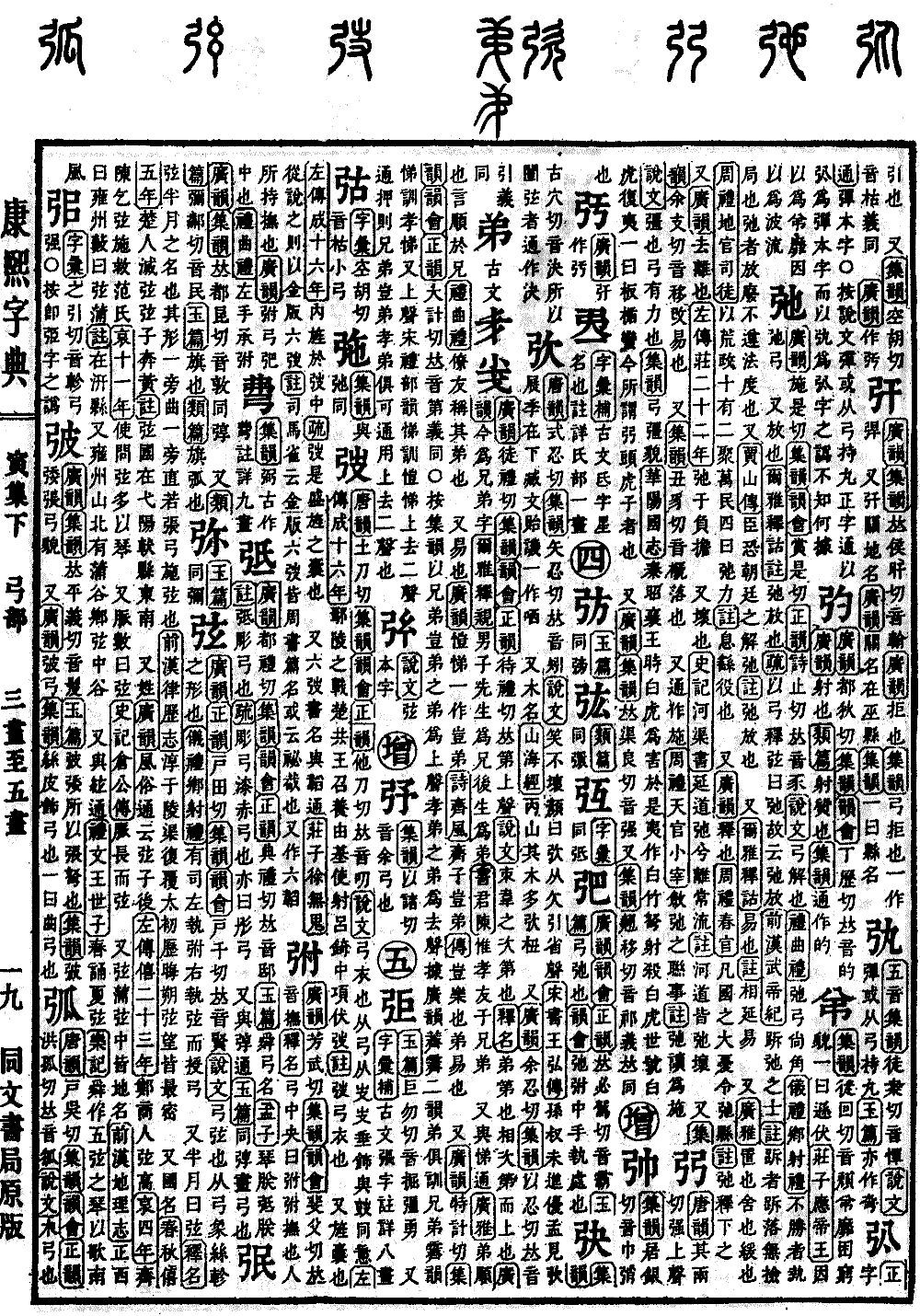
Yin Collection, Lower Volume
Radical: Bow (gōng)
Kangxi Strokes: 7
Page 357, Entry 17
Ancient literary references: Broad Rhymes (Guangyun) states the pronunciation is ti (rising tone). The Collected Rhymes (Jiyun), Collected Rhymes and Annotations (Yunhui), and Orthodox Rhymes (Zhengyun) state the pronunciation is dai (rising tone). Explaining and Analyzing Characters (Shuowen Jiezi) defines it as the order of lashing leather. Explaining Names (Shiming) explains that the term for younger brother implies sequence, meaning to be arranged in order. Broad Rhymes states that it is now used for the word for younger brother. The Erya: Explaining Kinship (Erya: Shiqin) records that a male born earlier is an elder brother, and one born later is a younger brother. The Book of Documents (Shangshu: Junchen) says: Only by being filial to parents and friendly to brothers. It is also interchangeable with the character meaning fraternal respect (ti). The Refined Dictionary (Guangya) explains the character as obedience, referring to obeying an elder brother. The Book of Rites (Liji: Quli) says colleagues and friends praise him for being friendly to his brothers. It also carries the meaning of being mild and easy-going. Broad Rhymes records the term meaning joyful and easy-going (kaidi), also written as (qidi). The Book of Odes (Shijing: Qifeng) contains the phrase the prince of Qi is joyful and easy-going. The Mao Commentary explains that joy (qi) means happy, and easy-going (di) means mild. Additionally, Broad Rhymes states the pronunciation is te (falling tone), and Collected Rhymes, Collected Rhymes and Annotations, and Orthodox Rhymes state the pronunciation is da (falling tone), with the same sound as the character for sequence (di). The meaning is the same. According to the Collected Rhymes, the character used for younger brother and in joyful/easy-going is categorized under the rising tone, while the character used for filial respect is categorized under the falling tone. According to the Ji and Ji rhyme divisions in the Broad Rhymes, both are explained as younger brother, while the Ti character in the Ji rhyme division is explained as filial respect and is also read in the rising tone. In the Song Dynasty Ministry of Rites Rhyme Book, the character for fraternal respect is explained as joyful and easy-going, where the rising and falling tones can be used interchangeably. Thus, the characters for younger brother, joyful/easy-going, and filial respect may all be used interchangeably between the rising and falling tones.