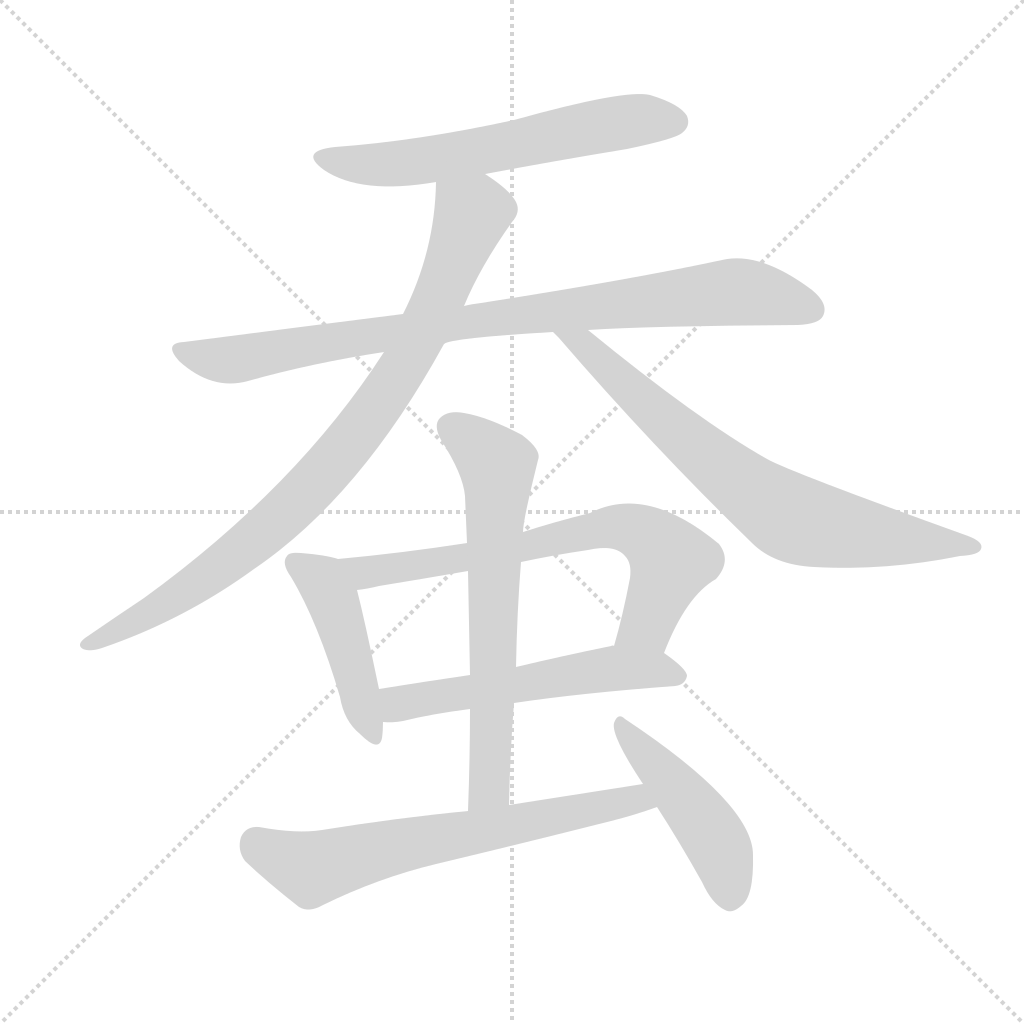
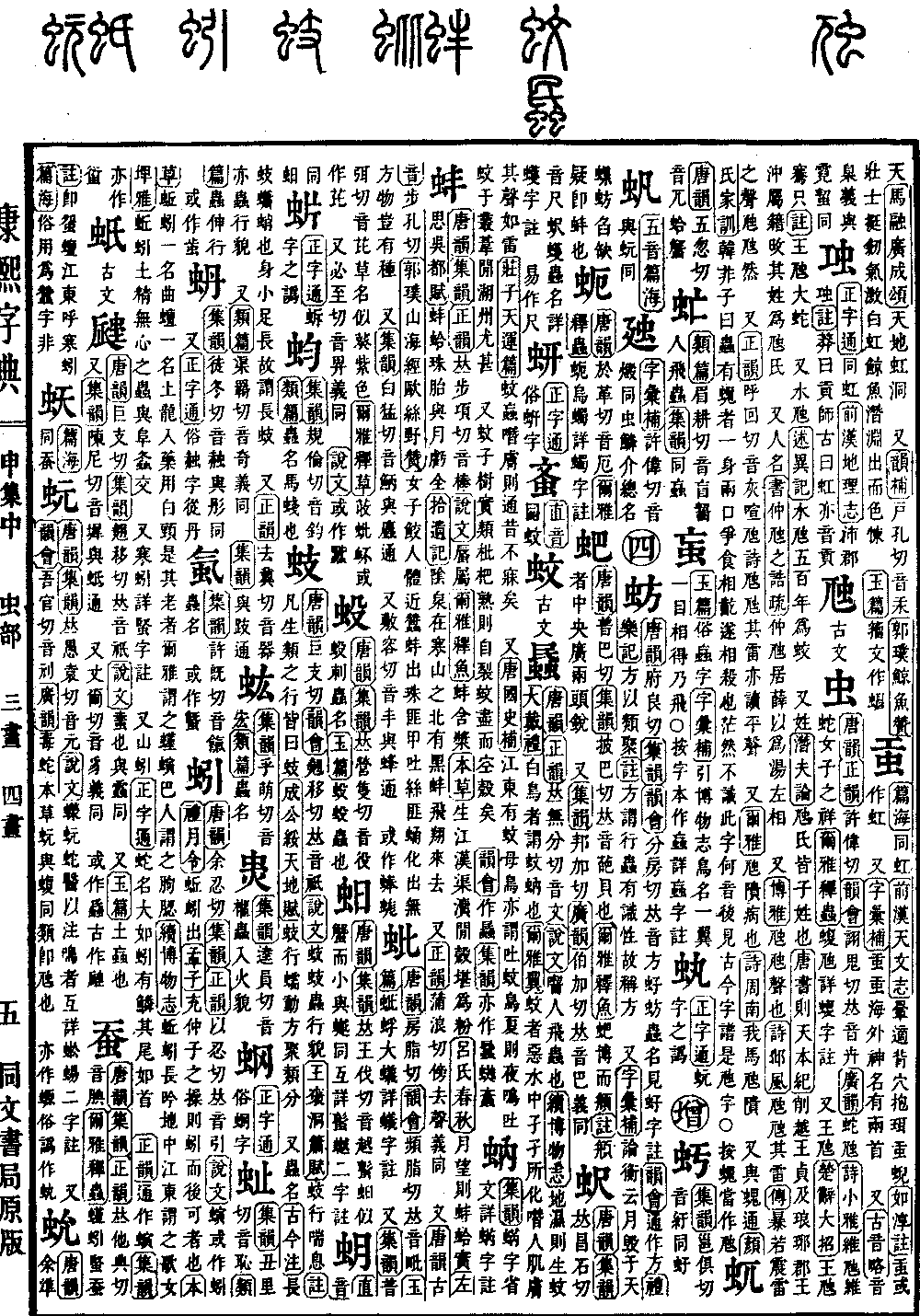
Shen Collection, Middle Volume. Radical: Insect (chóng). Kangxi Stroke Count: 24. Page 1077, Entry 38.
Pronounced tian (third tone). Book of Tang (Tangyun), Book of Rhymes (Jiyun), and Correct Rhymes (Zhengyun). According to Erh-ya: Explaining Insects (Erya: Shichong), it refers to an earthworm, also known as a cold worm. In the Collection of Characters (Pianhai), it is noted that this character is commonly used as a variant for silkworm, which is incorrect.
Silkworm. Pronounced can. A silk-producing insect. According to Explaining Graphs and Analyzing Characters (Shuowen), it is an insect that produces silk. In the Book of Odes: Odes of Pin (Shijing: Bin Feng), it is written, In the month of the silkworm, prune the mulberry trees. In the Book of Documents: Tribute of Yu (Shujing: Yugong), it is written, The mulberry soil is suitable for silkworms. In Huainanzi: Treatise on Astronomy (Huainanzi: Tianwen Xun), it is written, When the silkworm emits silk, the Shang-tuned string breaks. According to Records of Wide-Ranging Matters (Bowuzhi), the silkworm undergoes three molts; they are impregnated first and then mate, and those that do not mate also produce offspring. In Wings of the Erh-ya (Eryayi), it is stated: The appearance of the silkworm is such that its mouth is soft and resembles a horse, and its colors are mottled like a tiger. When they first hatch, it is called dusting; they are brushed with hair. The silkworms are still small and should not be exposed to dew. Mulberry leaves are kept in one’s clothing to warm them, and then they are shredded so the silkworms receive warmth, which eliminates various impurities. In Miscellaneous Morsels from Youyang (Youyang Zazu), it is noted that the silkworm is an insect that eats but does not drink.
Also the original silkworm. According to Biya, the silkworm that produces a second generation is called the original silkworm, also known as the Wei silkworm; nowadays it is raised using late-season leaves. Also the red silkworm. The silkworm moves its feet on the leaves, bowing three times and rising three times; after twenty-seven days, the silkworm is mature and becomes red, hence it is called the red silkworm. Also the wild silkworm. In History of the Later Han: Annals of Emperor Guangwu (Hou Hanshu: Guangwudi Ji), it is written, Wild silkworms formed cocoons, covering the hills and mounds. Also the flower silkworm. In Records of Strange Tales (Shuyiji), it is written that Yuan Ke planted five-colored fragrant herbs and fed them to flower silkworms, obtaining 120 cocoons, each as large as a jar. Also, according to Materia Medica (Bencao), stone silkworm, also known as the sand louse, is a tiny insect in the waters of the eastern stream. Also the snow silkworm, which lives in the Yin Mountains and Mount Emei; northerners call it the snow maggot. Also the gold silkworm, which curls like a finger ring and eats old red silk and brocade, just as a silkworm eats leaves. Also the silkworm chamber. In History of the Jin: Treatise on Rites (Jinshu: Lizhi), it is written, The Empress personally rode in a carriage to the silkworm chamber in the eastern suburbs garden to offer sacrifices to the silkworm deity. Also the silkworm deity. In Wings of the Erh-ya (Eryayi), it is stated that the silkworm deities are the Yuan Yu woman and the Princess Yu, totaling two deities. Also a person's name. In Records of Chengdu (Chengduji), it is mentioned that the Cancong clan were the rulers of Shu. Also a place name. In History of the Former Han: Treatise on Geography (Qian Hanshu: Dilizhi), it mentions Canling in the Shu Commandery. In Records of States (Guomingji), it is noted that there is a Silkworm Cliff in Zun County of Peng. Also silkworm cocoon, a plant name. According to Materia Medica (Bencao), it treats swelling.