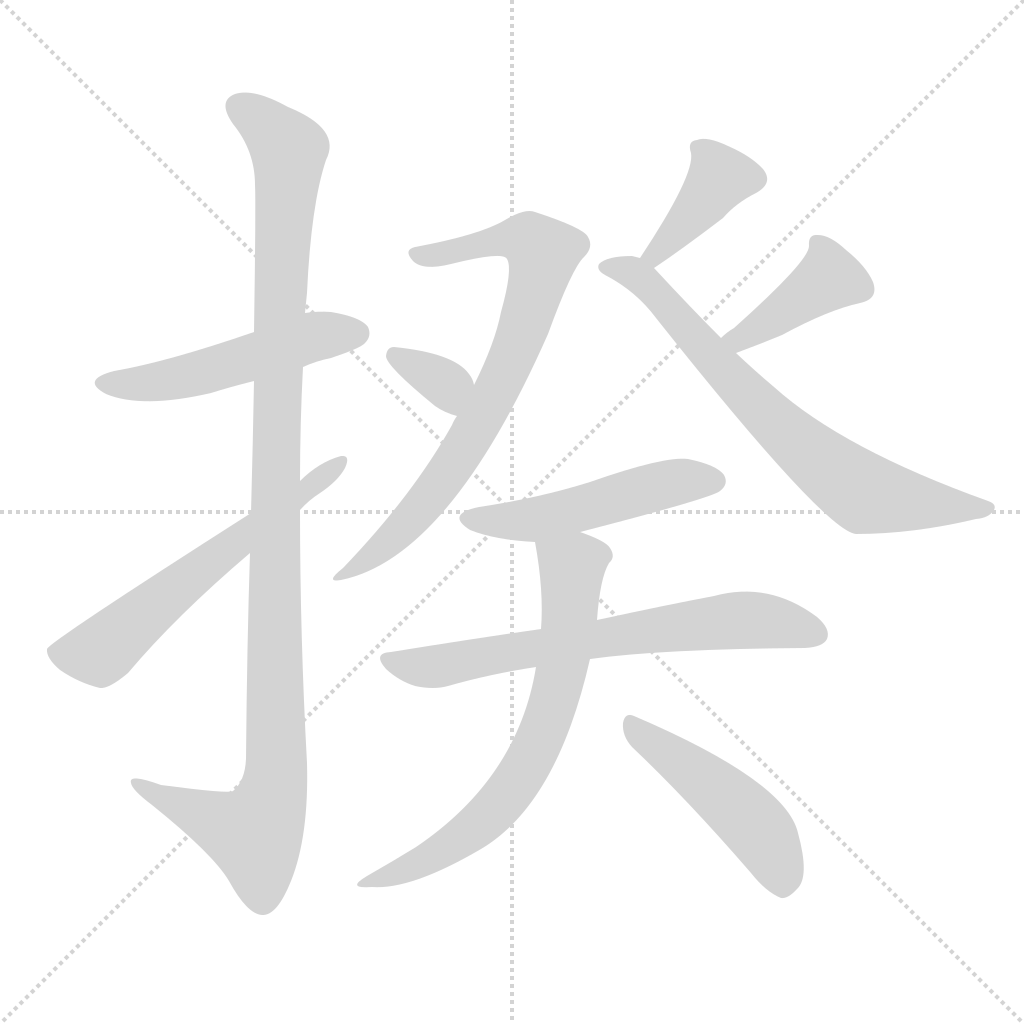
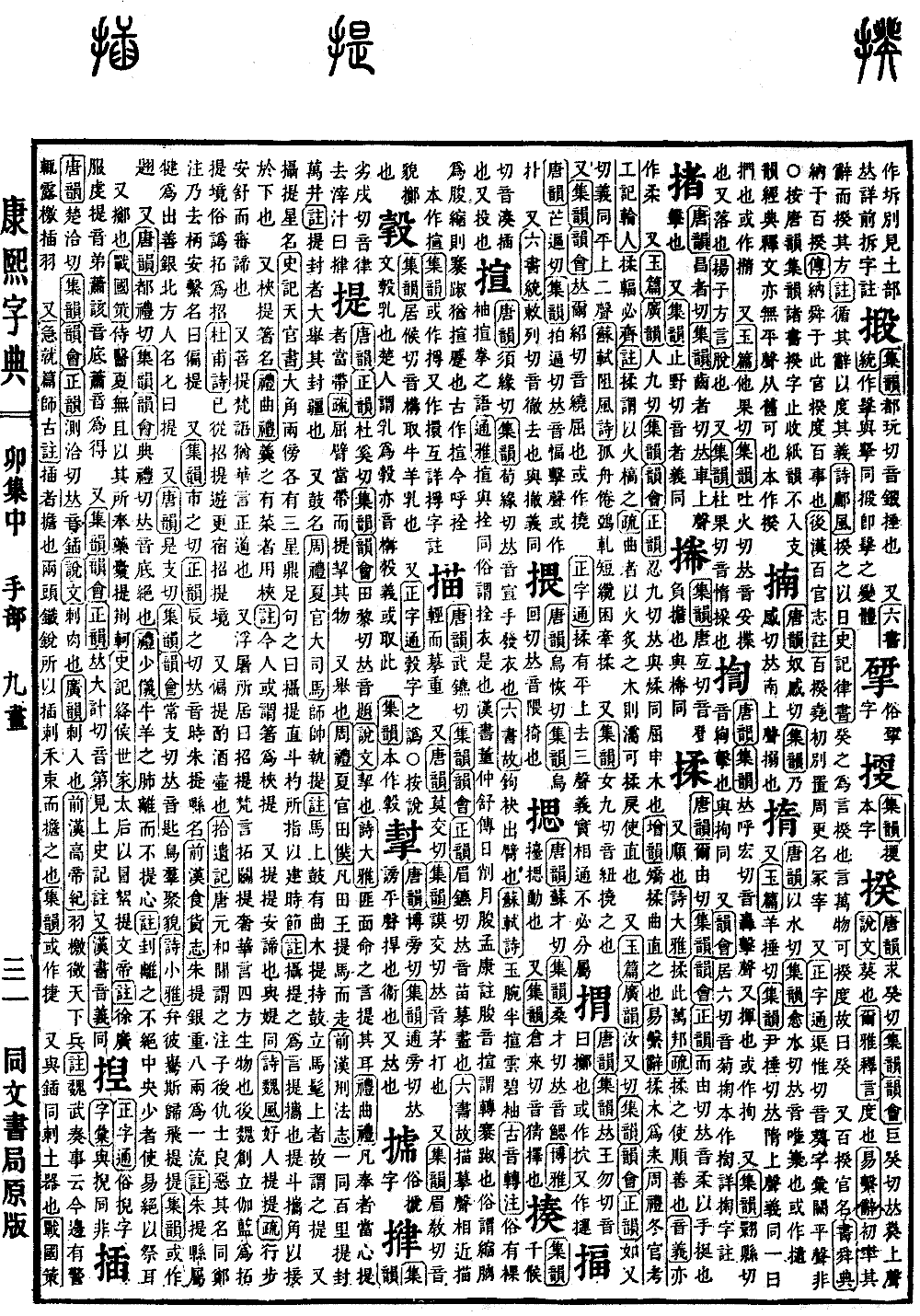
Mao Collection, Middle Volume. Radical: Hand (shǒu). Kangxi stroke count: 13. Page 441, Entry 04.
Pronounced kui (rising tone). According to Tang Rhymes (Tangyun), Collection Rhymes (Jiyun), and Rhyme Meeting (Yunhui), the pronunciation is kui (rising tone), similar to the rising tone of the character for mallow. According to Explanation of Script and Elucidation of Characters (Shuowen Jiezi), it means mallow. According to the Literary Interpretations in the Erya, it means to measure. In the Book of Changes (Yijing), Appendix: Remarks on the Trigrams, it says, First follow the words and measure their direction. The commentary states, Follow the words to measure their meaning. In the Book of Odes (Shijing), Odes of Yong, it says, Measure it by the sun. In the Records of the Grand Historian (Shiji), Treatise on the Pitch Pipes, it says, The term gui implies kui, meaning all things can be measured, therefore it is called gui. Also, the Hundred Kui is a title of an official. In the Book of Documents (Shujing), Canon of Shun, it says, Appointed to the Hundred Kui. The commentary states, Appointed Shun to this office to measure and manage all affairs. In the Commentary on the Records of Official Titles in the Later Han (Hou Hanshu), it is noted that the Hundred Kui was first established by Yao and renamed Prime Minister during the Zhou dynasty. Also, according to the Zhengzitong, it is pronounced kui. The Zihui omits the level tone, which is incorrect. Note: In the Tang Rhymes, Collection Rhymes, and various other books, the character kui is only categorized under the zhi rhyme and is not included in the zhi rhyme. The Classical Texts and Explanations (Jingdian Shiwen) also contains no entry for a level tone; it is appropriate to follow the established convention. It was originally written as the character variant.