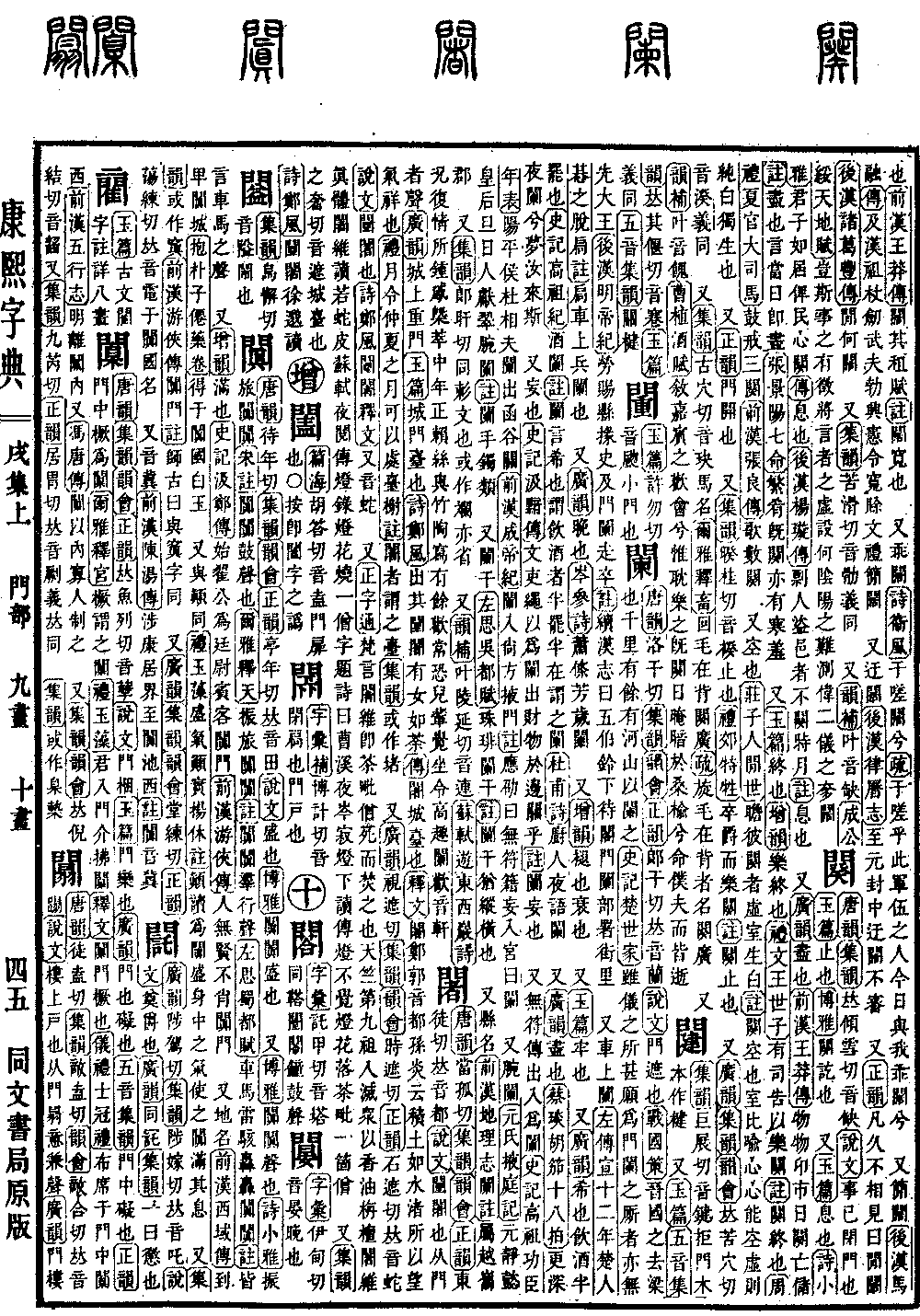
Xu Collection, Upper Volume
Radical: Gate (mén)
Kangxi stroke count: 17
Page 1339, Entry 06
Pronounced que.
Shuowen Jiezi (Explaining Simple and Analyzing Compound Characters): To close a door after affairs have concluded.
Yupian (Jade Chapters): To stop.
Guangya (Broad Refinement): Que means finished.
Also, Yupian: To cease or rest.
Book of Odes (Shijing), Lesser Odes of the Kingdom: If the gentleman dwells in peace, he can bring stability to the hearts of the people.
Commentary: To cease.
History of the Later Han (Hou Hanshu), Biography of Yang Xuan: Those who rob people and plunder cities will not cease for a time.
Note: To cease.
Also, Guangya (Broad Refinement): Exhausted or finished.
History of the Former Han (Hanshu), Biography of Wang Mang: Various goods rely on the market for supply, and are exhausted daily with no reserves.
Note: Exhausted, meaning to use up entirely within the day.
Zhang Jingyang, Seven Commands (Qi Ming): The abundant dishes have all been finished, with only some cold food remaining.
Also, Yupian: To terminate.
Zengyun (Additional Rhymes): To bring music to a conclusion.
Book of Rites (Liji), Hereditary Princes of King Wen: The official in charge reports that the musical performance has concluded.
Note: Que means to terminate.
Rites of Zhou (Zhouli), Summer Offices, Grand Minister of War: The drum is beaten three times to end the alert.
History of the Former Han (Hanshu), Biography of Zhang Liang: It was sung several times.
Also, emptiness.
Zhuangzi, In the World of Men: Observe that empty place; the empty room gives birth to pure white light.
Note: Que means empty. The heart-room is a metaphor for the inner mind; if the mind can be empty, then pure, brilliant light will arise of its own accord.
Also, Zheng Yun (Orthography Rhymes): A gate being opened.
Also, Jiyun (Collection of Rhymes): Pronounced kui. To stop.
Book of Rites (Liji), Suburban Sacrifice and the Sacrificial Animals: When the wine is finished, the music ceases.
Note: Que means to stop.
Also, Guangyun (Broad Rhymes), Jiyun, and Yunhui (Gathering of Rhymes): Pronounced xue. The meaning is the same.
Also, Jiyun: Pronounced jue. The name of a horse.
Erya (Approaching Elegance), Interpretation of Domestic Animals: A horse with hair swirling on its back is called queguang.
Commentary: A horse with swirling hair on its back is named queguang.
Also, Yunbu (Supplementary Rhymes): Rhymes as kui.
Cao Zhi, Ode to Wine (Jiufu): Narrating the joyous gathering of honored guests; yet, indulgence in pleasure has already ceased. The sun grows dim between the mulberry and elm trees; orders are given for all servants to depart.