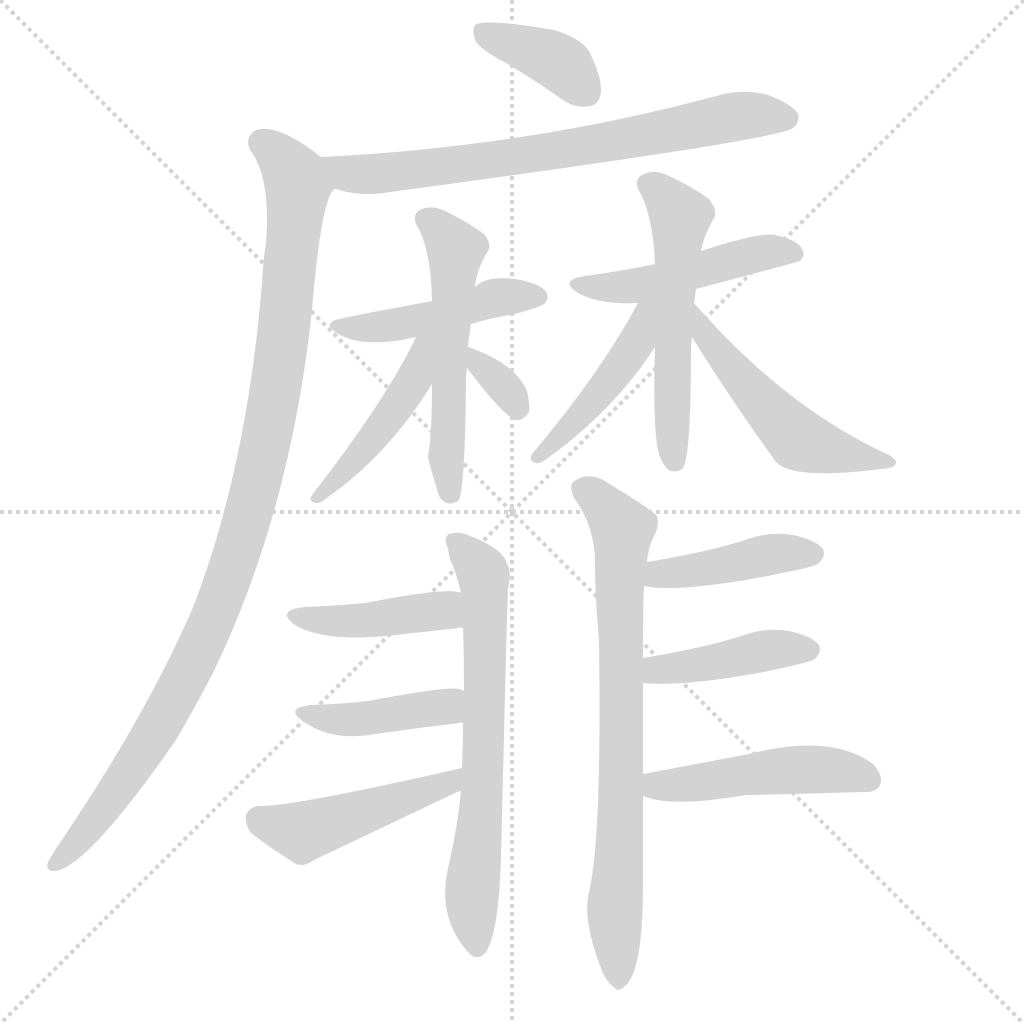
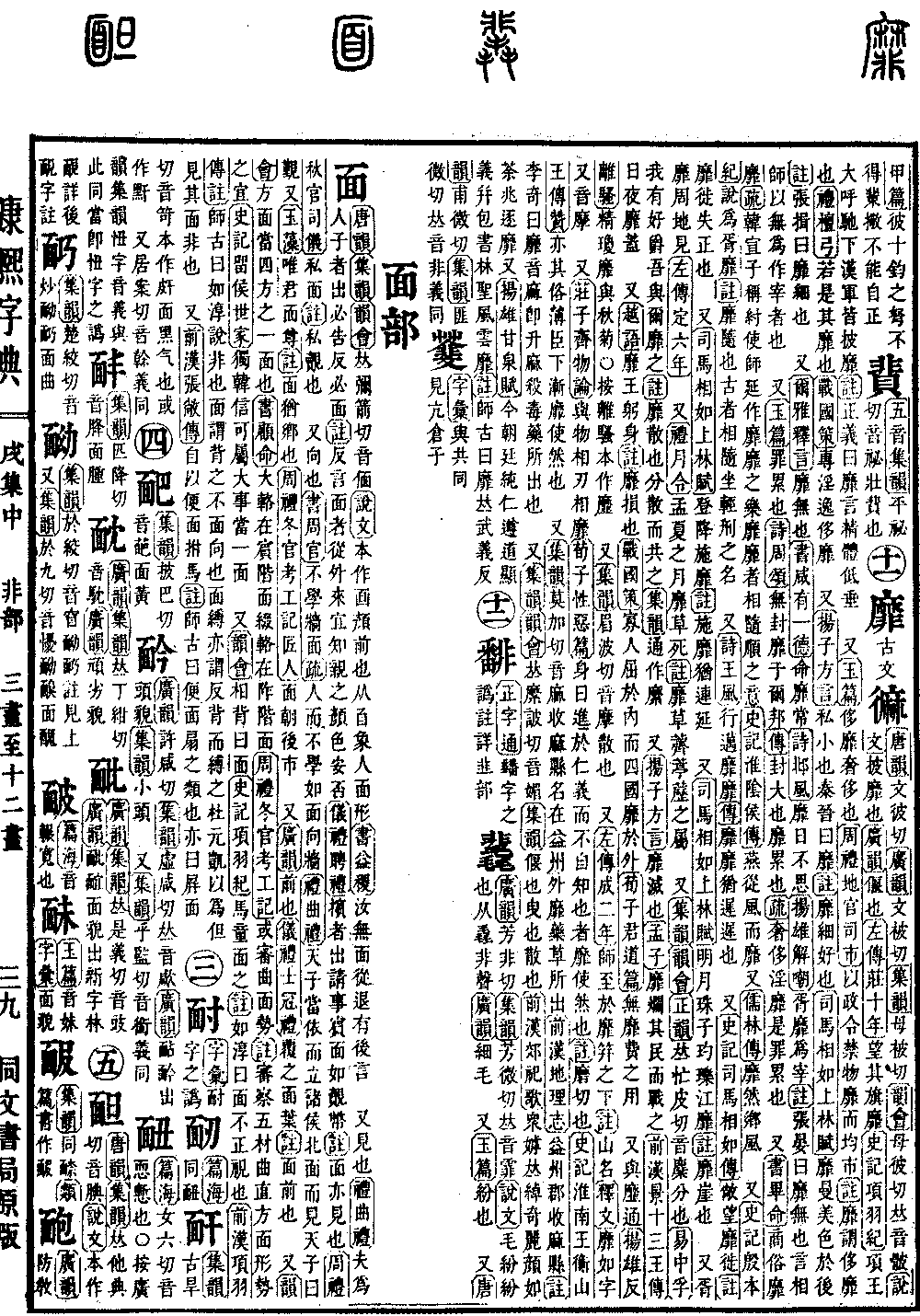
Xu Collection, Middle Volume. Radical: Non (fēi). Kangxi strokes: 19. Page 1383, Entry 02. Ancient form. Pronounced bi (rising tone). According to Explaining Graphs and Analysis of Characters (Shuowen Jiezi), it means to disperse or be scattered. According to General Dictionary of Sounds and Meanings (Guangyun), it means to bow or bend. In the Commentary of Zuo (Zuo Zhuan), Year 10 of Duke Zhuang, it is written: Looking at his flags bending. In Records of the Grand Historian (Shiji), Biography of Xiang Yu, it is written: The King of Xiang shouted loudly and charged down, and the Han army all scattered and fled. The commentary states: The meaning is that the spirit and body were drooping. Also, according to the Jade Chapters (Yupian), it refers to extravagance. In the Rites of Zhou (Zhouli), Earth Officials, Market Superintendents, it is written: Use government decrees to forbid extravagant goods and equalize the market. The commentary states: It refers to luxury. In the Book of Rites (Liji), Tan Gong, it is written: If it were that extravagant. In the Strategies of the Warring States (Zhanguoce), it is written: Specialize in lewdness, indulgence, and extravagance. Also, according to The Dialects (Fangyan) by Yang Xiong, it refers to small private matters; in the Qin and Jin regions, it is called mi. The commentary states: It means fine and good. In Sima Xiangru's Rhapsody on the Shanglin Park (Shanglin Fu), it is written: Fine, delicate, and beautiful colors follow behind. The commentary by Zhang Yi states: It means fine. Also, according to the Erya: Explaining Words (Erya), it means none. In the Book of Documents (Shujing), Imperishable Virtue, it is written: Order is not constant. In the Book of Odes (Shijing), Odes of Bei, it is written: There is not a day I do not think. In Yang Xiong's Disspelling Ridicule (Jiechao), it is written: Serving as a slave official. The commentary by Zhang Yan states: It means none. This means that if one takes nothing as the foundation, one becomes an official. Also, according to the Jade Chapters (Yupian), it refers to criminal burden. In the Book of Odes (Shijing), Odes of Zhou, it is written: Do not bring great burden to your state. The commentary states: Feng means great. Mi means burden. The sub-commentary states: Extravagance and lewdness are criminal burdens. Also, in the Book of Documents (Shujing), Completion of Orders, it is written: The customs of Shang are slack. The sub-commentary states: Han Xuanzi claimed that Zhou ordered Shi Yan to compose slack music. Mi-mi means following along compliantly. In Records of the Grand Historian (Shiji), Biography of the Marquis of Huaiyin, it is written: Yan followed the wind and bent. Also, in the Biography of Confucians, it is written: Bending like grass toward the wind. Also, in Records of the Grand Historian (Shiji), Annals of Yin, it is written: It was a slave official. The commentary states: Mi means to follow. In ancient times, those who were associated with prisoners or were punished lightly were called by this name. Also, in the Book of Odes (Shijing), Odes of Wang, it is written: Walking along slowly. The commentary states: Mi-mi means slow or delayed. Also, in Records of the Grand Historian (Shiji), Biography of Sima Xiangru, it is written: Looking about in confusion. The commentary states: Mi-xi means losing one's uprightness. Also, in Sima Xiangru's Rhapsody on the Shanglin Park (Shanglin Fu), it is written: Climbing and descending, extending continuously. The commentary states: Shi-mi means extending continuously. Also, in Sima Xiangru's Rhapsody on the Shanglin Park (Shanglin Fu), it is written: Bright moon pearls, gleaming at the river bank. The commentary states: Mi means bank. Also, Xu-mi is a place in the Zhou state; see the Commentary of Zuo (Zuo Zhuan), Year 6 of Duke Ding. Also, in the Book of Rites (Liji), Monthly Ordinances, it is written: In the month of early summer, the mi-grass dies. The commentary states: Mi-grass refers to shepherd's purse and similar plants.
Also, pronounced mi (rising tone). To divide. In the Classic of Changes (Yijing), Inner Faith, it is written: I have good wine, I share it with you. The commentary states: Mi means to disperse. To scatter and share. In the Collection of Rhymes (Jiyun), it is also written as a variant form (mi). Also, according to The Dialects (Fangyan) by Yang Xiong, it means to destroy. In Mencius, it is written: Destroying their people to fight. In the History of the Former Han (Qian Hanshu), Biography of the Thirteen Kings of Jing, it is written: Day and night it is exhausted. Also, in the Discourses of Yue (Yueyu), it is written: Do not ruin the king's body. The commentary states: Mi means to damage. In the Strategies of the Warring States (Zhanguoce), it is written: I am exhausted within, and the four states are exhausted without. In the Xunzi, Chapter on the Way of the Ruler, it is written: No wasteful expenses. It is also used interchangeably with another character. In Yang Xiong's Anti-Li Sao, it is written: Pure jade and autumn chrysanthemums. Note: In the Li Sao, it is written with another character originally. Also, according to the Collection of Rhymes (Jiyun), pronounced mo. To disperse. Also, in the Commentary of Zuo (Zuo Zhuan), Year 2 of Duke Cheng, it is written: The army arrived at the foot of the Mi-ji mountain. The commentary states: A mountain name. The explanation of sounds states: Mi is read as written, and also pronounced mo. Also, in the Zhuangzi, Discourse on Making All Things Equal, it is written: To sharpen and wear down against things. In the Xunzi, Chapter on the Evil Nature, it is written: One's body advances toward benevolence and righteousness daily without realizing it; this is brought about by imperceptible influence. The commentary states: Mo means to rub or cut. Also, in the praise of the Biography of the Kings of Huainan and Hengshan in the Records of the Grand Historian (Shiji), it is written: It is also because their customs are thin and the subjects are influenced by gradual corruption. Also, according to the Collection of Rhymes (Jiyun), pronounced ma. Shou-ma is a county name in Yizhou, where the medicine herb outer-mi is produced. In the History of the Former Han (Qian Hanshu), Treatise on Geography, it is written: Shou-ma County in Yizhou Commandery. The commentary by Li Qi states: Mi is pronounced ma, which is the same as black hellebore, from which toxic medicinal substances are produced. Also, according to the Collection of Rhymes (Jiyun) and the Rhyme Compilation (Yunhui), pronounced mei. According to the Collection of Rhymes (Jiyun), it means to bow, to drag, or to disperse. In the History of the Former Han (Qian Hanshu), Songs for the Suburban Sacrifices, it is written: The crowd of beautiful women are graceful and extraordinary, their faces like flowering rushes following the wind. Also, in Yang Xiong's Rhapsody on the Ganquan Palace (Ganquan Fu), it is written: Now the imperial court is purely benevolent, following the way and manifesting righteousness, embracing the forest of books, and the sacred wind spreads everywhere. The commentary by Yan Shigu states: Mi is pronounced with the initial sound of wu and the final sound of yi. Correction: In the History of the Former Han, Biography of the Thirteen Kings of Jing, the original text says "mi-gai," which should be corrected to "mi" according to the original source.