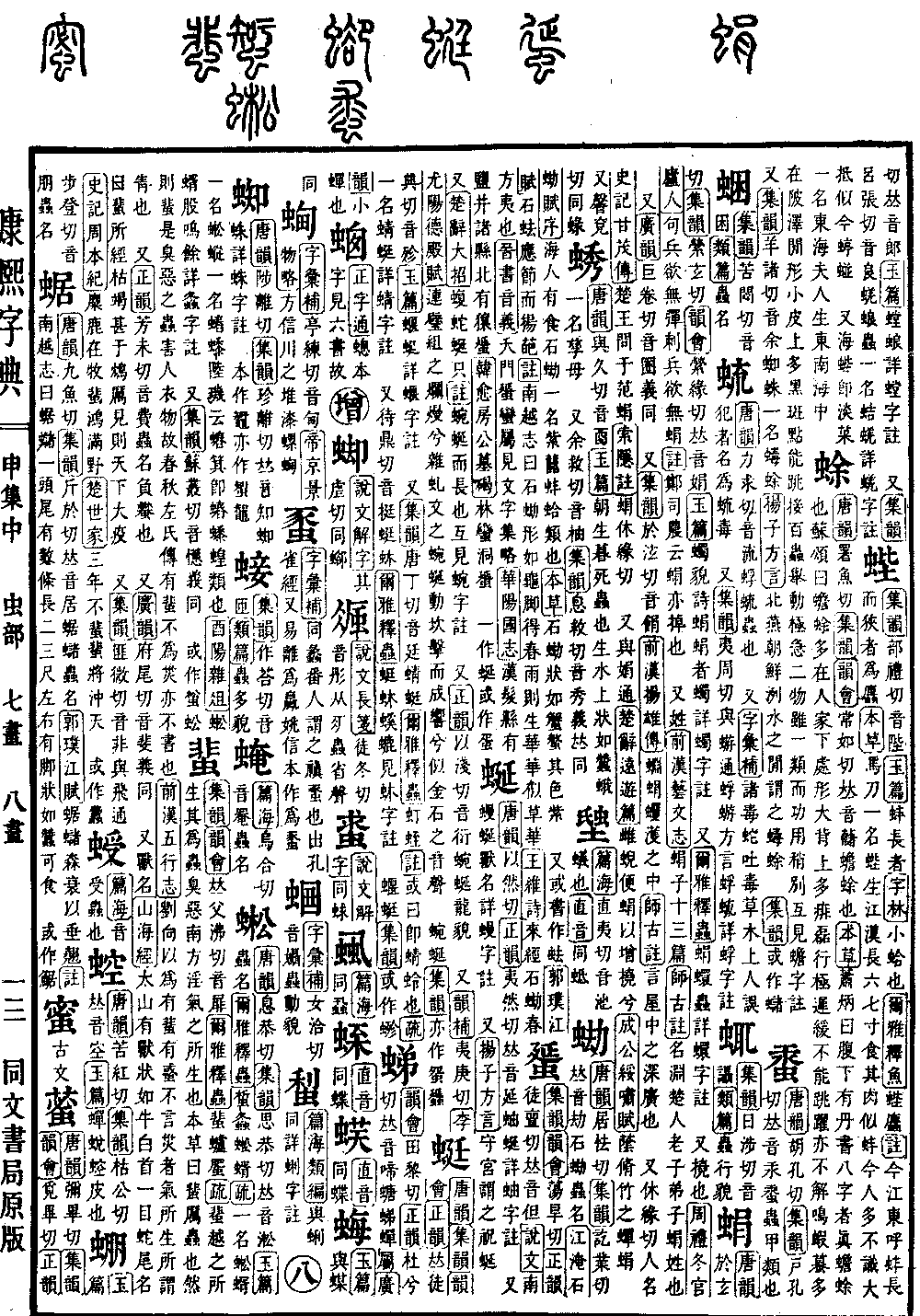
Shen Collection, Middle Volume. Radical: Insect (chóng). Kangxi strokes: 14. Page 1085, Entry 31.
Rhyme Dictionary of Sounds (Jiyun) and Collection of Rhymes (Yunhui) state it is pronounced fei (falling-rising tone).
Erya: Explanation of Insects (Erya - Shichong) states: The fei is the lufei. The commentary states: The fei is an insect native to the Yue region. This insect has a foul, repulsive odor and is born from the hot, humid vapors of the south. The Materia Medica (Bencao) states: The fei is a poisonous insect. Thus, the fei is a foul-smelling insect that damages human clothing. Therefore, the Spring and Autumn Annals of Zuo (Zuo Zhuan) records that when fei insects appeared without causing a disaster, they were not officially documented.
History of the Former Han: Treatise on the Five Elements (Qianhan - Wuxingzhi) notes that Liu Xiang believed the appearance of fei insects was not considered a disaster because they are generated by elemental vapors, which refers to this specific case.
Also, Standard Rhymes (Zhengyun) states it is pronounced fei (falling tone). It is the name of an insect, also known as the fusan.
Also, Extended Rhymes (Guangyun) states it is pronounced fei (rising tone). The meaning is the same.
Also, it is the name of a beast. The Classic of Mountains and Seas (Shanhaijing) states: On Mount Tai there is a beast shaped like an ox with a white head, a single eye, and a serpent tail; its name is fei. Wherever it passes, the vegetation withers; its toxicity is more potent than the zhen bird, and when it appears, a great plague will strike the world.
Also, Jiyun states it is pronounced fei. It is interchangeable with fei (to fly). Records of the Grand Historian: Annals of Zhou (Shiji - Zhoubenji) mentions elk in the pastures and fei-hong (flying geese/birds) filling the plains. In the House of Chu (Chu Shijia) it is written: It does not fly for three years, but once it flies, it will soar to the heavens. Some editions write this as fei (fly).