Mao Collection, Middle Volume
Radical: Hand (shǒu)
Kangxi Strokes: 12
Page 437, Entry 13
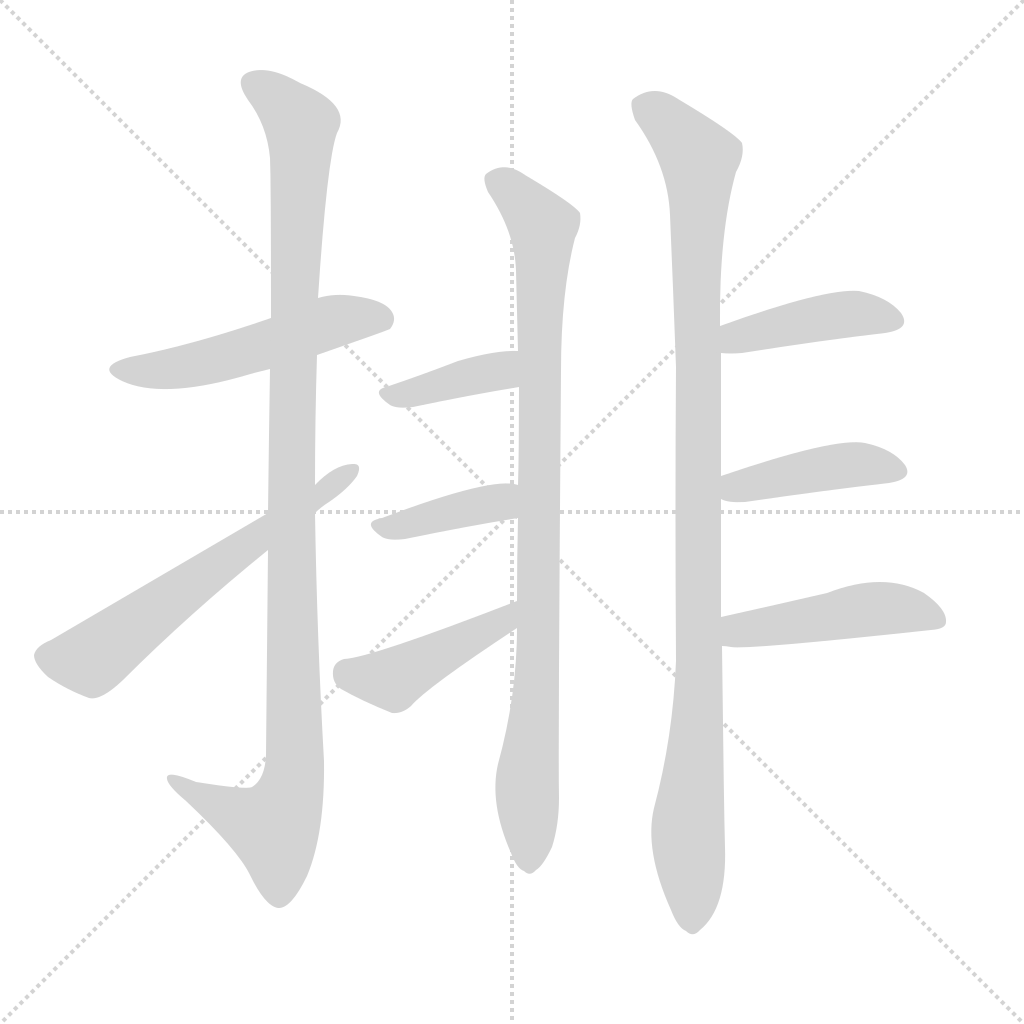
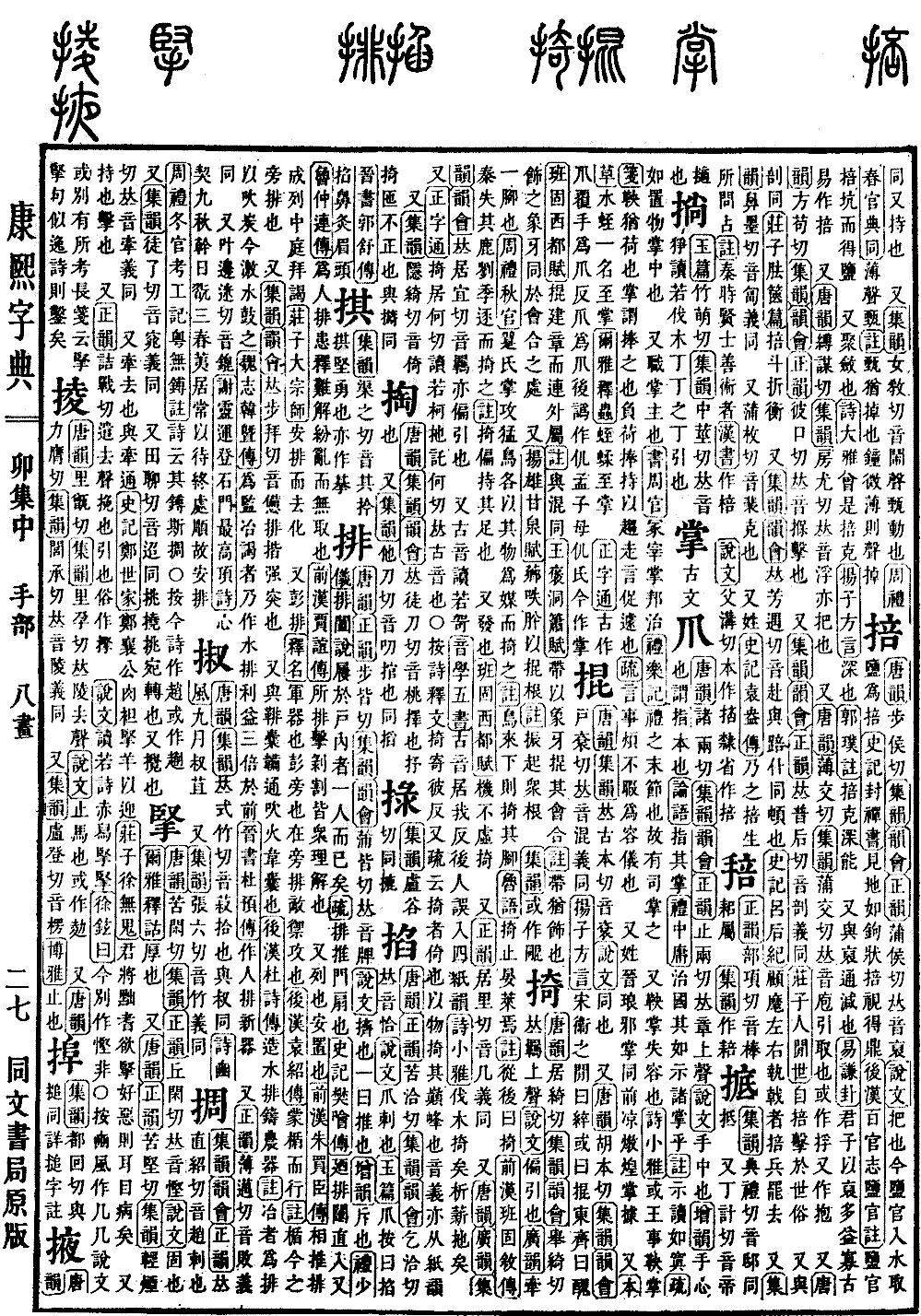
Pronounced pai. Pronounced pai. The pronunciation is the same as the character for a plaque.
Shuowen Jiezi (Explaining Simple and Analyzing Compound Characters): The meaning is to push or crowd. Another interpretation is simply to push.
Zengyun (Additional Rhymes): The meaning is to reject or exclude.
Book of Rites (Liji), Section on Minor Rituals: Pushing open the inner door of a room and removing one's shoes inside is a task meant for only one person.
Commentary: To push is to push open the door panel.
Records of the Grand Historian (Shiji), Biography of Fan Kuai: Thereupon, he pushed open the door and entered directly.
Records of the Grand Historian (Shiji), Biography of Lu Zhonglian: To push away the worries of others, eliminate their dangers, resolve their disputes and chaos, and yet seek no reward.
Book of Han (Hanshu), Biography of Jia Yi: That which is pushed away, criticized, and analyzed are all principles that the masses are able to comprehend.
Also refers to arranging or setting in place.
Book of Han (Hanshu), Biography of Zhu Maichen: Mutually yielding and arranging themselves into a row to kneel and pay respects in the courtyard.
Zhuangzi, Section on The Great and Venerable Teacher: To be at peace with the arrangements of nature and to adapt to changes.
Also includes pengpai. A type of weapon.
Shiming (Explaining Names): Peng means to be at the side. It is a device kept at the side to resist the enemy's attack.
Book of the Later Han (Houhanshu), Biography of Yuan Shao: Advancing while holding up a shield.
Annotation: A shield is what is known today as a side-pai.
Also pronounced bei. Paikai, meaning to forcefully collide or crash into.
Also used interchangeably with nangbei. Refers to a leather bag used to blow air into a fire.
Book of the Later Han (Houhanshu), Biography of Du Shi: Constructed water-powered bellows to cast agricultural tools.
Annotation: Those who smelt metal create bellows to blow air onto the charcoal fire, using water power to activate the mechanism to generate a blast of air.
Records of the Three Kingdoms (Weizhi), Biography of Han Ji: Served as the official overseeing smelting, and consequently created water-powered bellows, obtaining three times the previous efficiency.
Book of Jin (Jinshu), Biography of Du Yu: Created human-powered bellows and new implements.
Also pronounced bai. The meaning is the same.
Also rhymes with bi.
Xie Lingyun, Poem on Ascending the Highest Peak of Mount Shimen: My heart is in accord with the trunks of the trees of the ninth month; daily I admire the tender grasses of early spring. Living in peace while awaiting the end of life, I am content in favorable circumstances and thus able to submit to natural arrangements.
Textual Research: Also includes pengpai. Shiming: A type of weapon. Peng means to be at the side, used at the side to push back the enemy and resist their attack.
Note: The phrase "a military weapon" is not in the original text of Shiming. It is hereby corrected to: Also includes pengpai. A type of weapon. Shiming: Peng means to be at the side, used at the side to push back the enemy and resist their attack.
Book of the Later Han (Houhanshu), Biography of Du Shi: Annotation: Those who smelt metal create bellows to blow air onto the charcoal; water power is used to activate the mechanism to generate a blast of air.
Note: Following the original text, the character for now has been corrected to the character for cause/order.