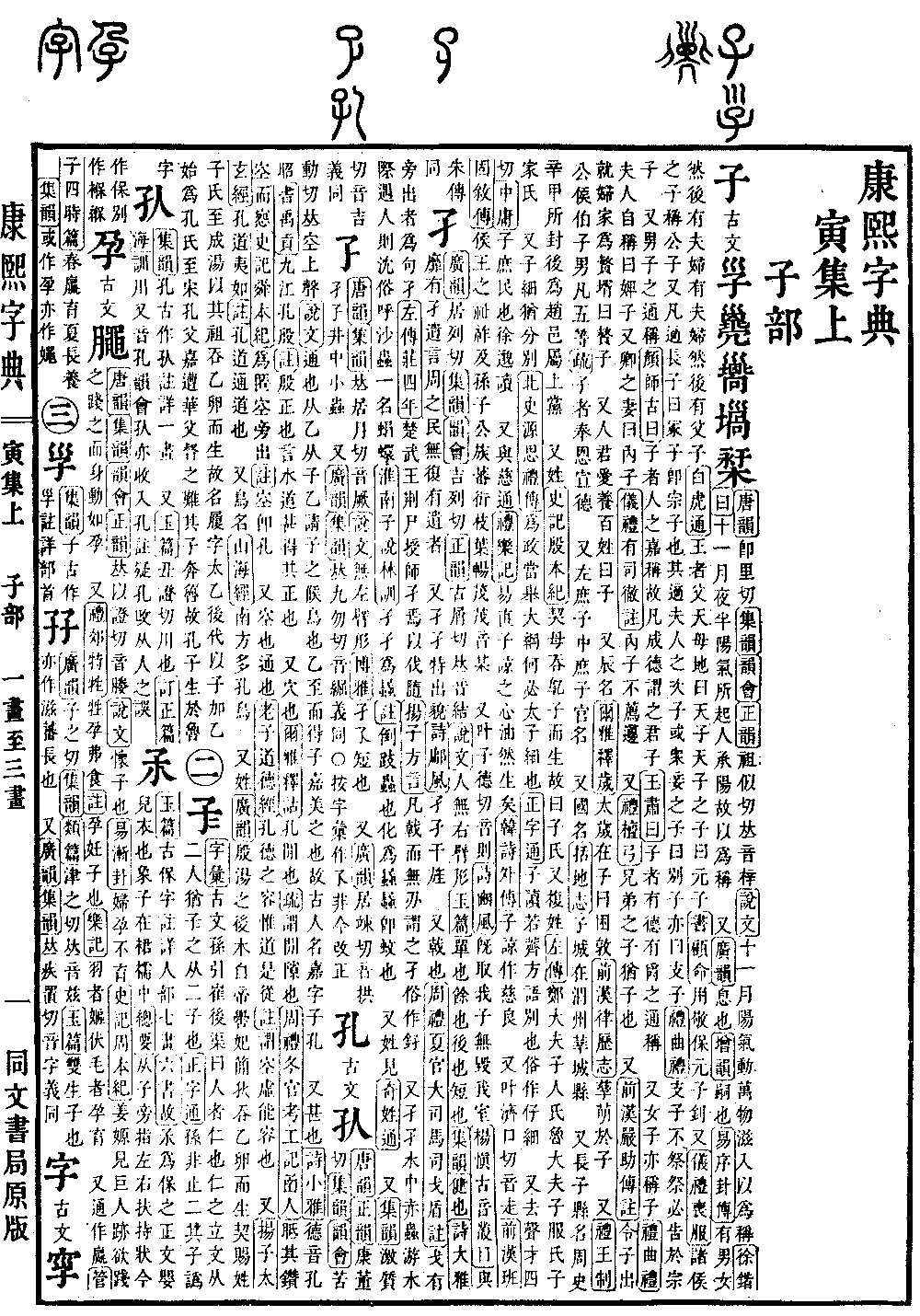
Yin Collection, Upper Volume
Radical: Child (zǐ)
Kangxi stroke count: 3
Page 277, Entry 01
Ancient form. Pronounced zǐ (rising tone). According to the Shuowen Jiezi, in the eleventh month, the solar energy stirs, and all things begin to grow, hence it is used as a designation. Xu Kai stated: At midnight in the eleventh month, the solar energy begins to rise. Humans inherit this solar energy, and thus it is used as a term of address.
Also, meaning to cease or rest. Meaning successor or heir. From the Book of Changes (Yijing), Order of the Hexagrams: There are men and women, then there are husbands and wives. There are husbands and wives, then there are fathers and sons. According to the Comprehensive Discussions in the White Tiger Hall (Baihu Tong), a king who takes Heaven as father and Earth as mother is called the Son of Heaven. The son of the Son of Heaven is called the original son. In the Book of Documents (Shujing), Testimonial Charge (Guming): Use reverence to protect the original son Zhao.
Also, in the Book of Etiquette and Ceremonial (Yili), Mourning Rites, the sons of feudal lords are called the sons of a noble (gongzi).
Also, a firstborn son born to a legal wife is called the eldest son (zhongzi), who is the clan leader (zongzi). A secondary son born to a legal wife, or a son born to a concubine, is called a branch son (biezi), also known as a collateral son (zhizi). In the Book of Rites (Liji), Tradition of Rites (Quli): A branch son does not perform the ancestral rites; if he does perform them, he must report to the clan leader.
Also, a general term for a man. Yan Shigu stated: The term is a laudatory title for a person, so anyone with virtue is called a superior man (junzi). Wang Su stated: The term is a general title for people with virtue and rank.
Also, from the rank of noble concubine (shifu) downward, one refers to oneself as a servant (bizi), see Book of Rites (Liji), Tradition of Rites (Quli).
Also, the wife of a high official is called the inner person (neizi). In the Book of Etiquette and Ceremonial (Yili), commentary on the You-si Che: The inner person does not present the bamboo baskets of offerings.
Also, in the Book of Rites (Liji), Tan Gong: A brother's son is treated as one's own son.
Also, in the commentary on the Biography of Yan Zhu in the History of the Former Han (Qian Han Shu): Allowing a son to become a son-in-law living in the wife's family is called a dependent son (zhuizi).
Also, a ruler who loves and nurtures the common people is called a son.
Also, a name for a zodiac sign. In the Erya, Explaining Heaven (Shitian): When the Grand Duke (Jupiter) is in the zodiacal position of zi, it is called Kundun. In the History of the Former Han (Qian Han Shu), Treatise on Harmonics and Calendars: Growth begins at zi.
Also, in the Book of Rites (Liji), Royal Regulations: Duke, Marquis, Earl, Viscount, and Baron constitute the five ranks. The commentary states: The term viscount (zi) implies the meaning of practicing grace and promoting moral transformation.
Also, Zuo Shuzi and Zhong Shuzi are titles for government officials.
Also, a name of a state. According to the Comprehensive Geography (Kuodiji), Zicheng was located in Xin County, Wei Prefecture.
Also, Zhangzi is the name of a county. It was the fief of the Zhou dynasty historian Xin Jia, later becoming a city of the Zhao state, belonging to Shangdang Commandery.
Also, a surname. In the Records of the Grand Historian (Shiji), Annals of Yin: Xie was born after his mother swallowed a dark bird's egg, so he took Zi as his surname.
Also, compound surnames. In the Zuo Tradition (Zuo Zhuan), the Zheng state had a high official of the Ziren clan, and the Lu state had high officials of the Zifu clan and the Zijia clan.
Also, zixi, meaning separate or careful. In the History of the Northern Dynasties (Bei Shi), Biography of Yuan Sili: In handling official business, one should grasp the major aspects; why be so detailed? According to the Zhengzitong: Zi is read as ji, which in local dialect means to differentiate. It is commonly written as zixi (careful).
Also, read in the departing tone. Used in the Doctrine of the Mean (Zhongyong) to mean the common people. Xu Miao read it this way.
Also, interchangeable with the term for benevolent. In the Book of Rites (Liji), Record of Music: A mind of ease, uprightness, benevolence, and sincerity arises naturally. In the Han Garden of Anecdotes (Han Shi Waizhuan), the term ziliang is written as ciliang (benevolent and honest).
Also, rhyming with the reading ji, sounded as zou. In the History of the Former Han (Qian Han Shu), Narratives of Ban Gu: The blessings of the princes and kings extend to their descendants; the ducal clan multiplies, its branches and leaves flourishing.
Also, rhyming with the reading de, sounded as ze. In the Book of Odes (Shijing), Binfeng: You have already seized my fledgling, do not destroy my nest. According to Yang Shen’s Gu Yin Cong Mu, this matches the commentary by Zhu Xi.
Textual Research: A daughter is also called a son. In the Book of Rites (Liji), Tradition of Rites (Quli): A high official's wife refers to herself as a servant (bizi). Note: Referring to oneself as a servant is used by a noble concubine (shifu) and those below her, not a high official's wife. A high official's wife refers to herself as a young attendant, not a servant. Based on this, it has been corrected to: From noble concubine downward, one refers to oneself as a servant, see Book of Rites (Liji), Tradition of Rites. In the Erya, Explaining the Years (Shisui): When the Grand Duke is in the zodiacal position of zi, it is called Kundun. Note: According to the original book, Explaining the Years has been corrected to Explaining Heaven.