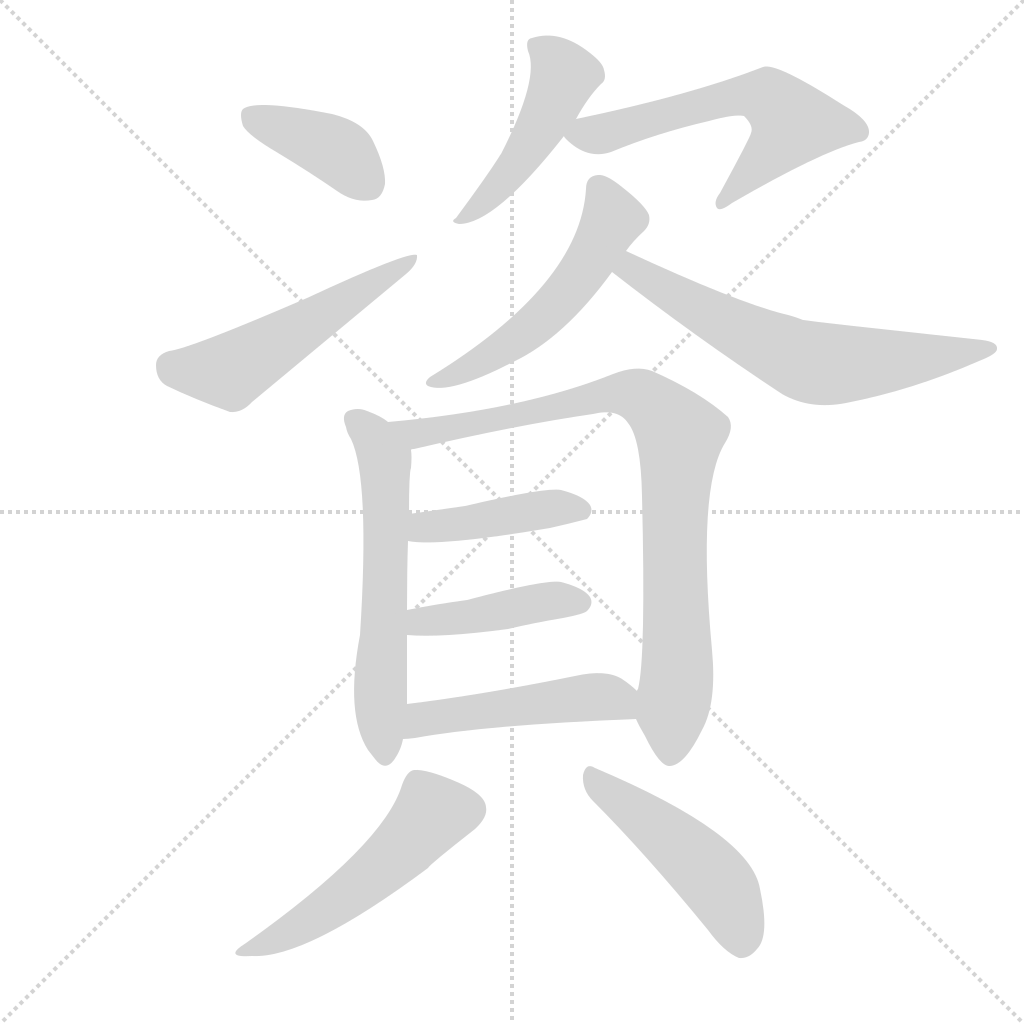
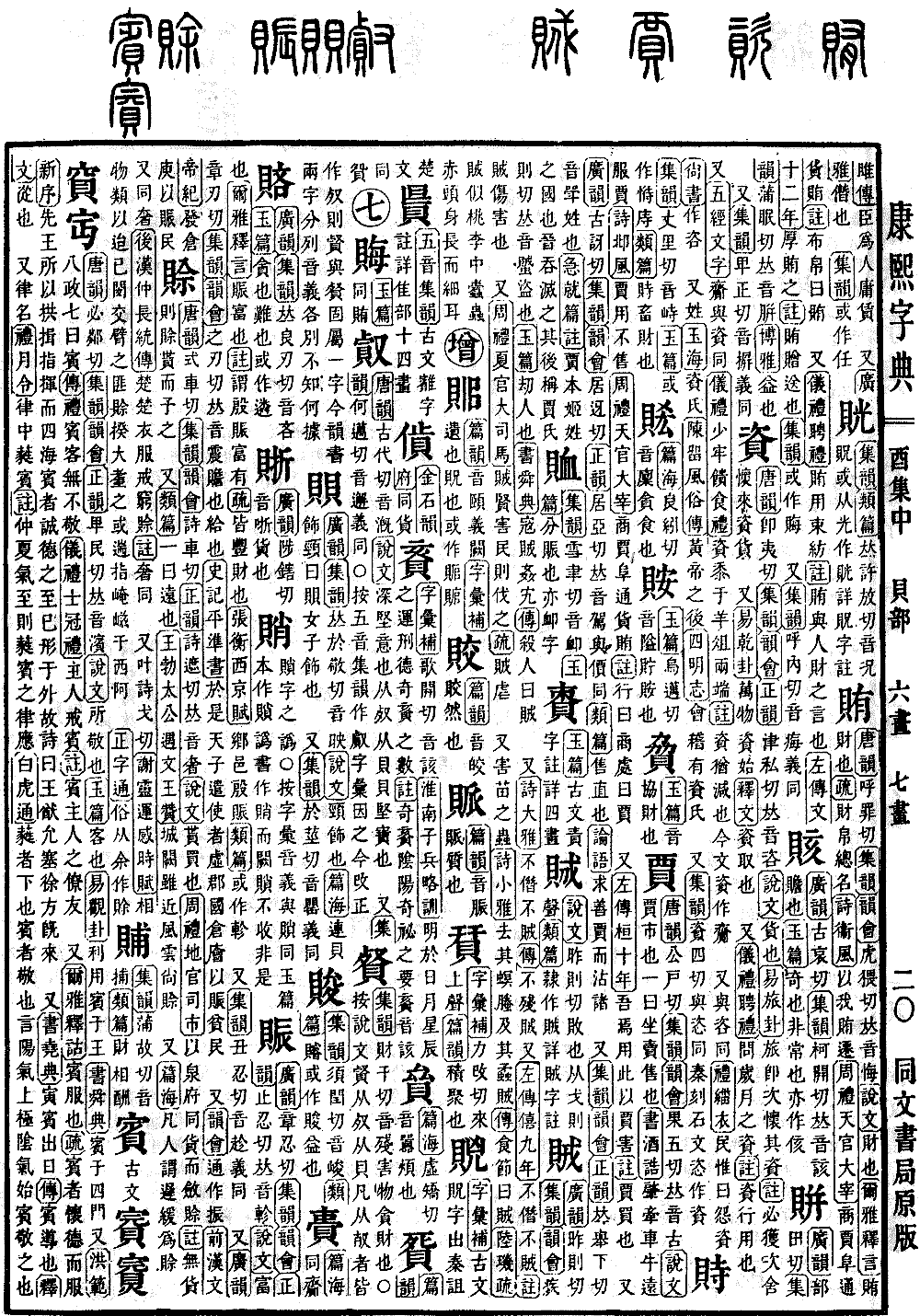
You Collection, Middle Volume
Radical: Cowrie (bèi)
Zi; Kangxi strokes: 13; Page 1208, Entry 05
Tang Rhyme (Tangyun): Pronounced zi. Collected Rhymes (Jiyun), Rhyme Meetings (Yunhui), and Orthodox Rhymes (Zhengyun): Pronounced zi.
Shuowen Jiezi: Goods.
Book of Changes (Yijing), Travel Hexagram: To travel is to find a place to stay, carrying one's assets. Commentary: One must obtain lodging and carry assets and goods.
Also, Book of Changes (Yijing), Creative Hexagram: All things derive their beginning from it. Explanation of Texts (Shiwen): Zi means to take or derive.
Also, Book of Etiquette and Ceremonial (Yili), Engagement Rites: To inquire about the assets for the years and months. Commentary: Zi means things used for travel.
Also, Five Classics Characters (Wujing Wenzi): The character ji is the same as zi.
Book of Etiquette and Ceremonial (Yili), Shaolao Offering Ritual: Distribute millet on both ends of the mutton tray. Commentary: Zi means the same as to reduce. In the modern text, zi is written as ji.
Also, same as zi (to sigh).
Book of Rites (Liji), Black Robes (Ziyi): The people only speak of their grievances. In the Book of Documents (Shangshu), it is written as zi.
Also, a surname. Jade Ocean (Yuhai): The Zi family.
Liu, Customs Traditions (Fengsu Tong): Descendants of the Yellow Emperor.
Four Brightness Records (Siming Zhi): There is a Zi family in Kuaiji.
Also, Collected Rhymes (Jiyun): Pronounced zi. Same as zi (to be unrestrained). In the stone inscriptions of the Qin dynasty, the character for unrestrained is written as zi.