Xu Collection, Middle Volume
Radical: Short-tailed bird (zhuī)
Kangxi Strokes: 13
Page 1365, Entry 24
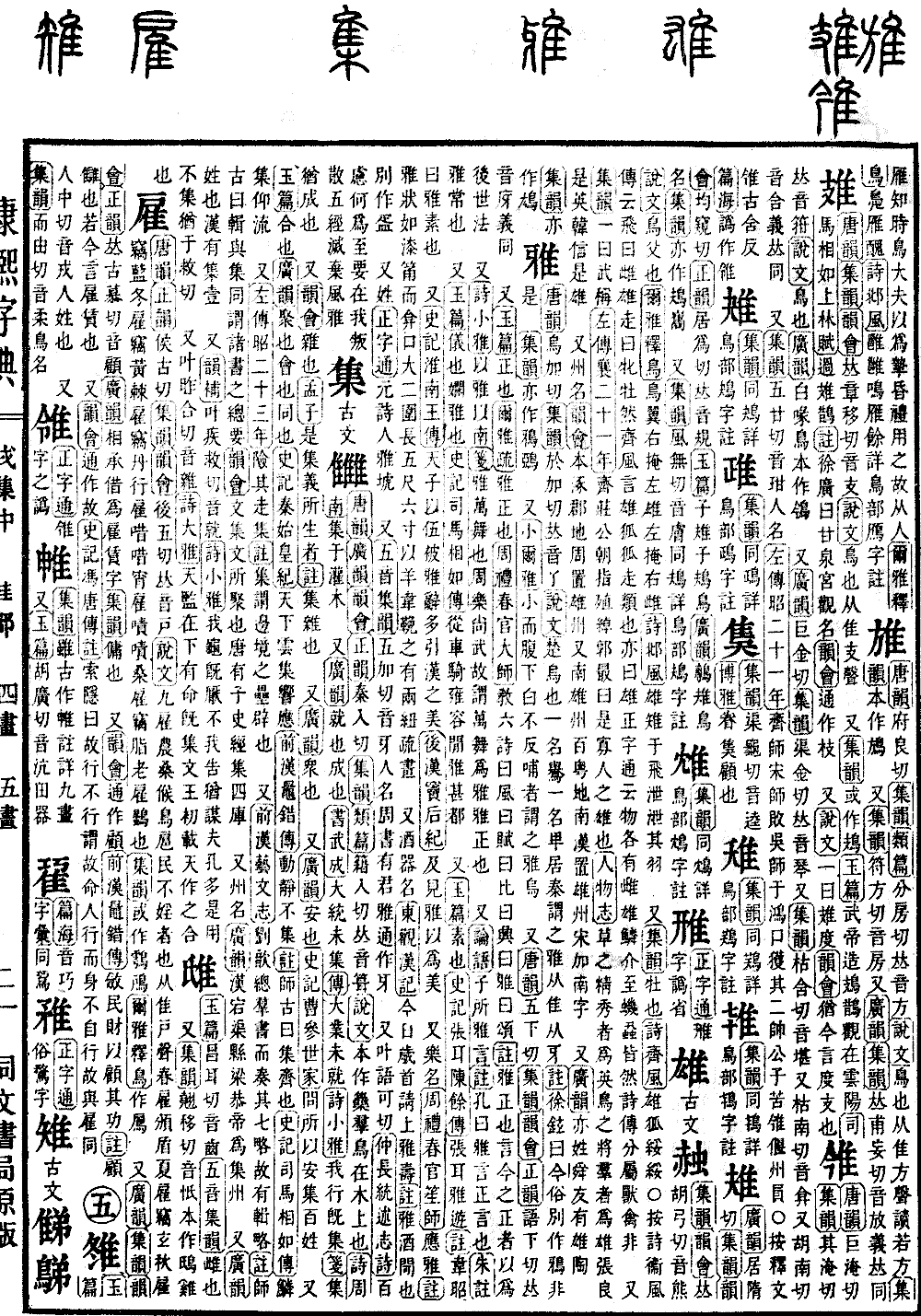
Ancient script. Pronounced zhi (falling tone). Pronounced zhi (falling tone). According to the Shuowen Jiezi, there are fourteen species of pheasants. According to the Erya (Glossary of Birds), there are the yao pheasant, jiao pheasant, bu pheasant, bi pheasant, and the zhi-zhi sea pheasant, di mountain pheasant, han pheasant, and zhuo pheasant. The pheasant has exceptional strength and flutters its wings. South of the Yi and Luo rivers, a white-bodied pheasant with five-colored, well-patterned plumage is called a hui. South of the Yangtze and Huai rivers, a blue-bodied pheasant with five-colored, well-patterned plumage is called a yao. In the south, it is called [untranslated variant], in the east it is called zhi, in the north it is called xi, and in the west it is called zun. The commentary explains the distinctions between the names of various pheasants. In the Book of Changes (Yijing), the Li trigram symbolizes the pheasant. In the Rites of Zhou (Zhouli), under the Offices of Spring, it is noted that among the six types of gifts for social audiences, the scholar uses a pheasant. In the Gongyang Commentary (Gongyang Zhuan), it is said that the pheasant was regarded lightly. Also, the Erya (Glossary of Birds) notes that the duo-jiu is a pheasant; the commentary explains that the pheasant is also known as the duo-jiu. Furthermore, in the Yanzi Chunqiu, the states of Zou and Teng are described as fleeing their lands like pheasants, yet styling themselves as dukes and marquises. In the Discourses of Jin (Jinyu), it is recorded that someone hanged themselves in the ancestral temple of Xincheng; the commentary explains that the term zhi-jing refers to hanging oneself by the neck until death. Additionally, in the Rites of Zhou (Zhouli), under the Records of Tradesmen, it is written that the regulation for the roof ridge of the royal palace is five zhi, the corner of the palace wall is seven zhi, and the corner of the city wall is nine zhi; the commentary notes that a zhi measures thirty feet in length and ten feet in height. In the Zuo Commentary (Zuo Zhuan), it is recorded that the walls of the capital city exceeded one hundred zhi; the commentary states that a square of ten feet is called a du, and three du make a zhi. A wall of one zhi is thirty feet long and ten feet high. A marquess or earl’s city had a perimeter of five li, with a diameter of three hundred zhi, which is why their great cities did not exceed one hundred zhi. In the Guanzi, it is written that the state should levy taxes on towers, pavilions, and city walls. Also, in the Spring and Autumn Annals (Chunqiu), under the second year of Duke Ding, it is noted that the Zhi Gate and its flanking watchtowers caught fire; the commentary explains that the Zhi Gate is the southern gate of the feudal lord’s palace. In the Gan Quan Fu by Yang Xiong, it is recorded that new zhi were planted in overgrown areas; the commentary by Fu Qian states that the new zhi is a type of fragrant herb. According to the Erya (Glossary of Words), zhi means to rule. The commentary notes that the meaning is unclear. According to the Fangyan (Regional Dialects) by Yang Xiong, zhi signifies to govern. Also, the Yunhui states it is a surname, with descendants of the Yin dynasty bearing the name Zhi. Furthermore, in the commentary to the Annals of Empress Gao in the History of the Former Han (Hanshu), Xun Yue states that people avoided the character for pheasant and instead called it a wild chicken. Shi Gu comments that because Empress Lu was named Zhi, officials avoided using the character. The Yunhui notes that people of the Han dynasty avoided the character and referred to the bird as a wild chicken. Also, according to the Jiyun, it is pronounced the same as the character for 'preface'. It is the original form of the character. See the entry for that character for details. Also, according to the Jiyun, it is pronounced yi (rising tone). It is the name of a county. In the Geography Treatise of the History of the Former Han (Hanshu), it is recorded as Xia Zhi County in Jiangxia Commandery; the commentary notes that the pronunciation of zhi here is similar to the character for 'sheep'. Also, Zhi County in Nanyang Commandery; the commentary notes the pronunciation is similar to the character for 'shoot'. Also, according to the Jiyun, it is pronounced kai. In Guilin, people refer to short stature as bo-zhi; it may also be written with a variant character. Also, pronounced zhi (falling tone). Refers to a wild chicken. Note: The Shuowen entry for the eastern pheasant has been corrected from the original text's erroneous character to zhi. In the note for the Annals of Empress Gao in the History of the Former Han (Hanshu), the text stating that the character for pheasant was avoided by calling it a wild chicken has been amended to include the omitted word.