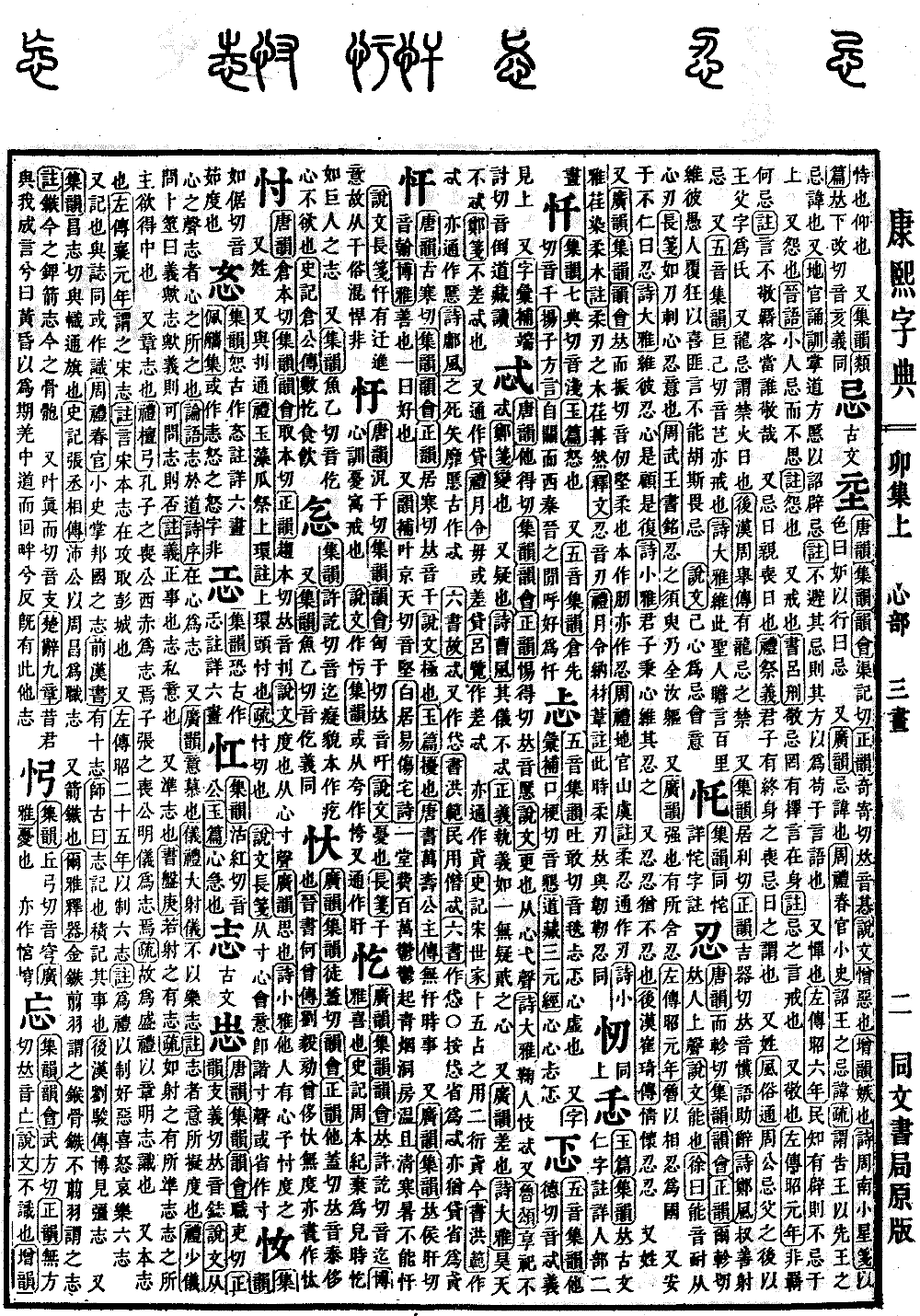
Mao Collection, Upper Volume
Radical: Heart (xīn)
Page 376, Entry 21
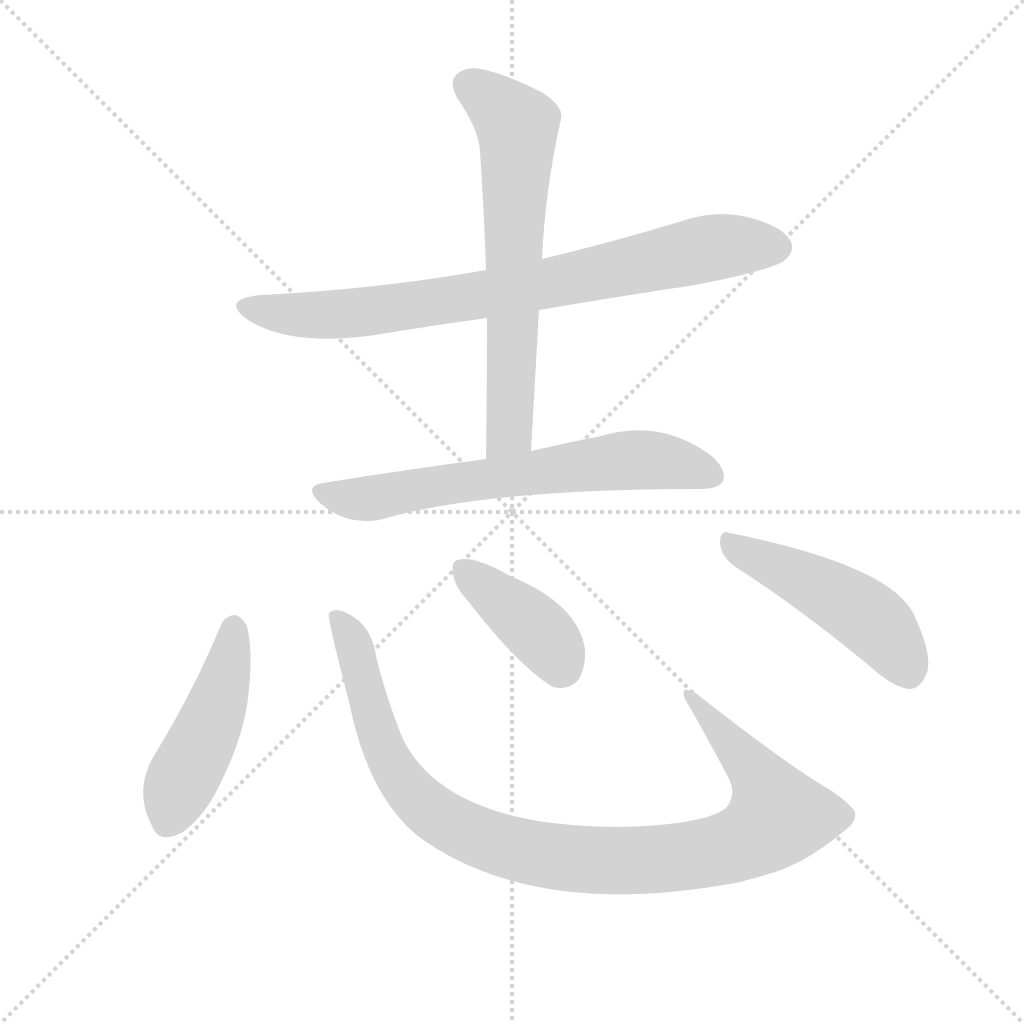
Ancient form. Pronounced zhi (falling tone) according to Tangyun, Jiyun, and Yunhui; pronounced zhi (falling tone) according to Zhengyun. The pronunciation is the same as the character for metal engraving. According to Shuowen Jiezi, it is formed from the Heart radical with zhi acting as the phonetic component. It refers to the place toward which the heart or mind is directed. The Analects (Lunyu) states: To have one’s will (zhi) directed toward the Way. The Preface to the Book of Odes (Shijing) states: When it is in the heart, it is called will (zhi). Also, according to Guangyun, it means longing or yearning in the heart. The Book of Etiquette and Ceremonial (Yili), in the section on the Great Archery Rite, mentions not using music to express one’s will (zhi). The commentary states that will (zhi) refers to what one contemplates or intends within the heart. The Book of Rites (Liji), in the section on minor etiquette, records that when asking about divination, one should ask if the intent arises from moral duty or from personal interest. If it arises from moral duty, one may ask; if from personal interest, one should not. The commentary explains that duty refers to righteous matters, while will (zhi) refers to personal selfish intent. It also refers to a target or a standard. The Book of Documents (Shangshu), in the Pan Geng chapter, says it is like needing a target when shooting an arrow. The sub-commentary explains that this is like aiming at a target; where the target is located, one intends to strike it. It also refers to manifesting or expressing one’s heart’s purpose. The Book of Rites (Liji), in the Tan Gong chapter, records that Gongxi Chi managed the funeral arrangements for Confucius to express his will (zhi), and Gongming Yi managed the funeral for Zizhang to express his will (zhi). The sub-commentary explains that grand rites are performed to clarify and record one’s inner purpose. It also refers to original intent or heart’s desire. The Zuo Tradition (Zuo Zhuan), in the first year of Duke Xiang, speaks of calling it the original intent of the State of Song. The commentary explains this shows the original intent of the State of Song lay in capturing the city of Pengcheng. Also, the Zuo Tradition (Zuo Zhuan), in the twenty-fifth year of Duke Zhao, speaks of using ritual to restrain the six kinds of inner wills (zhi). The commentary explains that rituals are established to restrain the six inner emotions: likes, dislikes, joy, anger, sorrow, and pleasure. It also refers to an account or record, identical to the character for chronicle (zhi). Sometimes written in a variant form (shí). The Rites of Zhou (Zhouli), in the chapter on the Spring Officials, records that the minor scribes were in charge of the official records of the feudal states. The Book of the Former Han (Qian Hanshu) contains ten records (zhi). The commentator Yan Shigu explains that these records (zhi) are accounts that accumulate and document these events. The Book of the Later Han (Hou Hanshu), in the biography of Liu Jun, says he had extensive knowledge and a strong memory. Also, according to Jiyun, the pronunciation is chang-zhi. Used interchangeably with the character for banner (zhì). It refers to a flag or banner. The Records of the Grand Historian (Shiji), in the biography of Chancellor Zhang, records that the Duke of Pei appointed Zhou Chang as the officer in charge of the banners. It also refers to an arrowhead. The Erya, in the section on utensils, explains that a metal arrowhead with trimmed feathers is called a hou, while a bone arrowhead with untrimmed feathers is called a zhi. The commentary explains that the former is a type of arrow, while the latter is a bone-tipped arrow. Also, rhyme-aligned with the zhen sound, pronounced zhi. A line from the Chu Ci, in the Nine Pieces (Jiuzhang), reads: The ruler and I once had an agreement, promising to meet at dusk. Who knew the intent would change halfway, and that he would already have other plans.