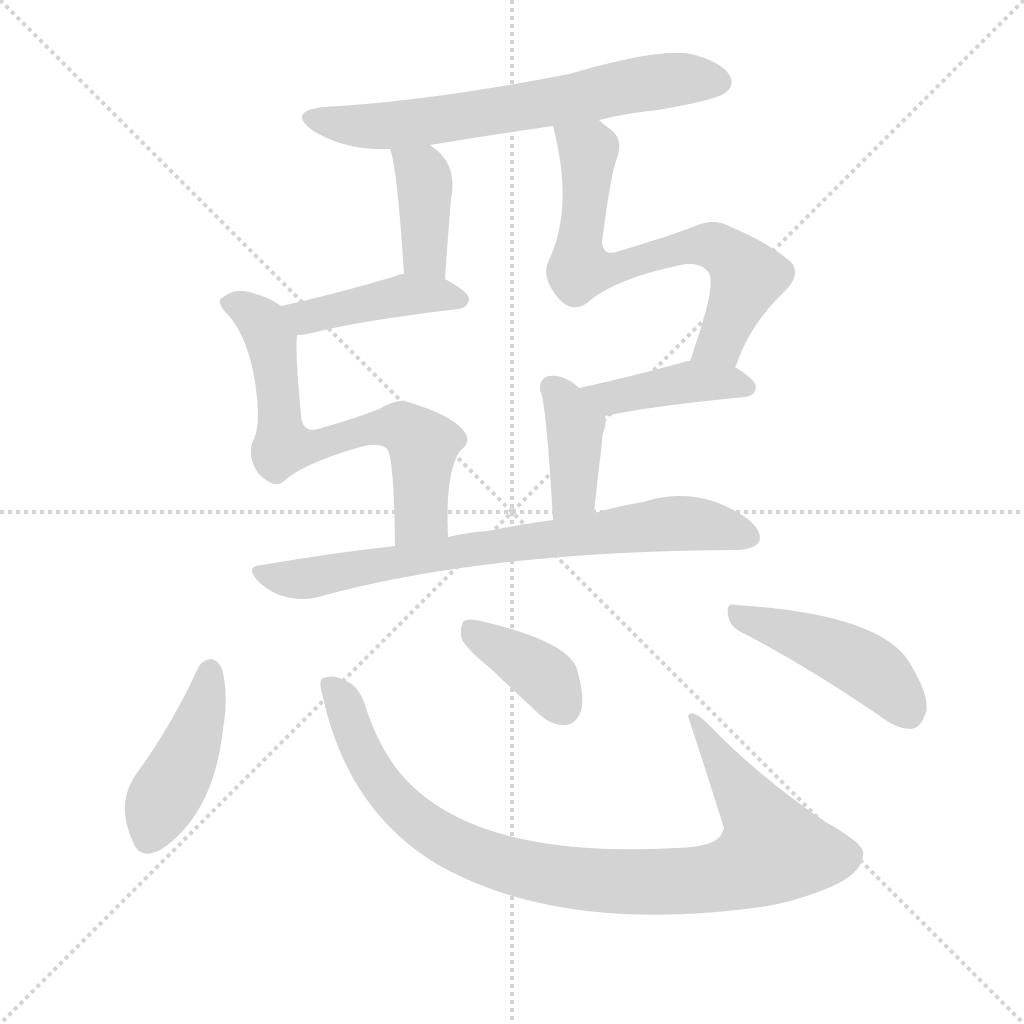
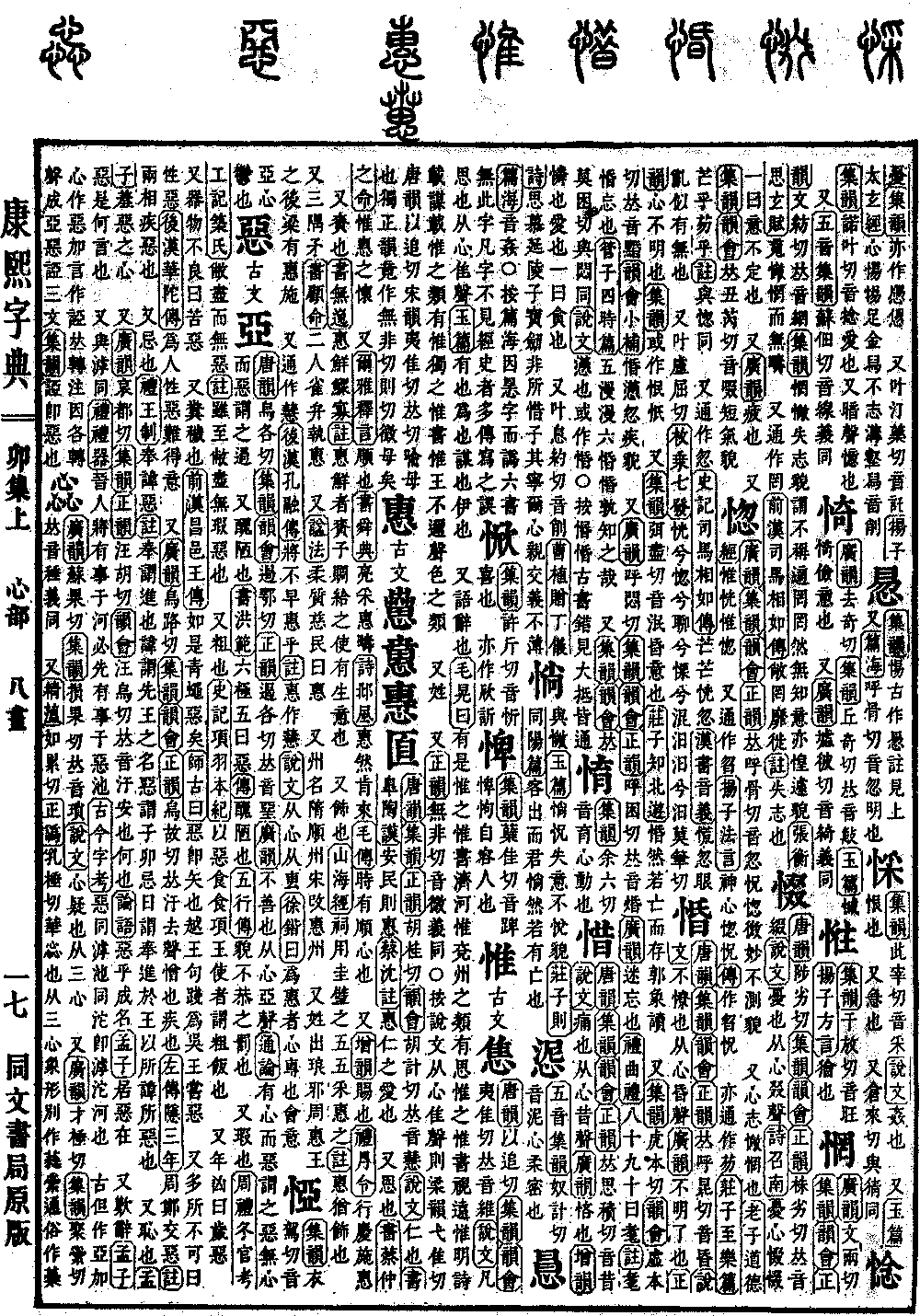
Mao Collection, Upper Volume
Radical: Heart (xīn)
Kangxi stroke count: 12
Page 391, Entry 25
Ancient form of the character ya.
Pronounced e.
Pronounced e.
Pronounced e.
Pronounced e.
Broadly defined as not good. Composed of the heart radical with ya serving as the phonetic component.
According to the General Treatise on Principles (Tonglun), if one acts with malicious intent it is called e, whereas if one acts without malice it is called guo (an error).
Also means ugly or unsightly.
In the Book of Documents (Shujing), specifically the Great Plan (Hongfan) chapter: Of the six extremes, the fifth is called e.
The commentary states: This refers to ugliness.
The Commentary on the Five Elements (Wuxing Zhuan) notes: This is the punishment for a lack of respect in one’s appearance.
Also refers to flaws or defects.
In the Rites of Zhou (Zhouli), specifically the section on the winter officials: Even when worn out, it should have no e.
The commentary states: Even when worn down to nothing, it should remain without flaws.
Also means coarse or inferior.
In the Records of the Grand Historian (Shiji), specifically the Annals of Xiang Yu: He fed the envoys of King Xiang with e food. This refers to coarse and low-quality meals.
Also used to describe a bad harvest, referred to as sui e.
Also used to describe inferior artifacts, referred to as ku e.
Also refers to excrement or filth.
In the History of the Former Han (Qian Hanshu), specifically the Biography of the Prince of Changyi: If it is like this, the blue flies will find the e.
The commentator Shigu says: E here means excrement.
King Goujian of Yue once tasted the e of the King of Wu.
Also used to describe an unpleasant temperament, referred to as xing e.
In the History of the Later Han (Hou Hanshu), specifically the Biography of Hua Tuo: As a person, his nature was e and he was difficult to please.
Pronounced wu (falling tone).
To hate or to loathe.
In the Zuo Tradition (Zuo Zhuan), specifically the third year of Duke Yin: The states of Zhou and Zheng began to show mutual e.
The commentary states: The two parties mutually loathed one another.
Also refers to taboos.
In the Book of Rites (Liji), specifically the Royal Regulations (Wangzhi): Offerings must respect taboos and e.
The commentary states: Offerings refer to presentations; taboos refer to the names of ancestors; e refers to the forbidden days of Zi and Mao. It means that when presenting items to a ruler, one must avoid both the tabooed names and the forbidden days.
Also refers to shame.
In the Mencius: The heart of shame and e.
Pronounced wu (level tone).
Used as an interrogative particle, meaning how or where.
In the Analects (Lunyu): How (e) can one achieve fame?
In the Mencius: Where (e) should one reside?
Also used as an exclamation.
In the Mencius: E, what kind of words are these?
Also identical to the character hu.
In the Book of Rites (Liji), specifically the section on Ritual Vessels (Liqi): When the people of Jin were about to conduct a ceremony at the river, they first had to conduct a ceremony at Echi.
According to the Examination of Ancient and Modern Characters (Gujin Zi Kao), e is the same as hu, and chi is the same as tuo, referring to the Hutuo River.
In ancient times, it was written only as ya; by adding the heart radical it became e, and by adding the speech radical it became a variant form, which are referred to as derivative characters (zhuanzhu). Because their pronunciations shifted, the three characters ya, e, and the speech-based variant were formed.
The Collection of Rhymes (Jiyun) identifies this as the character e.