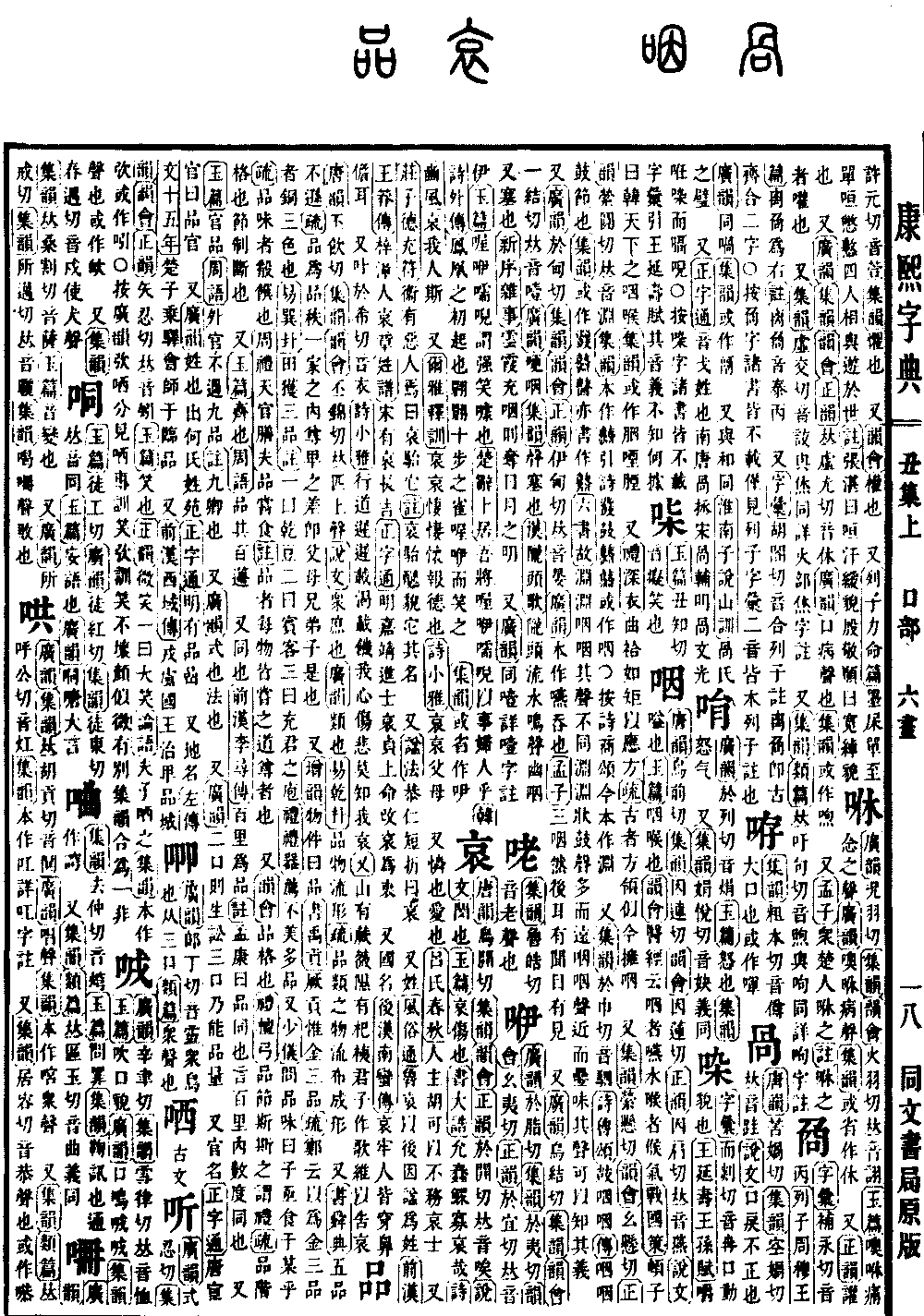
Chou Collection, Upper Volume
Radical: Mouth (kǒu)
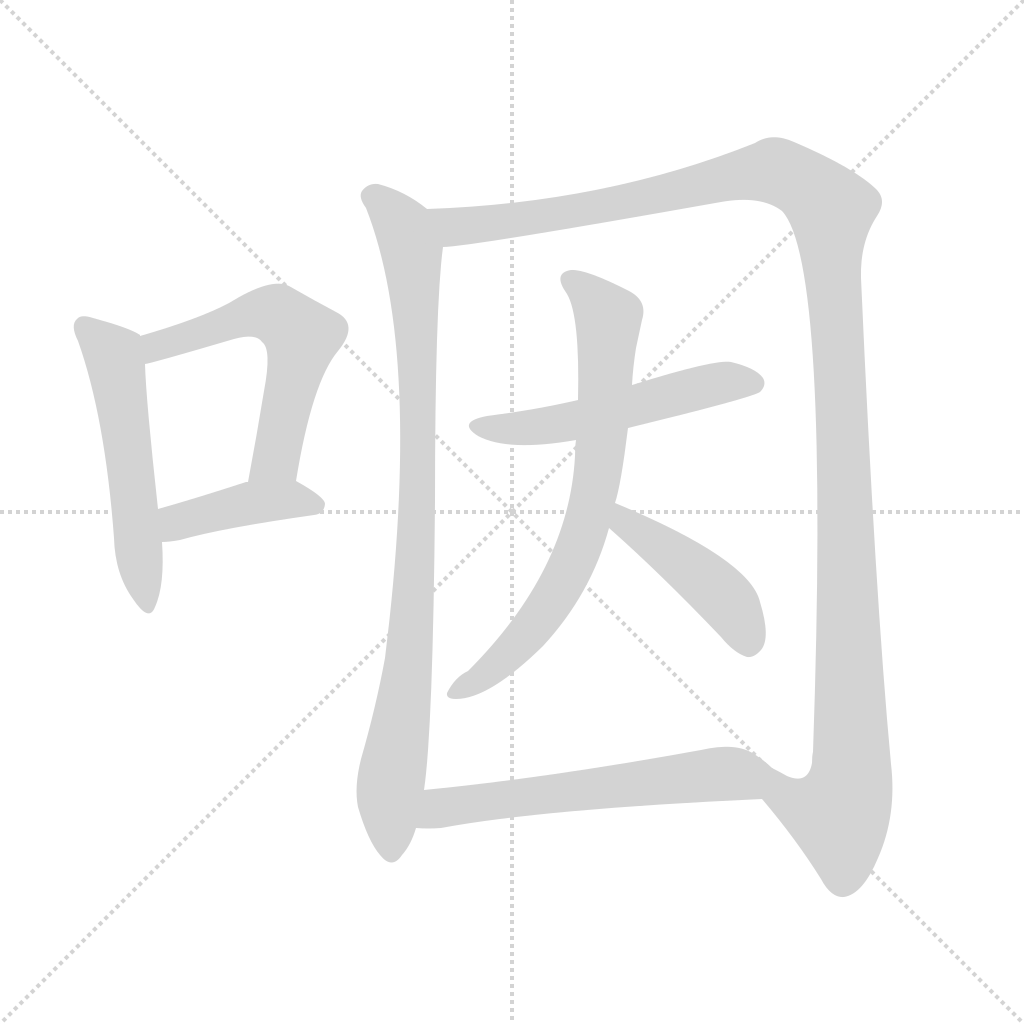
咽; Kangxi brush strokes: 9; Page 188, Entry 08
Pronounced yan (falling tone).
In Explanation of Words and Phrases (Shuowen): The gullet.
In Jade Chapters (Yupian): The pharynx or throat.
In Meeting of Rhymes (Yunhui): The Medical Classics state that the pharynx is for swallowing water, while the throat is for passing air.
In Strategies of the Warring States (Zhanguoce): Dunzi said: Han is the throat of the world.
In Collected Rhymes (Jiyun): Sometimes written in a variant form (yan).
Also, in Record of Rites (Liji), Deep Robes (Shenyi) section: The curved collar is like a square to correspond to the earth. The commentary notes that ancient square collars resembled what is now called a garment collar (yan).
Also, in Collected Rhymes (Jiyun): Pronounced yuan (level tone).
In Collected Rhymes (Jiyun): Originally written as a variant form, citing the Book of Odes (Shijing), to the beat of the hand-drum. Sometimes written as 咽. According to the current version of the Book of Odes (Shijing), Odes of Shang (Shangsong), it is written as yuan (level tone).
Also, in Collected Rhymes (Jiyun): Pronounced yin (level tone).
In Book of Odes (Shijing), Odes of Lu (Lusong): The drums resound (yanyin). The commentary states: Yanyin is the rhythm of the drums. In Collected Rhymes (Jiyun): Sometimes written as a variant form, also written as a variant form (yan).
In Six Scripts Explained (Liushugu): Yuan and yan differ in sound. Yuan describes the sound of drums as voluminous and distant, while yan describes the sound as close and dense. By savoring the sound, one can understand the meaning.
Also, in Broad Rhymes (Guangyun): Pronounced yan (falling tone).
In Broad Rhymes (Guangyun): Originally written as a variant form, to swallow.
In Mencius (Mengzi): Swallowed three times (yan) then the ears could hear and the eyes could see.
Also, in Broad Rhymes (Guangyun): Pronounced ye (rising tone).
In Broad Rhymes (Guangyun): Choking (gengye).
In Collected Rhymes (Jiyun): The voice is obstructed.
In Han Dynasty, Songs of Longtou (Longtou Ge): The running water at Longtou, the murmuring sound is deep and sobbing (youye).
Also: To block.
In New Prefaces of Miscellaneous Matters (Xinxu Zashi): If clouds and mist fill the throat (yan), they obscure the brightness of the sun and moon.
Also, in Broad Rhymes (Guangyun): Same as to choke (ye). See the detailed entry for the character ye.