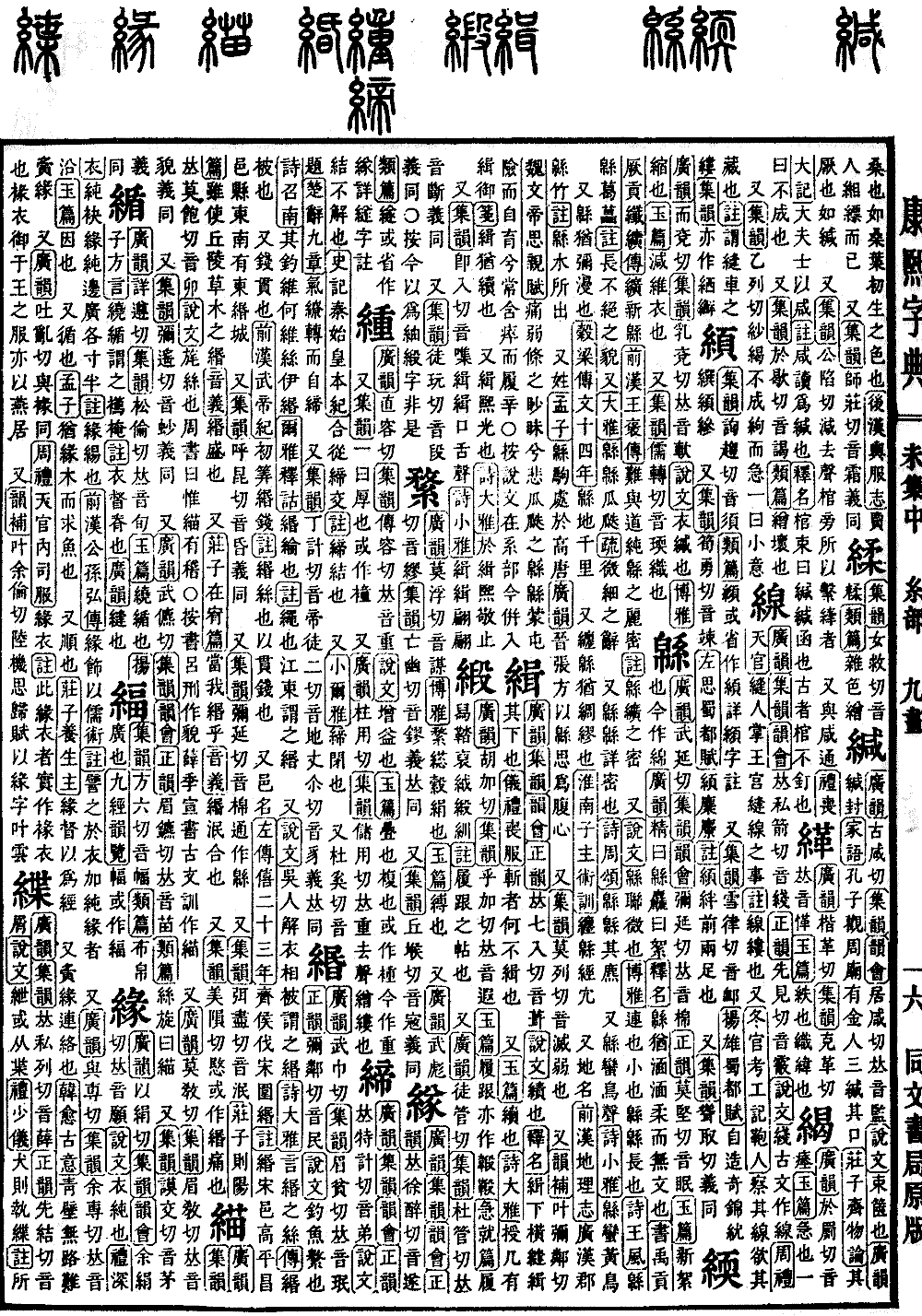
Wei Collection, Middle Volume. Radical: Silk (mì). Kangxi stroke count: 15. Page 930, Entry 14.
Guangyun dictionary: Pronounced yuan (falling tone). Jiyun dictionary and Yunhui dictionary: Pronounced yuan (falling tone).
Shuowen Jiezi dictionary: The edge or border of a garment.
Book of Rites (Liji), Deep Robe section: The sleeves are bordered and the edges are trimmed, each one and a half inches wide. Commentary: The term refers to a hem or border.
History of the Former Han (Qian Hanshu), Biography of Gongsun Hong: To decorate or embellish with Confucian arts. Commentary: This is analogous to adding a decorative border to a garment.
Guangyun dictionary: Pronounced yan (rising tone). Jiyun dictionary: Pronounced yan (rising tone).
Yupian dictionary: To cause or to rely upon. Also, to follow or proceed along.
Mencius: Like climbing a tree to seek fish.
Also, to follow or comply with. Zhuangzi, Nourishing the Principle of Life: Following the Governor Vessel (dumai) as a constant method.
Also, to climb or make connections. Han Yu, Ancient Thoughts: The blue cliffs have no path, making it difficult to climb and cling.
Guangyun dictionary: Pronounced tuan (falling tone). Identical to the variant form tuan.
Rites of Zhou (Zhouli), Offices of Spring, Inner Steward of Dress: Bordered robes. Commentary: These bordered robes are actually written as tuan robes. Tuan robes are garments worn by the queen, also used during leisure time.
Yunbu dictionary: Rhymes with the sound lun. Lu Ji, Ode on Thinking of Returning: Uses the character yuan to rhyme with the character yun.