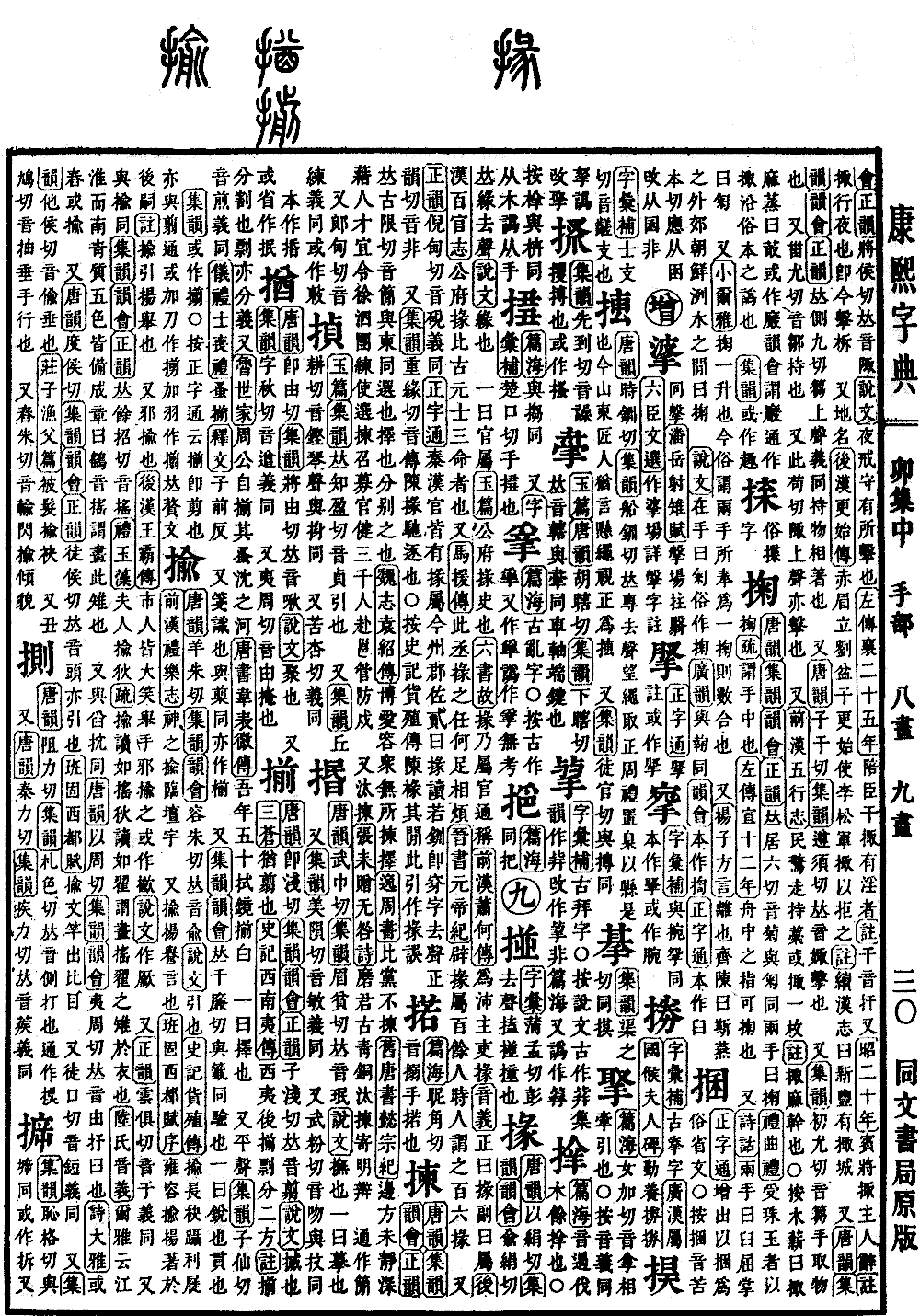
Mao Collection, Middle Volume
Radical: Hand (shǒu)
Kangxi strokes: 13
Page 440, Entry 20
Pronounced yuan (falling tone)
According to the Shuo Wen Jie Zi (Shuowen), it means to follow or to depend upon. Another definition is a class of official subordinates.
The Yu Pian (Yupian) defines it as a clerk or administrative official in a government office.
According to the Liu Shu Gu (Liushu Gu), yuan is a general term for subordinate officials.
In the Biography of Xiao He from the History of the Former Han (Qian Han Shu), it is noted he served as the chief clerk of Pei.
In the Yin Yi (Yinyi), it is stated that the principal is called yuan, and the deputy is called shu.
According to the Treatise on Officials in the History of the Later Han (Hou Han Shu), the clerks of the ducal offices were compared to the ancient officials of the third rank.
Also, in the Biography of Ma Yuan, it is asked if these are duties for assistants and clerks, and why one should be troubled with them.
In the Annals of Emperor Yuan from the Book of Jin (Jin Shu), it is recorded that he engaged over a hundred clerks, whom his contemporaries called the hundred and six clerks.
Also pronounced yan (falling tone). The meaning is the same.
According to the Zheng Zi Tong (Zhengzitong), officials in the Qin and Han dynasties all had subordinates called yuan; now, auxiliary officials in commanderies and prefectures are called yuan, pronounced like chuan (falling tone), meaning the character for to pierce or wear. The pronunciation provided in the Zheng Yun is incorrect.
Also pronounced chuan (rising tone). It means to gallop or pursue.
Note: In the Biographies of Money-makers from the Records of the Grand Historian (Shiji), the term used is chuan (to work the rafters), and its use here as yuan is an error.