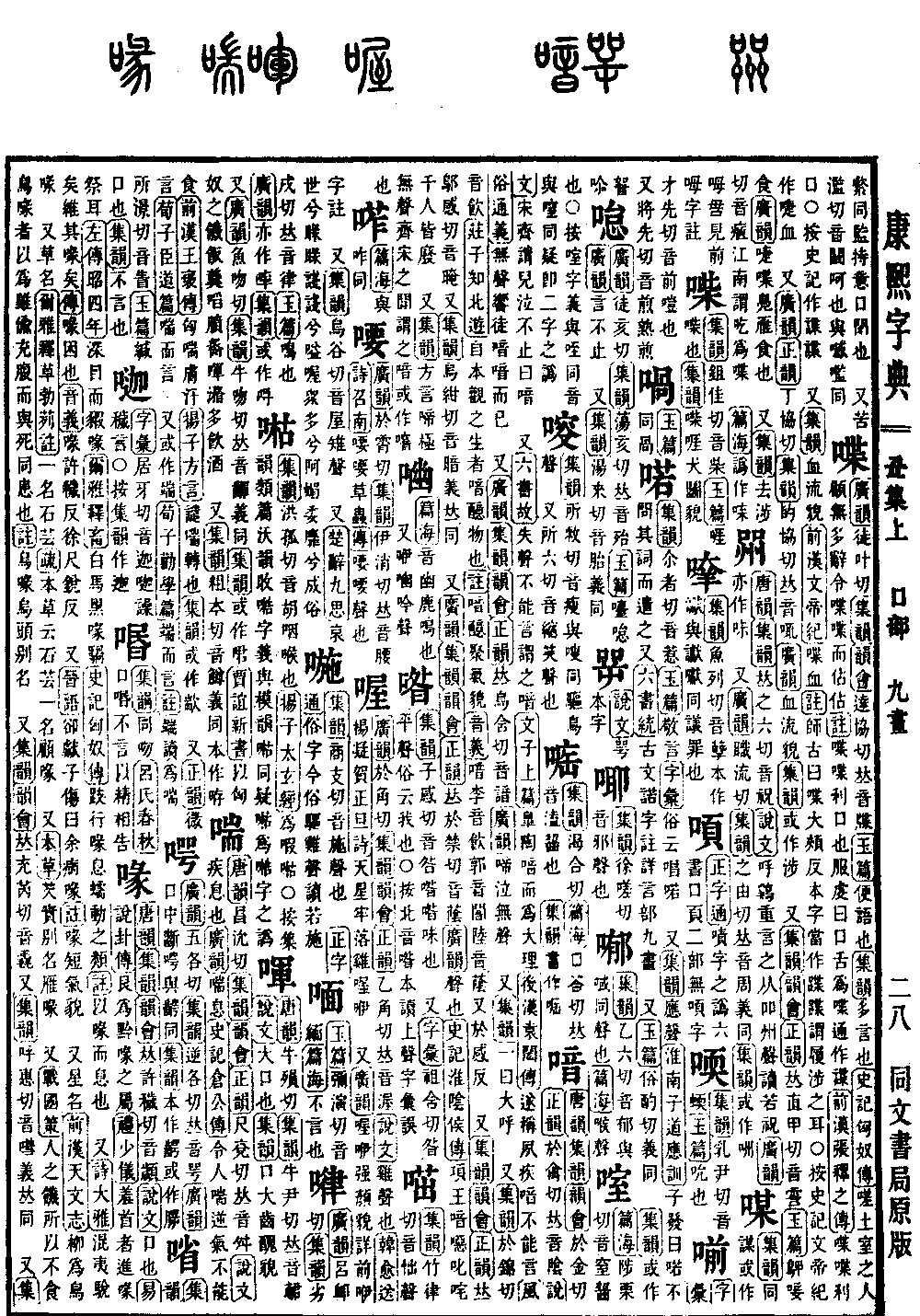
Chou Collection, Upper Volume
Radical: Mouth (kǒu)
Character: hui
Kangxi strokes: 12
Page 198, Entry 35
Tang Rhymes (Tangyun), Collected Rhymes (Jiyun), and Rhyme Meeting (Yunhui) define it as pronounced quan (rising tone).
Explaining Graphs and Analyzing Characters (Shuowen): A beak.
Book of Changes (Yijing), Commentary on the Trigrams of the Trigrams: The Gen hexagram represents an animal with a black beak.
Book of Rites (Liji), Lesser Rules of Deportment (Shaoyi): When presenting a head as a sacrificial offering, the beak and ears must be presented.
Zuo Tradition (Zuozhuan), Fourth Year of Duke Zhao: The eyes are deeply sunken, and the beak is like that of a boar.
Approaching Elegance (Erya), Explanation of Domestic Animals: A horse with a white body and a black beak is called a gua.
Records of the Grand Historian (Shiji), Account of the Xiongnu: All manner of living things that move on feet, breathe through their beaks, and crawl. Commentary: Refers to breathing through the beak.
Also, Book of Odes (Shijing), Greater Odes: The Hunyi (a western barbarian tribe) have fled, they are merely exhausted. Commentary: hui means exhausted and weary. Pronunciation and Meaning: hui, pronounced rui (falling tone), Xu Miao reads it as chui (falling tone).
Also, Discourses of the States (Jinyu): After the official Xi Xianzi was wounded, he said: I cannot catch my breath. Commentary: hui indicates short of breath.
Also, the name of a constellation. History of the Former Han (Qianhan), Treatise on Astronomy: The Willow constellation is the bird's beak.
Also, the name of a plant. Approaching Elegance (Erya), Commentary on Grasses: Also known as shi yun. Sub-commentary: The Materia Medica states that shi yun is also known as gu hui.
Also, Materia Medica (Bencao): The fox nut has the alternative name yan hui.
Also, Strategies of the Warring States (Zhanguoce): When people are starving, the reason they do not eat the bird's beak (a type of aconite) is that they know that while it may temporarily fill their stomachs, it will bring the disaster of death. Commentary: Niao hui is an alternative name for aconite.
Also, Collected Rhymes (Jiyun) and Rhyme Meeting (Yunhui) define it as pronounced cui (falling tone).
Also, Collected Rhymes (Jiyun) defines it as pronounced hui (falling tone). The pronunciation and meaning are the same.
Originally written as zhou. Sometimes written as zhou. See the entry for zhou for full details.