Hai Collection, Lower Volume
Radical: Fish (yú)
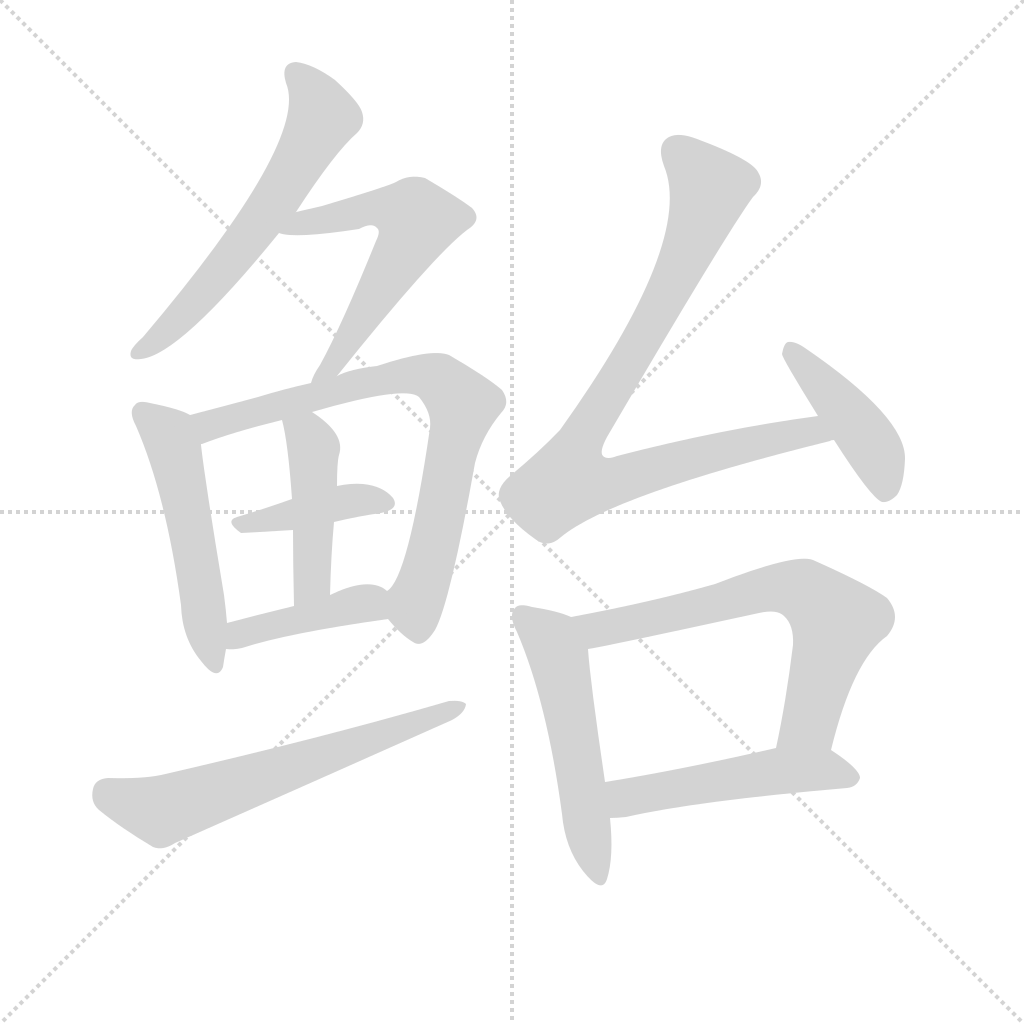
Character: 鮐
Kangxi Stroke Count: 16
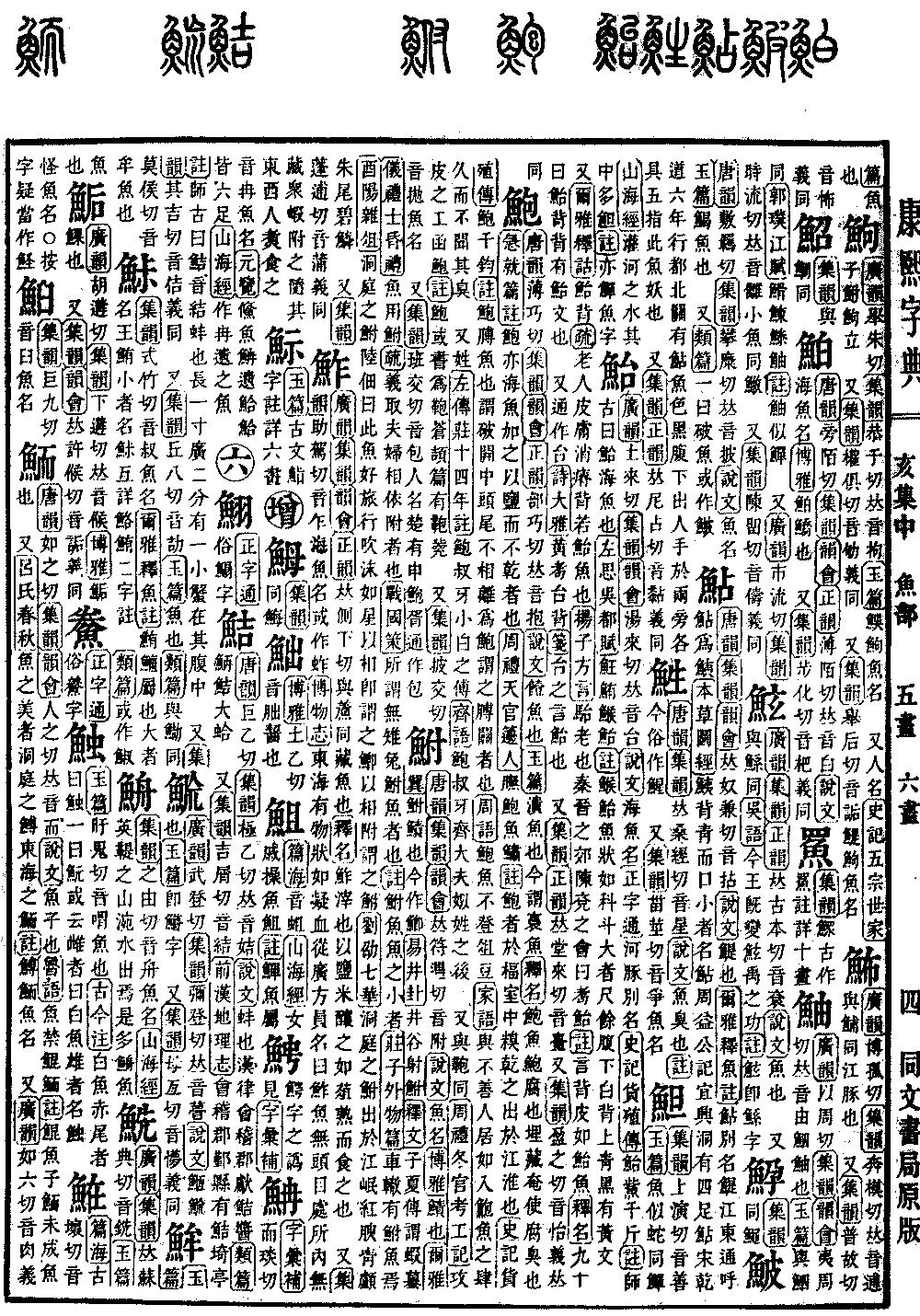
Page 1468, Entry 02
According to the Expanded Rhymes (Guangyun), it is pronounced tai (level tone). According to the Collected Rhymes (Jiyun) and the Rhyme Compendium (Yunhui), it is also pronounced tai (level tone). According to the Explanatory Text (Shuowen), it is the name of a sea fish. According to the Guide to Correct Characters (Zhengzitong), it is an alternative name for the pufferfish. In the Records of the Grand Historian (Shiji), Biography of Economic Merchants, it mentions one thousand catties of pufferfish. The commentary by Shigu states that the pufferfish is a sea fish. In the Rhapsody on the Capital of Wu (Wu Du Fu) by Zuo Si, it mentions tuna and pufferfish. The commentary notes that the pufferfish resembles a tadpole, growing to over a foot in length, with a white underside and a blue-black back marked with yellow patterns.
Additionally, in the Erya, Explanations of Ancient Terms, it refers to the term taibei (pufferfish back/old age). The commentary explains that when the skin of an elderly person becomes thin and withered, it resembles the back of a pufferfish. In the Local Dialects (Fangyan) by Yang Xiong, it states that taibei means old. In the regions of Qin, Jin, Chen, and Yan, it is called goutai. The commentary explains that the skin of the back resembles that of a pufferfish. In the Definitions of Names (Shiming), it states that at ninety years of age, one is called taibei, as the back develops patterns like a pufferfish. It is also commonly written in the variant form tai (level tone). In the Book of Odes (Shijing), Greater Odes, it says: with yellow-haired old age and pufferfish-like back. The commentary notes that tai is a word for taibei. According to the Collected Rhymes (Jiyun) and the Correct Rhymes (Zhengyun), it is also pronounced tai (level tone). According to the Collected Rhymes (Jiyun), it is also pronounced yi (level tone). The meanings are the same.