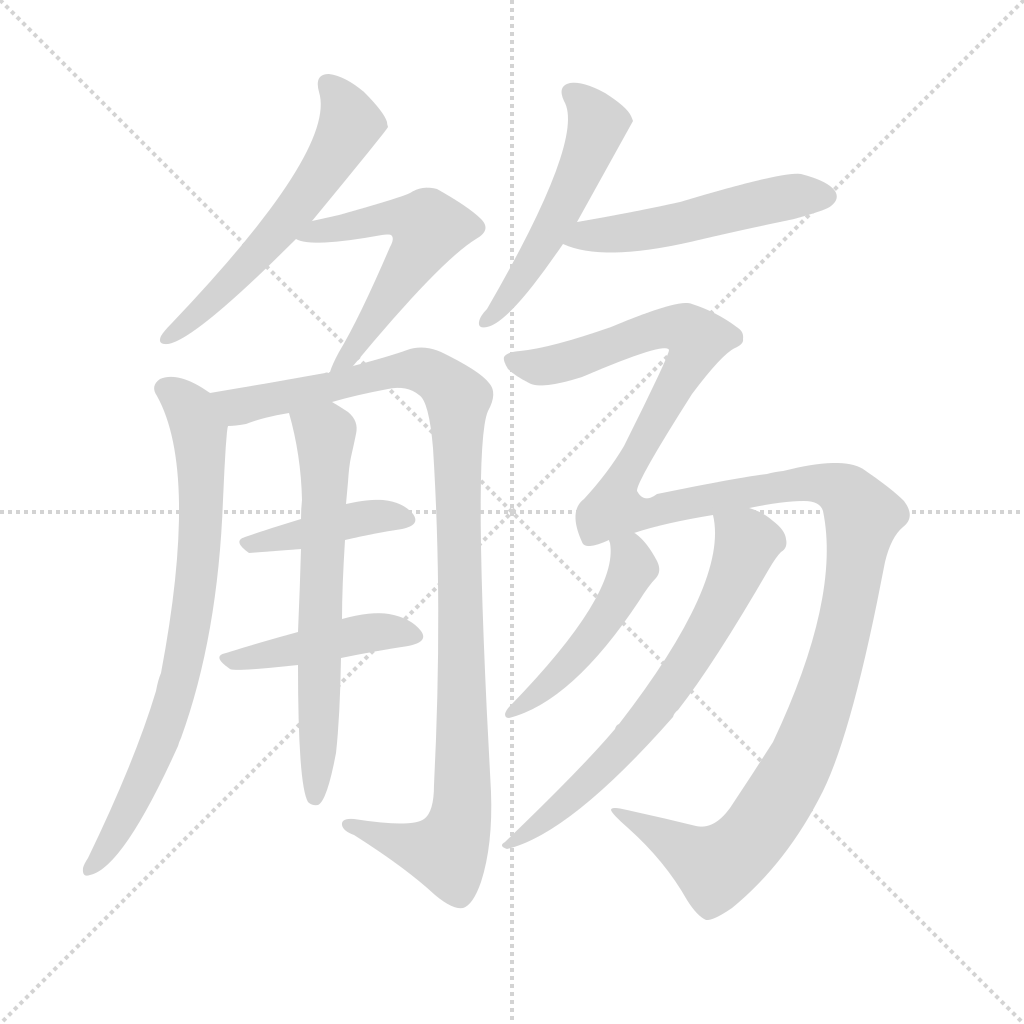
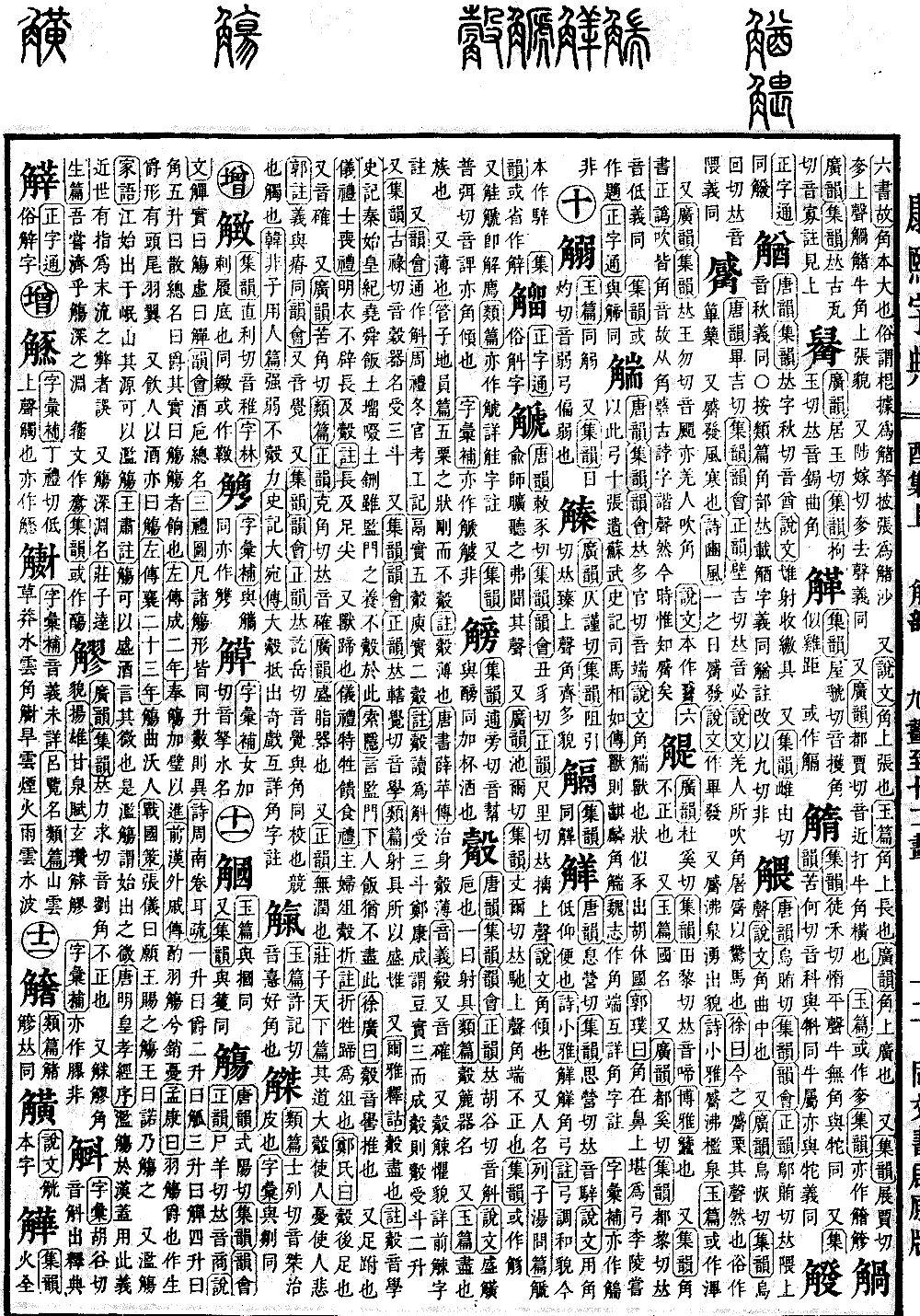
You Collection, Upper Volume
Radical: Horn (jiǎo)
Page 1144, Entry 18
Pronounced shang.
According to the Explaining Graphs and Analyzing Characters (Shuowen Jiezi), a filled vessel is called a shang, while an empty one is called a zhi.
According to the Collection of Rhymes (Yunhui), it is a general term for wine cups.
According to the Illustrations of the Three Rituals (Sanli Tu), all vessels known as shang have the same shape but differ in capacity.
In the commentary to the Book of Odes (Shijing), it is noted that one sheng is called a jue, two sheng is a gu, three sheng is a zhi, four sheng is a jiao, and five sheng is a san. They are collectively called jue, but in practice, they are called shang. Shang refers to that which is used to entertain guests.
Left Commentary of Zuo (Zuo Zhuan): Offering a cup and a jade disk to present them.
History of the Former Han (Qian Han Shu), Biography of Imperial Relatives: Pouring wine into a feathered cup to melt away sorrow. Meng Kang states that the feathered cup is a drinking vessel shaped like a bird with a head, tail, and wings.
It also refers to the act of giving someone wine to drink. Left Commentary of Zuo (Zuo Zhuan): Served wine to the people of Quwo.
Strategies of the Warring States (Zhan Guo Ce): Zhang Yi said, I wish for the King to bestow upon him a cup. The King said, Agreed. Then he gave him wine.
Also, lan-shang. In the Family Sayings of Confucius (Kongzi Jiayu), the Yangtze River begins at Mount Min, and its source is small enough to float a cup. Wang Su comments that because a cup can hold wine, this indicates that the source is minute; thus, lan-shang refers to the small beginning of something.
In the preface to the Classic of Filial Piety (Xiaojing) by Emperor Xuanzong of Tang, it mentions the practice originated in the Han dynasty, using the term in this sense. In recent times, those who interpret it as referring to degenerate customs are mistaken.
It is also the name of a deep pool. Zhuangzi, chapter on Understanding Life (Dasheng): I once crossed the pool of Shangshen.
The greater seal script variant is written as the character composed of the radical for horn and the character for business.
According to the Collection of Rhymes (Yunhui), it is also written as the variant form composed of the radical for horn and the character for merchants.