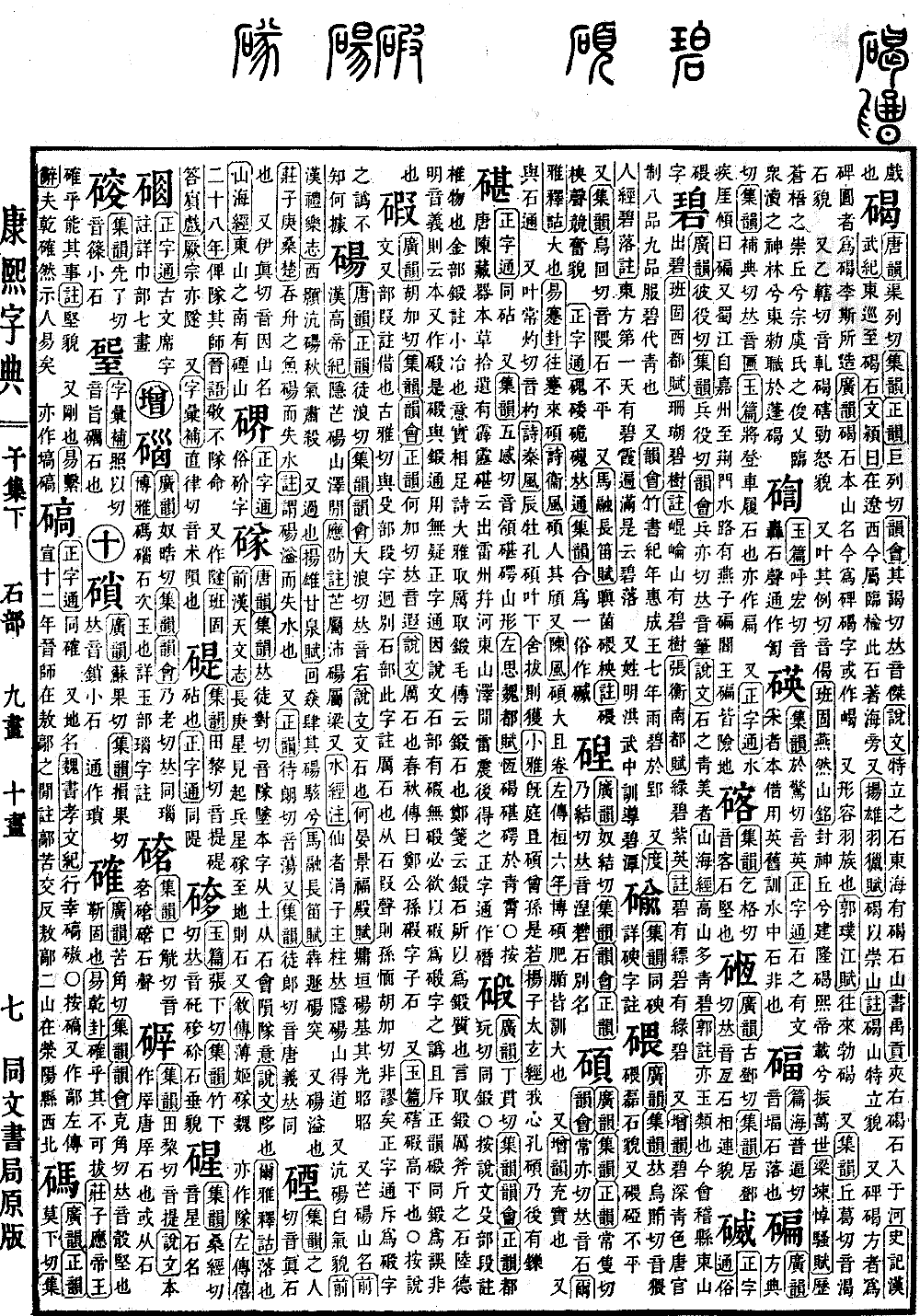
Wu Collection, Lower Volume
Radical: Stone (shí)
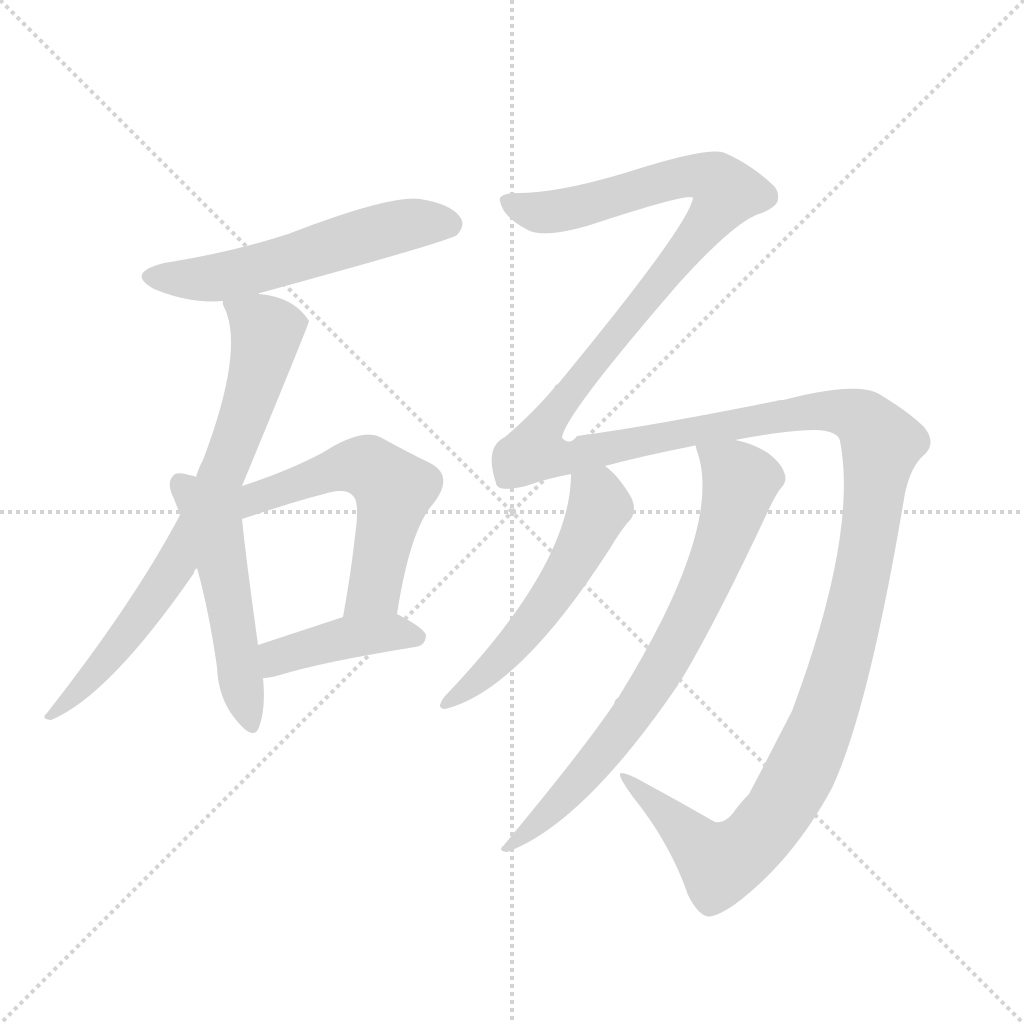
Character: Dang
Kangxi stroke count: 14
Page 833, Entry 06
Pronounced dang (falling tone).
According to the Explaining Graphs and Analyzing Characters (Shuowen Jiezi), it refers to a patterned stone.
In the Rhapsody on the Jingfu Hall (Jingfu Dian Fu) by He Yan: The walls and enclosures are built upon foundations of patterned stone, and their light is bright and clear.
Also Mangdang, a mountain name. In the Annals of Emperor Gaozu in the Former Han Dynasty (Qian Han Shu): He hid among the mountains and marshes of Mangdang. The commentary by Ying Shao states: Mang belongs to Pei, and Dang belongs to Liang.
In the Commentary on the Water Classic (Shuijing Zhu): The immortal Juanzi, the lord of the pillar, hid in Mount Dang and attained the Way.
Also described as hangdang, the appearance of white mist. In the Treatise on Ritual and Music in the Former Han Dynasty (Qian Han Shu): The western mist of autumn is vast and white, and the autumn atmosphere is bleak and killing.
Also means to pass by or overrun. In the Rhapsody on the Ganquan Palace (Ganquan Fu) by Yang Xiong: A swirling gust of wind spreads its wild terror. In the Rhapsody on the Long Flute (Changdi Fu) by Ma Rong: To rush, escape, and dash about wildly.
Also means to overflow. In the Zhuangzi: A fish capable of swallowing a boat overflows and loses the water. The commentary states: This means to overflow and thus lose the water.
Also pronounced dang (rising tone).
Also pronounced tang. The meanings are the same.