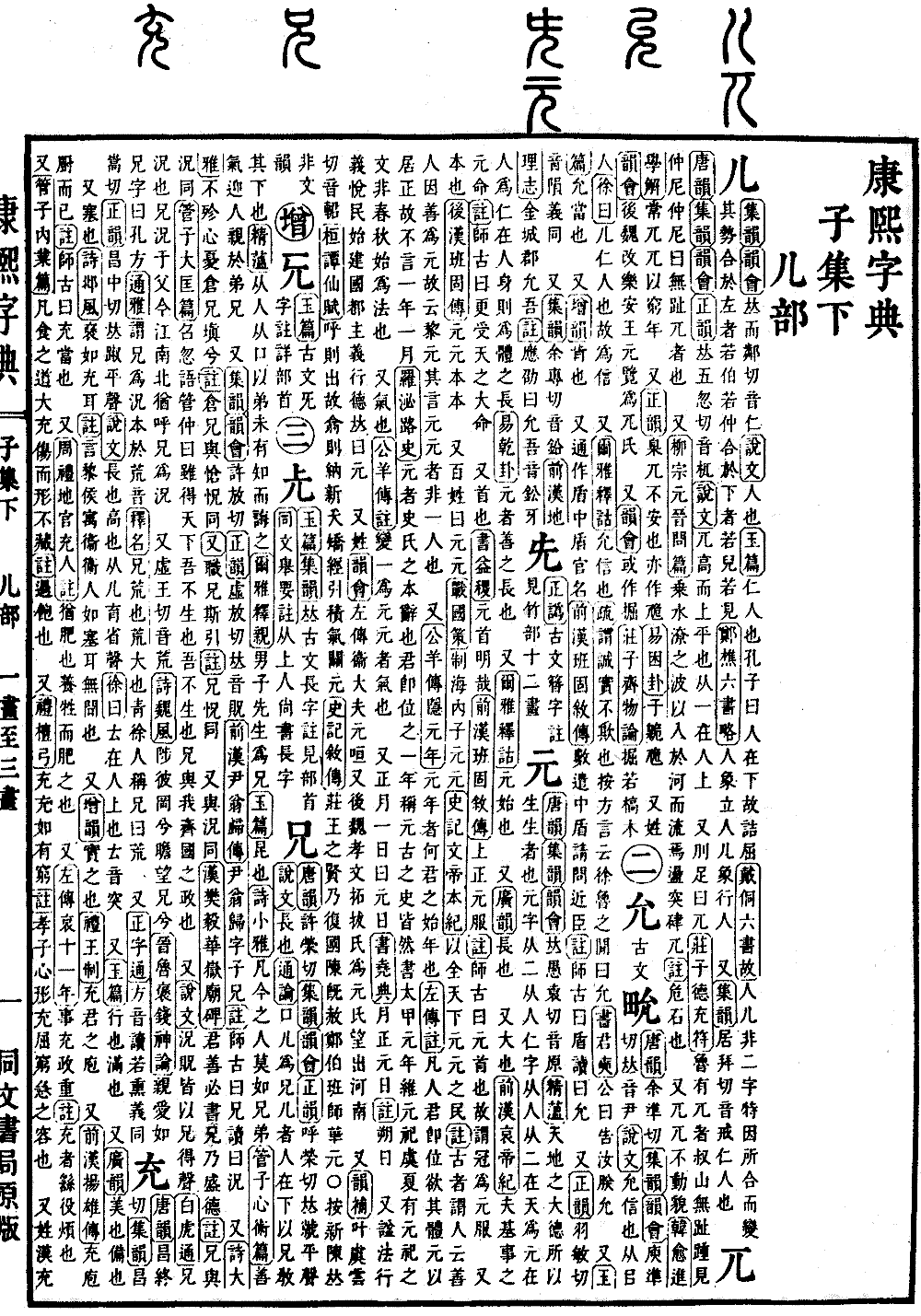
Zi Collection, Page Position: Lower
Radical: Man (ér)
Character: xiōng
Kangxi stroke count: 5
Page 123, number 09
In the Tang Dictionary (Tangyun), the pronunciation is xǔ-róng. In the Collected Rimes (Jiyun), the Rime Guide (Yunhui), and the Correct Rimes (Zhengyun), the pronunciation is hū-róng, which has the same level tone as the character pronounced xì.
In the Explanation of Graphs and Analysis of Characters (Shuowen Jiezi), it is defined as an elder.
In the General Discussions (Tonglun), it is argued that the character is composed of the components for mouth and man. The man component represents a person in a lower position, while the elder brother uses the mouth component to provide instruction to those beneath him.
The Essential Mysteries (Jingyun) states the character is composed of the components for person and mouth, representing an elder brother providing instruction to a younger brother who is not yet sensible.
In the Approaching the Correct (Erya), section Explaining Kinship, the male born first is called xiōng.
The Jade Chapters (Yupian) explains it as kūn (elder brother).
The Book of Odes (Shijing), Lesser Court Hymns, says: Of all the men in the world, there are none equal to brothers.
In Master Guan (Guanzi), Arts of the Mind, it says: To treat others with a benevolent spirit is to be closer than brothers.
Also, in the Collected Rimes and the Rime Guide, the pronunciation is xǔ-fàng. In the Correct Rimes, the pronunciation is xū-fàng, and it is read as kuàng.
In the History of the Former Han (Hanshu), Biography of Yin Wanggui, his courtesy name was Zixiong. The commentary by Yan Shigu notes that here the character is pronounced the same as kuàng.
Also, in the Book of Odes, Greater Court Hymns: The sorrow of my heart is continuous; grief and disappointment fill my breast. The commentary states that the phrase cāng xiōng is the same as chuàng huǎng (disappointment).
Also, in the Book of Odes: Managing these matters only increases the pull of my grief. The commentary states that xiōng is the same as huǎng (agitation).
The character is also used interchangeably with kuàng (moreover).
On the Han Dynasty Stele of Fan Yi at Mount Hua Temple (Fan Yi Hua Yue Miao Bei), it says: The good deeds of the ruler must be recorded, how much more so for such magnificent virtue. The note states that xiōng is used here for kuàng.
In Master Guan, Great Rectification, Shao Hu said to Guan Zhong: Even if I were to gain the world, I would not wish to live. I do not wish to live, how much less so if I were made to manage the government of the state of Qi.
Also, in the Explanation of Graphs and Analysis of Characters, the characters kuàng (furthermore) and kuàng (to grant) both take their phonetic sound from xiōng.
In the Comprehensive Discussions in the White Tiger Hall (Baihu Tong), xiōng is explained as kuàng. An elder brother is to a father as a comparison (kuàng). Today, in the regions north and south of the Yangtze River, an elder brother is still called kuàng.
The character is also pronounced xū-wáng, read as huāng.
In the Book of Odes, Odes of Wei: I climb that ridge and gaze toward my elder brother.
In the Jin Dynasty Discourse on the Spirit of Money (Qian Shen Lun) by Lu Bao: He is loved like an elder brother; his name is Kongfang.
The General Refinements (Tongya) states that calling an elder brother kuàng originates from the pronunciation of huāng.
In the Explanation of Names (Shiming), xiōng means huāng, and huāng means great. People of the Qingzhou and Xuzhou regions call an elder brother huāng.
The Correct Character Mastery (Zhengzitong) notes that in certain dialects it is pronounced like xūn, with the same meaning.