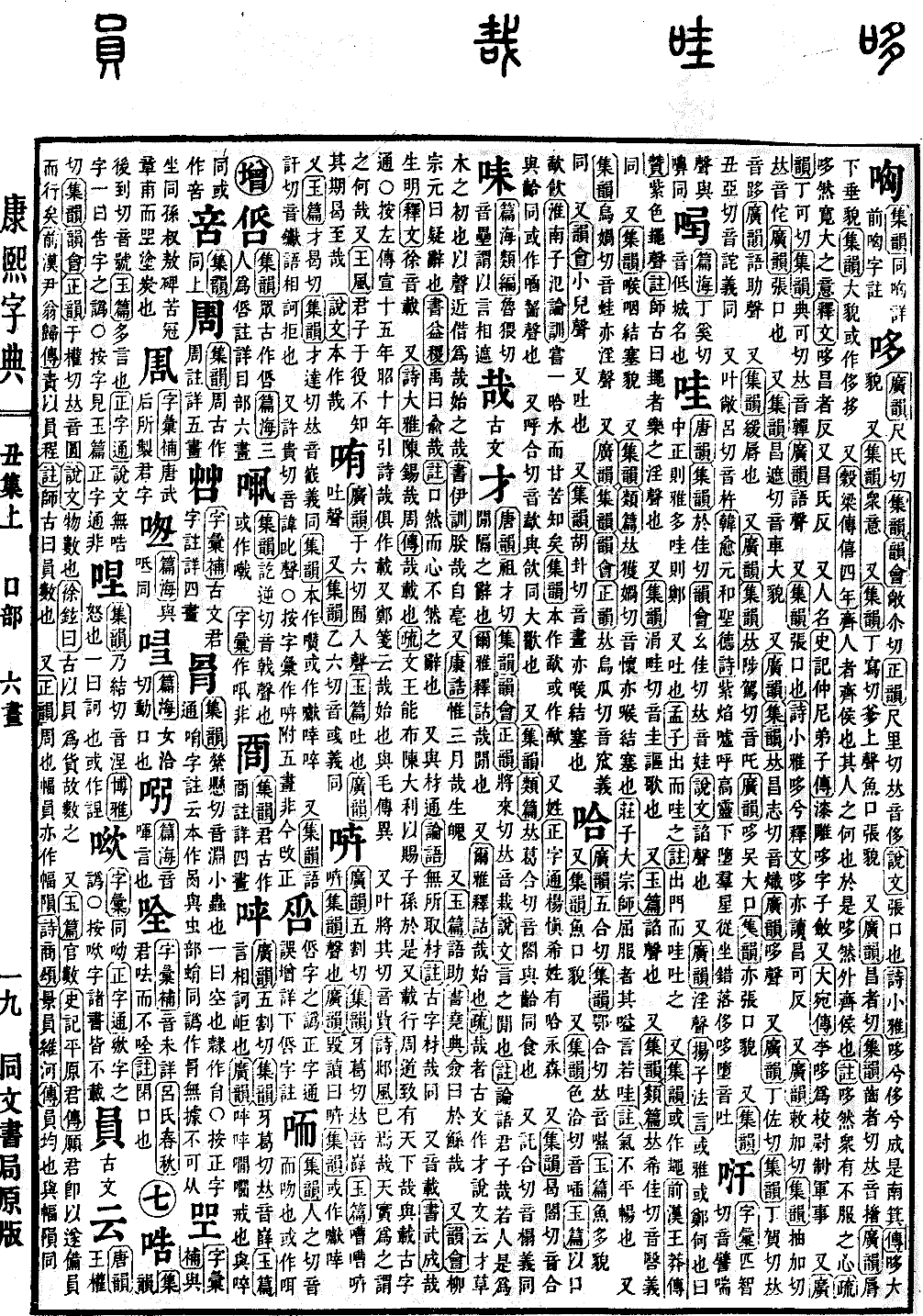
Chou Collection, Upper Volume
Radical: Mouth (kǒu)
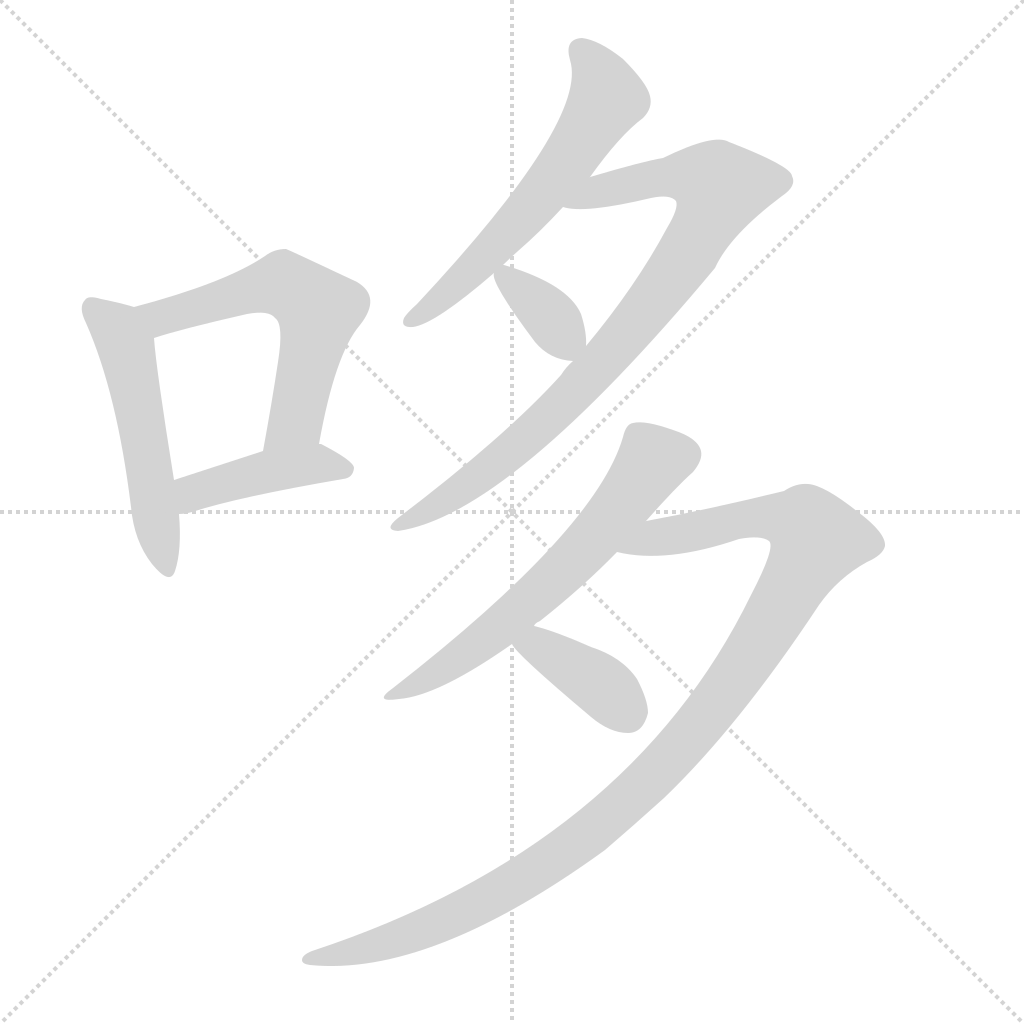
Character: Duo
Kangxi Strokes: 9
Page 189, Entry 02
Pronounced chi. In the book Explaining Graphs and Analysis of Characters (Shuowen Jiezi), it means to open the mouth wide. In the Book of Odes (Shijing), it says: Like the open mouth, like the spread, forming this Southern Dipper. The commentary states: Duo signifies a large appearance.
According to the Collected Rhymes (Jiyun), it also means the will of the masses.
Pronounced die (rising tone). It refers to the appearance of a fish opening its mouth.
Pronounced che. According to the Wide Rhymes (Guangyun), it refers to the appearance of the lips drooping. According to the Collected Rhymes (Jiyun), it means a large appearance. It is sometimes written as a variant form (chi) or (yi).
According to the Guliang Commentary to the Spring and Autumn Annals (Guliang Zhuan): The people of Qi refer to the Marquis of Qi. Why is he called a person? This is an expression of alienation toward the Marquis of Qi. The commentary notes: This implies a feeling of widespread dissent. The sub-commentary explains: This signifies a broad and expansive intent. The Explanatory Text (Shiwen) notes it is also pronounced chang-zhe or chang-shi.
As a proper name. In the Records of the Grand Historian (Shiji), Disciple of Confucius Biography, there is Qidiao Duo, whose courtesy name was Zilian. In the Biography of Dayuan, Li Duo served as a colonel, managing military affairs.
Pronounced duo (rising tone). According to the Wide Rhymes (Guangyun), it is a sound used in speech.
According to the Collected Rhymes (Jiyun), it means to open the mouth. The Explanatory Text for the Book of Odes (Shijing) notes that it is also pronounced chang-ke.
Pronounced cha. According to the Wide Rhymes (Guangyun), it means to open the mouth wide.
Pronounced che. According to the Collected Rhymes (Jiyun), it means a large appearance.
Pronounced chi. According to the Wide Rhymes (Guangyun), it is the sound of duo.
Pronounced duo (falling tone). According to the Wide Rhymes (Guangyun), it is a particle used in speech. According to the Collected Rhymes (Jiyun), it means to slacken the lips.
Pronounced zha. According to the Wide Rhymes (Guangyun), it refers to a large mouth. According to the Collected Rhymes (Jiyun), it also describes the appearance of opening the mouth.
Pronounced cha. The meaning is the same as above.
Additionally, used as a rhyme in the sound chu. In Han Yu’s Poem on the Holy Virtue of the Yuanhe Period, it appears as: The purple flames breathe and exhale, the high spirits descend. The constellations follow and sit, arranged and spread (duo). (Note: In this context, it rhymes with tuo).