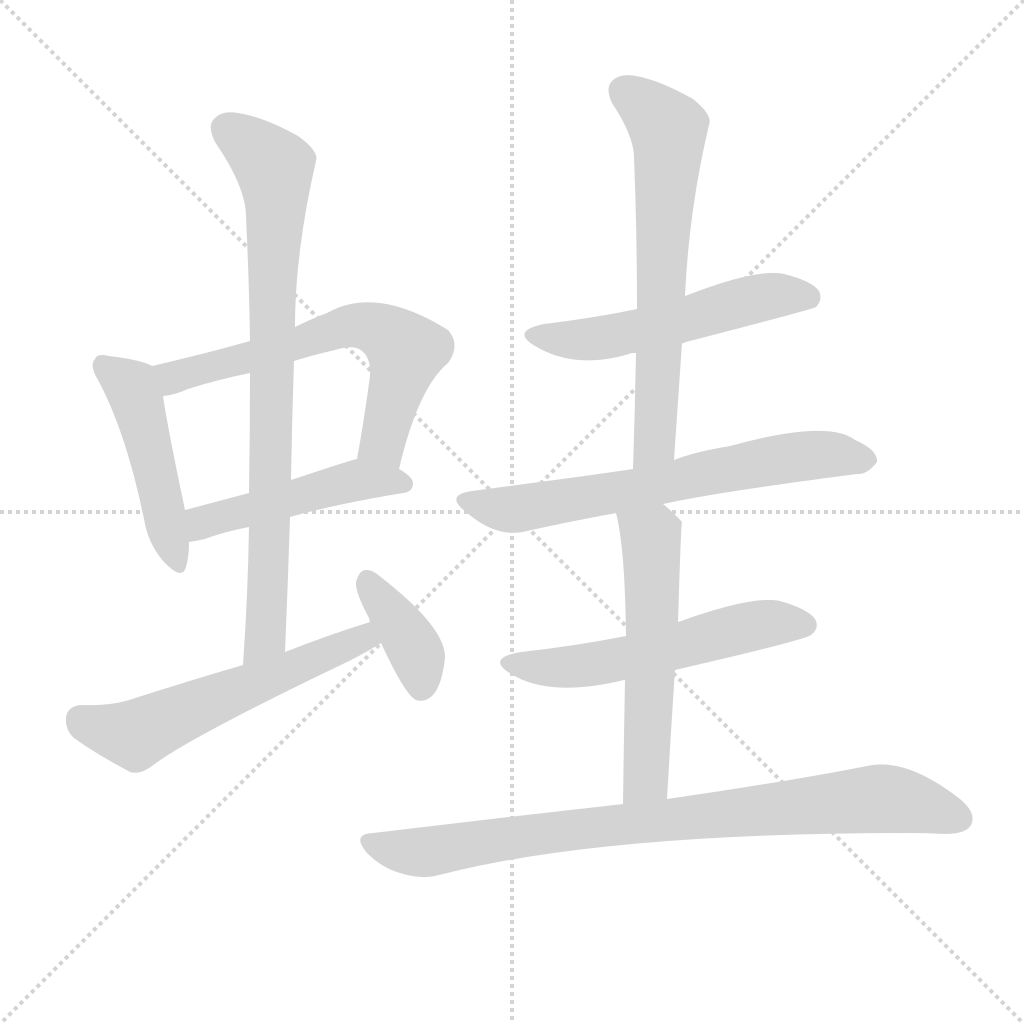
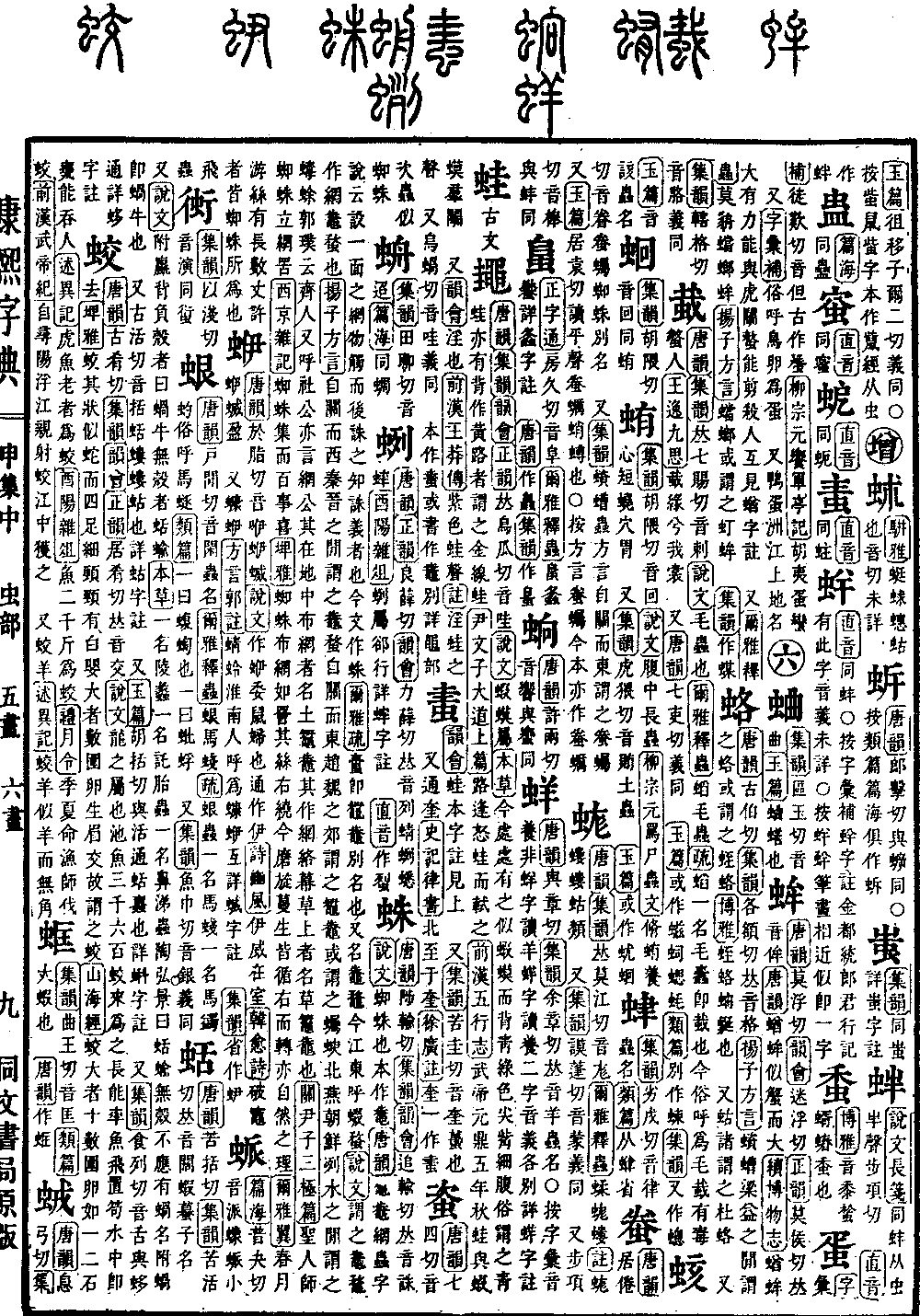
Shen Collection, Middle Volume. Radical: Insect (chóng). Kangxi Stroke Count: 12. Page 1081, Entry 25.
Archaic form.
According to the Tang Dynasty Rhyme Dictionary (Tangyun), the Collected Rhymes (Jiyun), the Compilation of Rhymes (Yunhui), and the Correct Rhymes (Zhengyun), it is pronounced wa.
In the Explaining Graphs and Analyzing Characters (Shuowen), it is described as a type of toad. In the Materia Medica (Bencao), it is noted that these are found everywhere, resembling a toad but with a green back, a pointed mouth, and a slender abdomen; commonly known as the green frog. Some have yellow stripes on their backs and are called golden-thread frogs.
In the Yin Wenzi (Yinwenzi), it is mentioned that one should offer respect to an angry frog encountered on the road.
In the History of the Former Han (Qianhan), Five Elements Treatise, it is recorded that in the autumn of the fifth year of the Yuanding reign of Emperor Wu of Han, frogs and toads fought in groups.
Also, according to the Compilation of Rhymes (Yunhui), it means lewd or licentious. In the History of the Former Han (Qianhan), Biography of Wang Mang, it is written as purple, frog-like sounds. The commentary states this refers to licentious cries.
Also pronounced wa. The meaning is the same. This is the original form. Sometimes written as a variant form. See further details under the Amphibian (mǐn) radical.