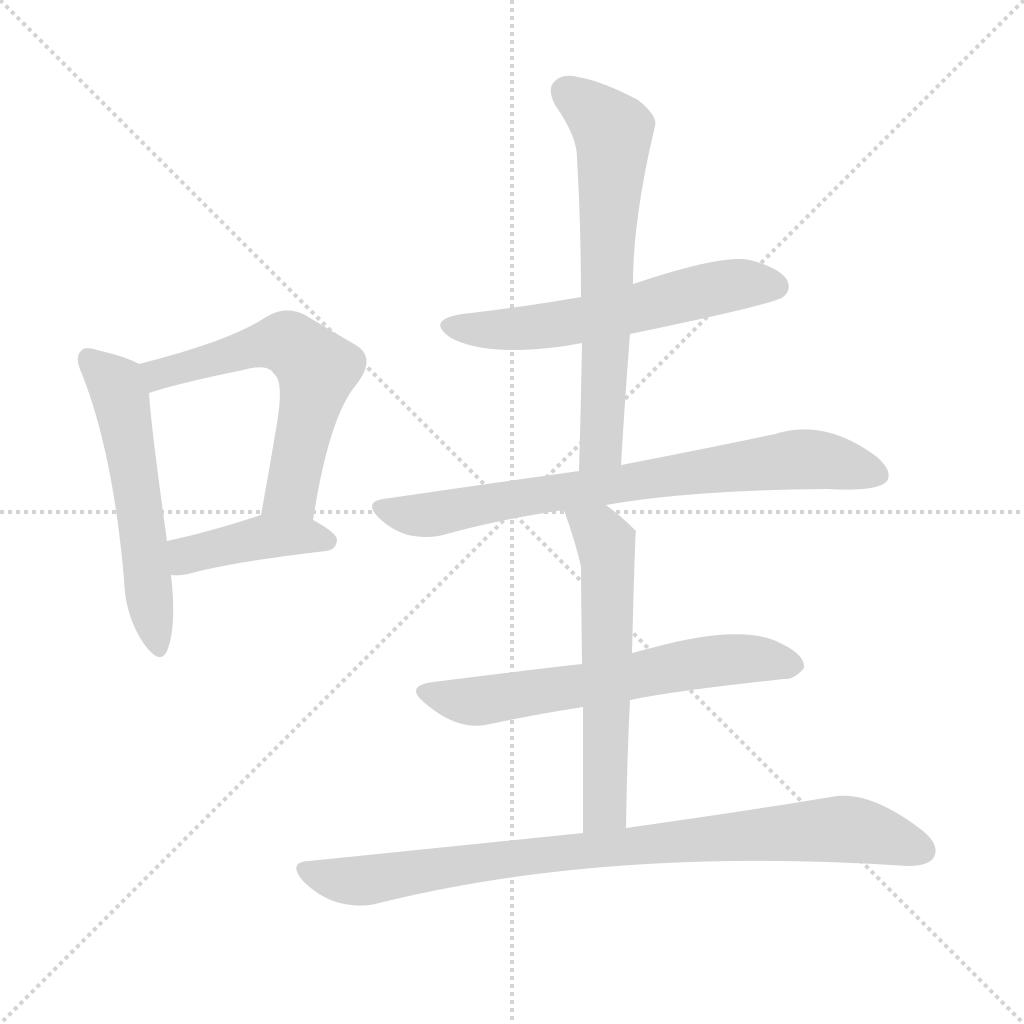
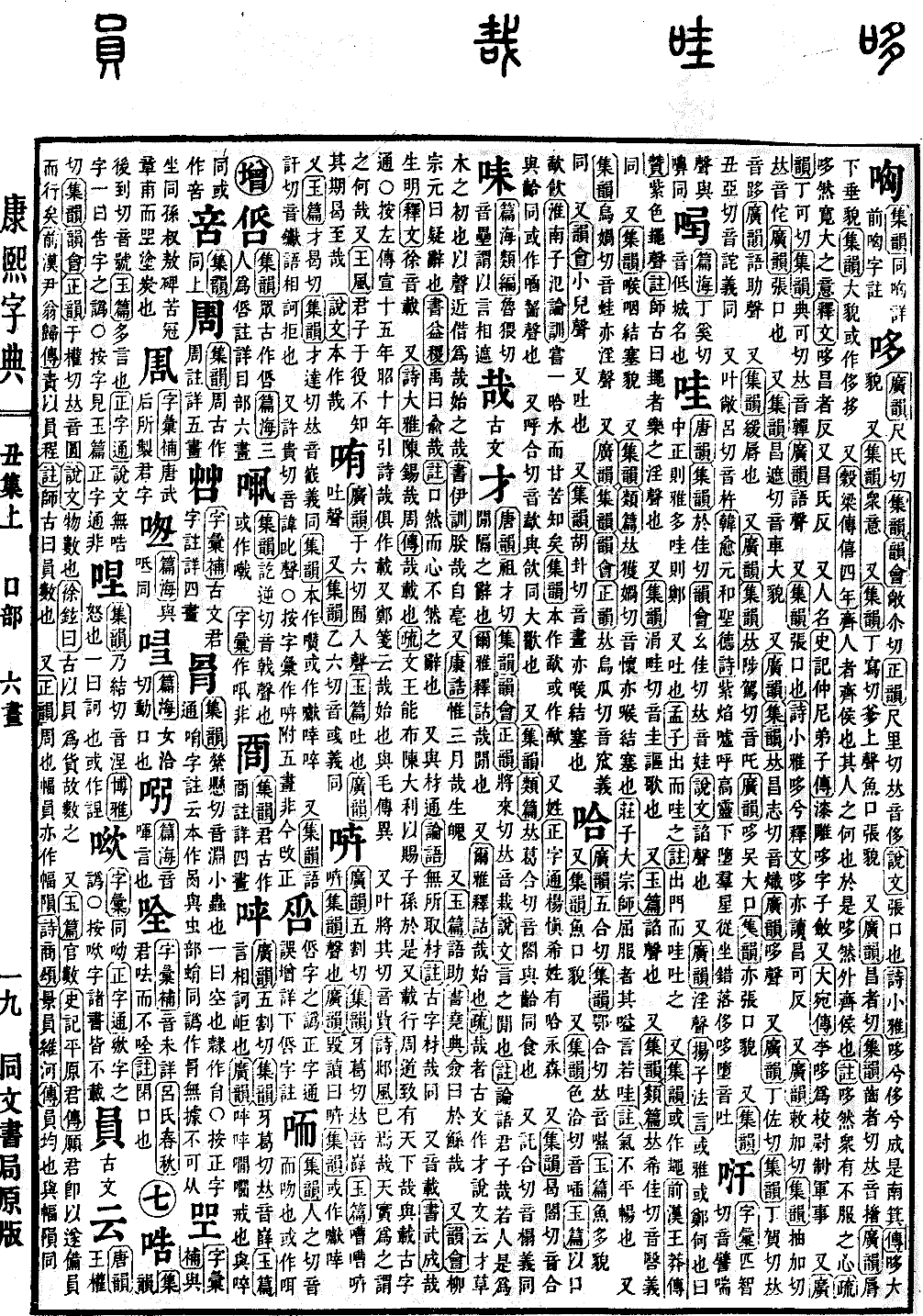
Chou Collection, Upper Volume
Radical: Mouth (kǒu)
wa
Kangxi Strokes: 9
Page 189, Entry 05
Tang Rhymes (Tangyun) and Collected Rhymes (Jiyun) state the pronunciation is wa. Rhyme Gathering (Yunhui) states the pronunciation is wa. Pronounced wa (level tone).
Shuowen Jiezi states it refers to the sound of flattery. Also, according to Guangyun, it refers to lewd or lascivious sounds.
Yangzi's Model Sayings (Fayan) asks: Some sounds are elegant and correct while others resemble the music of Zheng, why is this? The answer is: moderation and correctness constitute elegance, whereas an excess of wa sounds constitutes the music of Zheng.
Also, to vomit.
Mencius says: He went out the door and wa-ed it. The commentary explains: He went out the door and vomited it.
Also, according to Collected Rhymes (Jiyun), sometimes written in a variant form.
In the praise attached to the Biography of Wang Mang in the History of the Former Han (Qian Han Shu), there is mention of purple colors and wa sounds. The commentary by Yan Shigu states: Wa sounds refer to the lewd sounds in music.
Also, according to Collected Rhymes (Jiyun), pronounced gui. To sing.
Also, according to the Jade Compendium (Yupian), it refers to the sound of flattery.
Also, according to Collected Rhymes (Jiyun) and Classified Dictionary (Leipian), pronounced xi. The meaning is the same.
Also, according to Collected Rhymes (Jiyun), it describes the appearance of a choked throat.
Also, according to Collected Rhymes (Jiyun) and Classified Dictionary (Leipian), pronounced huai. It also refers to a choked throat.
Zhuangzi's Great and Venerable Teacher (Da Zongshi) says: For those who submit, their throat makes a sound like wa. The commentary explains: The breath is not flowing smoothly.
Also, according to Collected Rhymes (Jiyun), pronounced wa. It also refers to lewd sounds.
Also, according to Guangyun, Collected Rhymes (Jiyun), Rhyme Gathering (Yunhui), and Correct Rhymes (Zhengyun), pronounced wa. The meaning is the same.
Also, according to Rhyme Gathering (Yunhui), the sound made by a small child. Also, to vomit.
Also, according to Collected Rhymes (Jiyun), pronounced hua. It also refers to a choked throat.