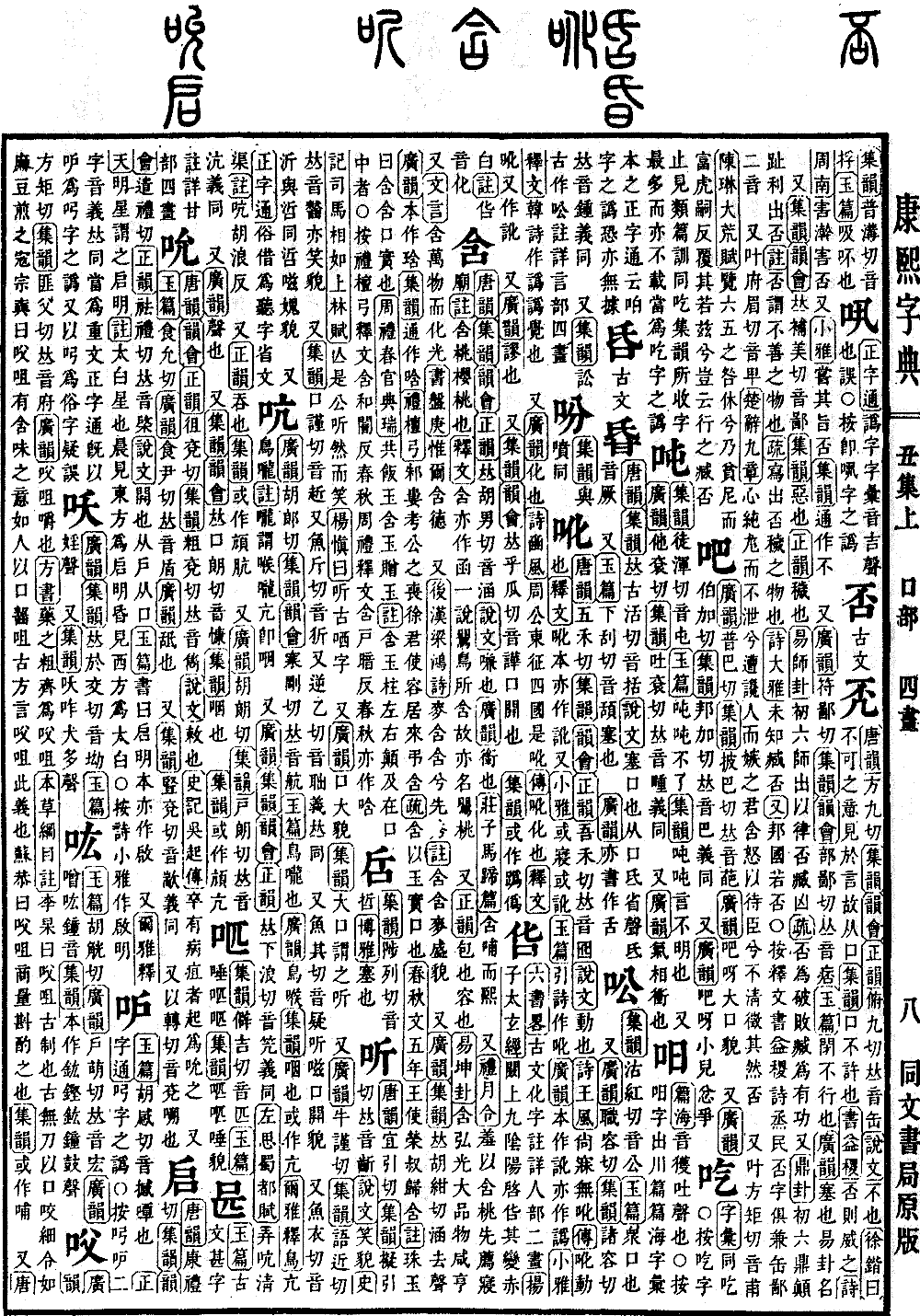
Chou Collection, Upper Volume
Radical: Mouth (kǒu)
Kangxi Strokes: 22
Page 178, Entry 16
Pronounced yin (rising tone).
Shuowen Jiezi (Shuowen): The appearance of laughing.
Records of the Grand Historian (Shiji), Biography of Sima Xiangru, Ode to the Imperial Park (Shanglin fu): Master Wangshigong laughed (ting ran).
Yang Shen says: Ting is the ancient form of the character for smile (shen).
Also, according to Guangyun: The appearance of a large mouth.
According to Jiyun: A large mouth is called ting.
Also pronounced jin (rising tone).
Also pronounced jin (rising tone).
Also pronounced jin (rising tone).
Also pronounced yi (rising tone).
Also pronounced yi (rising tone).
Also pronounced yi (rising tone).
Also pronounced yi (rising tone). The meaning is the same.
Also pronounced yi (rising tone). Ting-zi is the appearance of an open mouth.
Also pronounced yi (rising tone). Equivalent to another character. Zi (a variant form) describes the appearance of feeling ashamed.
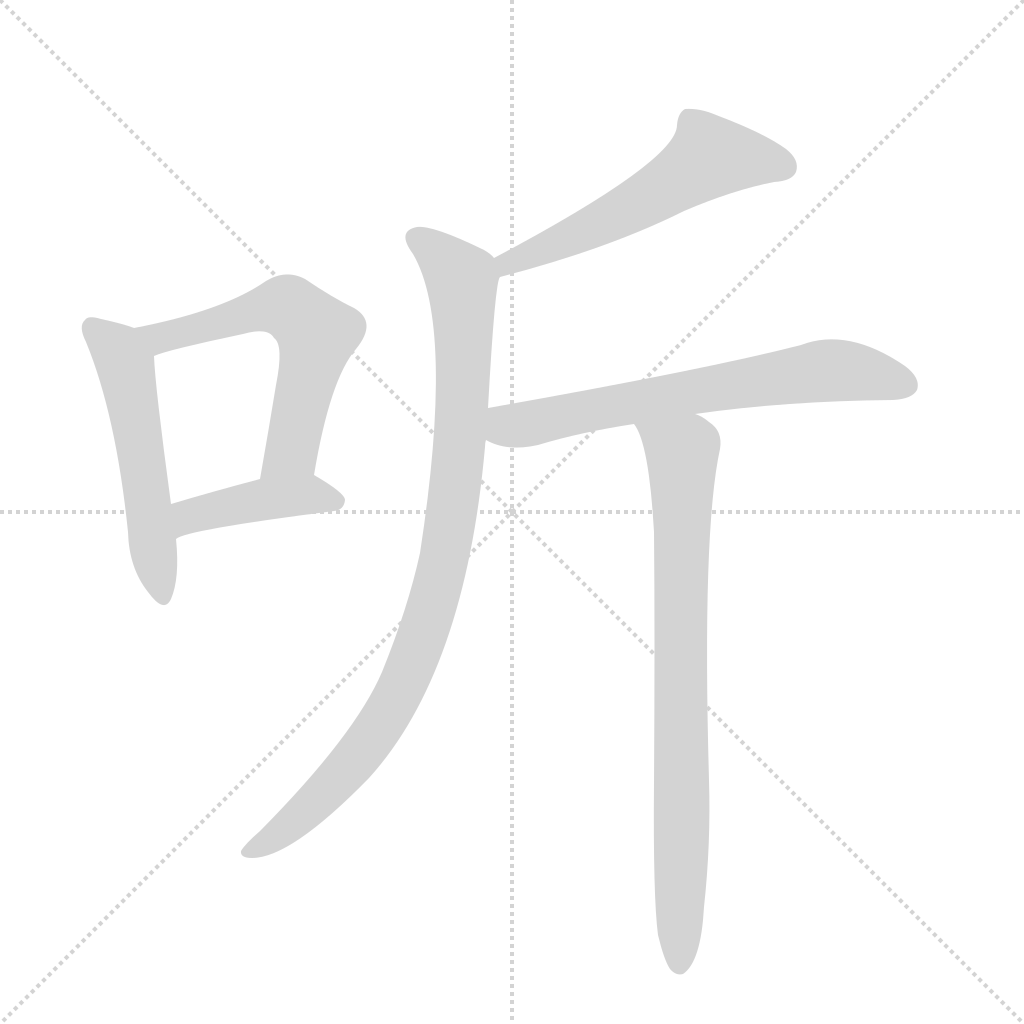
According to Zhengzitong: A popular simplified form borrowed for the character meaning to listen (ting).
Ancient form of the character for to listen (ting).
Pronounced ting (falling tone).
Shuowen Jiezi (Shuowen): To use the ears to receive sound.
Explanation of Names (Shiming): Ting means to be still. Only when one is still can what is heard be understood clearly.
Book of Documents (Shujing), Counsels of Gao Yao (Taijia): To listen to the words of the virtuous is what defines wisdom.
Book of Etiquette and Ceremonial (Yili), Marriage Rites of the Gentry: Admonishment says: Listen respectfully and comply with the words of your parents.
Also: To wait.
Also: To accept.
Zuo Commentary (Zuozhuan), Eleventh Year of Duke Cheng: The Earl of Zheng went to the State of Jin to accept peace terms.
Commentary: Ting is like accepting.
Also: To obey.
Book of Changes (I Ching), Gen Hexagram: One cannot save his followers, because the followers did not retreat and obey.
Commentary: Ting means to obey.
Zuo Commentary (Zuozhuan), Twenty-sixth Year of Duke Zhao: The mother-in-law is kind, the daughter-in-law obeys.
Also: To judge or try a case.
Book of Rites (Liji), Royal Regulations: The Minister of Justice distinguishes criminal laws to try lawsuits.
Rites of Zhou (Zhouli), Offices of Heaven, Grand Administrator: All minor state affairs are managed by the Chief Administrator.
History of the Former Han Dynasty (Qian Hanshu), Treatise on Penal Law: First, listen to the words; second, observe the expression; third, examine the breathing; fourth, verify the hearing; fifth, look at the eyes.
Also: To allow or permit.
History of the Former Han Dynasty (Qian Hanshu), Annals of Emperor Jing: It was proposed that commoners wishing to move to vast and fertile lands be permitted to do so.
Also: To scout or spy.
Strategies of the Warring States (Zhanguo Ce): Please allow me to scout the situation of the eastern states for Your Majesty.
Commentary: Ting means to scout.
Pronounced ting.
According to Jiyun: To listen, to accept. A government hall is called a tingshi, meaning it is a place where affairs are accepted and lawsuits are examined. Popularly written as a character with a cliff radical.
Mr. Mao says: In the Han and Jin dynasties, it was written as ting; it was only from the Six Dynasties period onward that the cliff radical was added.
Rhyme Supplement (Yunbu): Rhymes with the sound tang.
Su Zhe, Reading the Daoist Canon (Du Daozang): In the past when Huizi died, Zhuangzi laughed and grieved for himself. Subtle words are no longer understood; once spoken, who is there left to listen?