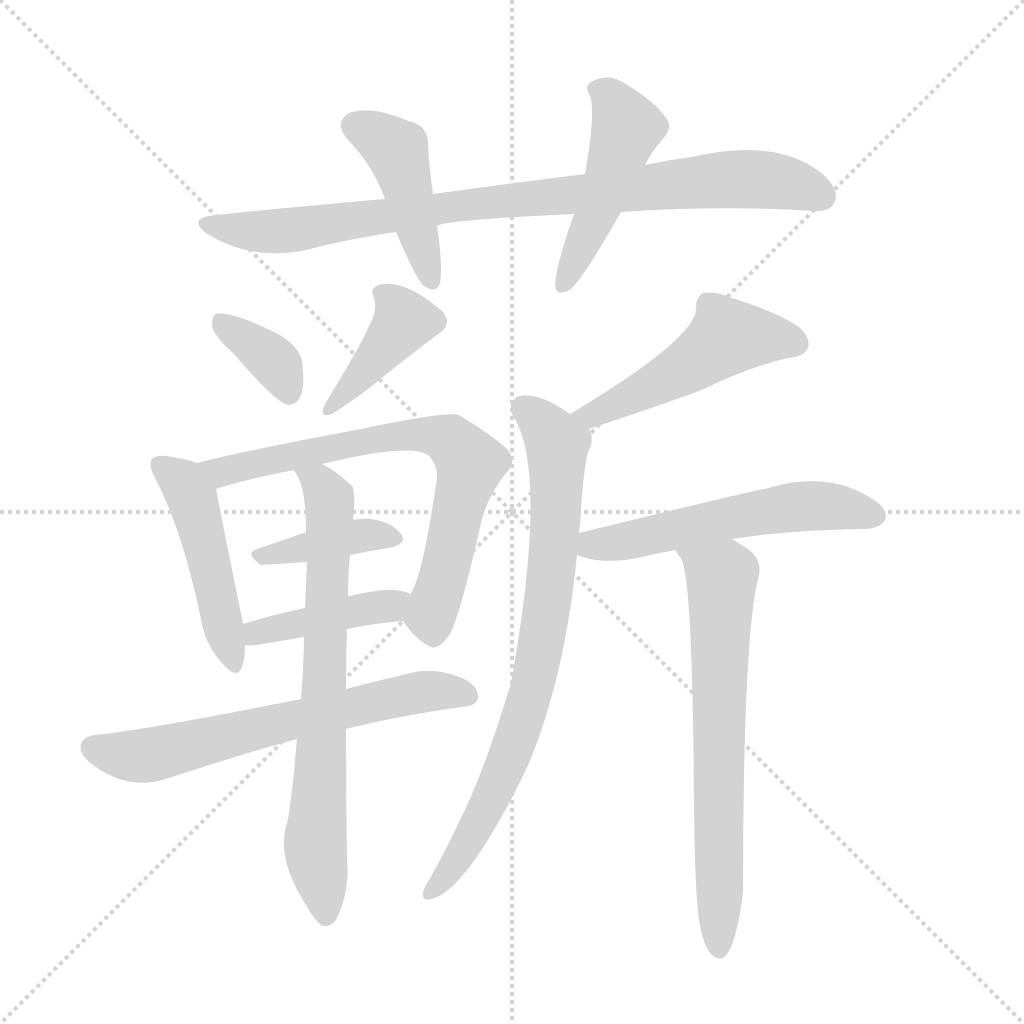
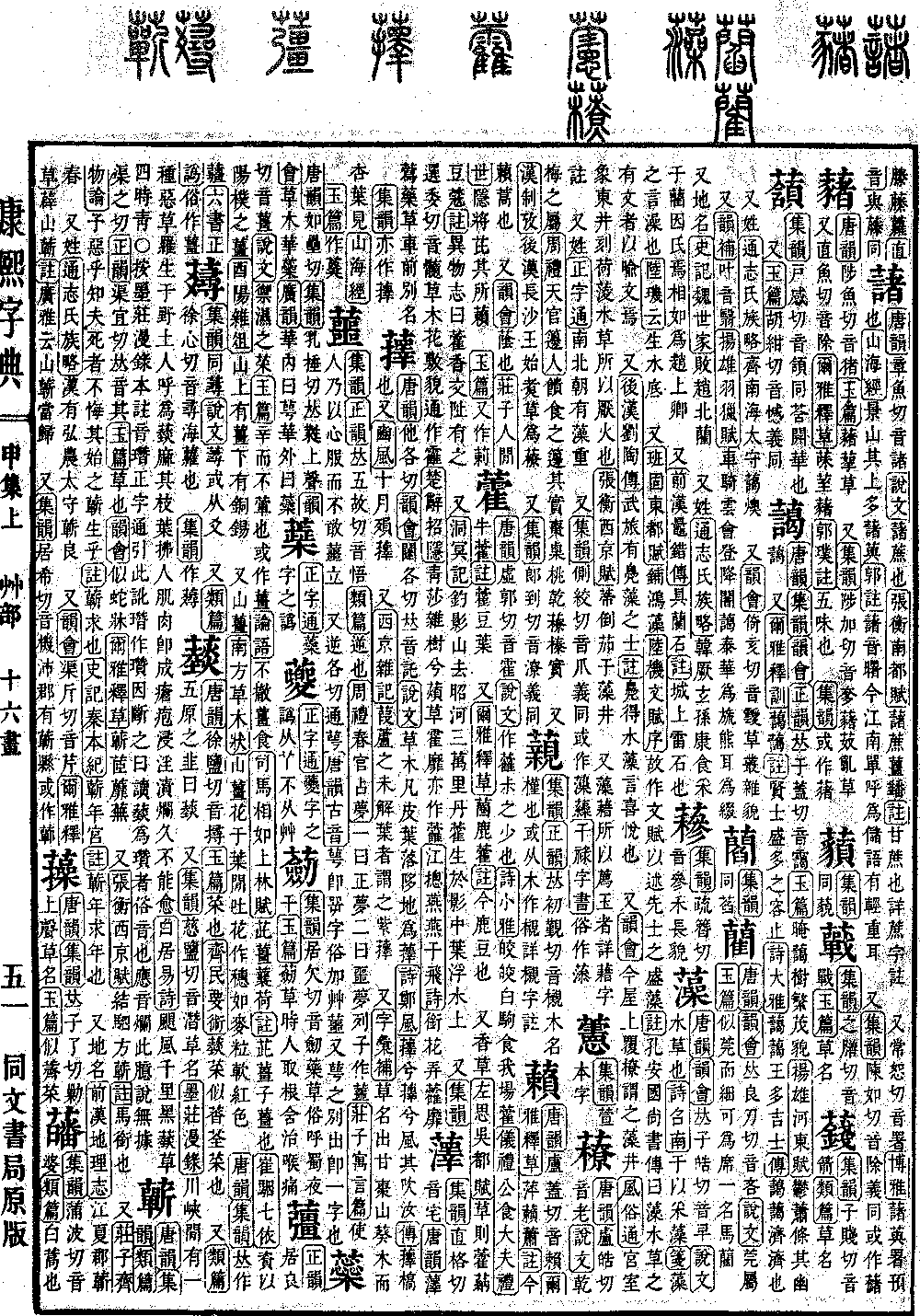
Shen Collection, Upper Volume
Radical: Grass (cǎo)
Kangxi strokes: 22
Page 1067, Entry 01
Pronounced qi.
In the Jade Chapters (Yupian), it is defined as a type of grass.
In the Collection of Rhymes (Yunhui), it is described as resembling a snakewort.
In the Literary Expositor (Erya), in the chapter explaining grasses: "Qi-chai is miwu."
Also in the Western Capital Rhapsody (Xijing Fu) by Zhang Heng: "Tying the team of horses to the qi." The commentary states: "A horse bit."
Also in the Zhuangzi, in the Discourse on Making All Things Equal: "How do I know that those who have died do not regret having sought life in the beginning?" The commentary states: "Qi means to seek."
In the Records of the Grand Historian (Shiji), in the Basic Annals of Qin: "Qinian Palace." The commentary states: "Qinian means to seek longevity."
Also a place name. In the Former Han History (Hanshu), in the Treatise on Geography: "Qichun, in Jiangxia Commandery."
Also a surname. In the Comprehensive Treatises (Tongzhi), in the Outline of Clans and Lineages: "During the Han dynasty, there was a Governor of Hongnong named Qi Liang."
Also pronounced qin. In the Collection of Rhymes (Yunhui): "In the Literary Expositor (Erya), in the chapter explaining grasses: 'Bi is shanqi.' The commentary states: 'The Guangya states that shanqi is angelica.'"
Also pronounced ji. There is a Qi County in Pei Commandery. Sometimes written in a variant form (qi).