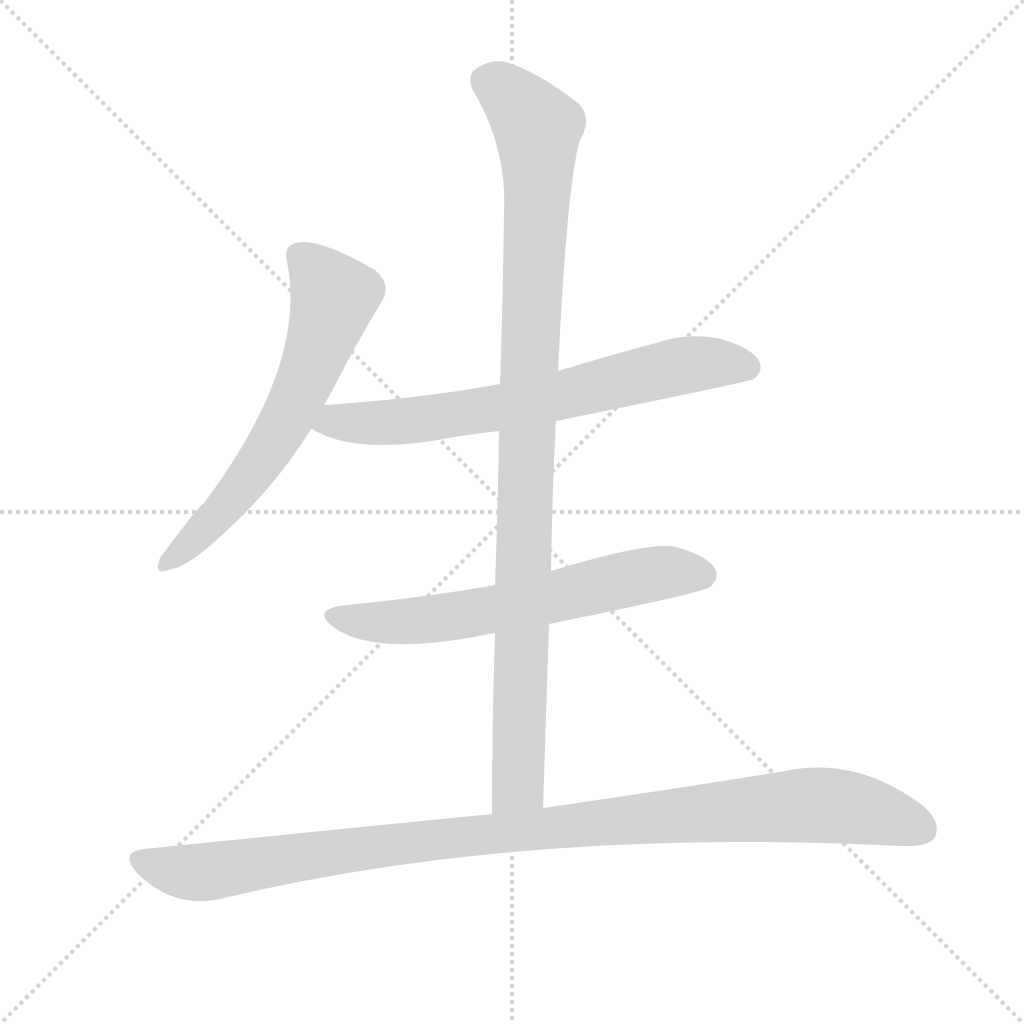
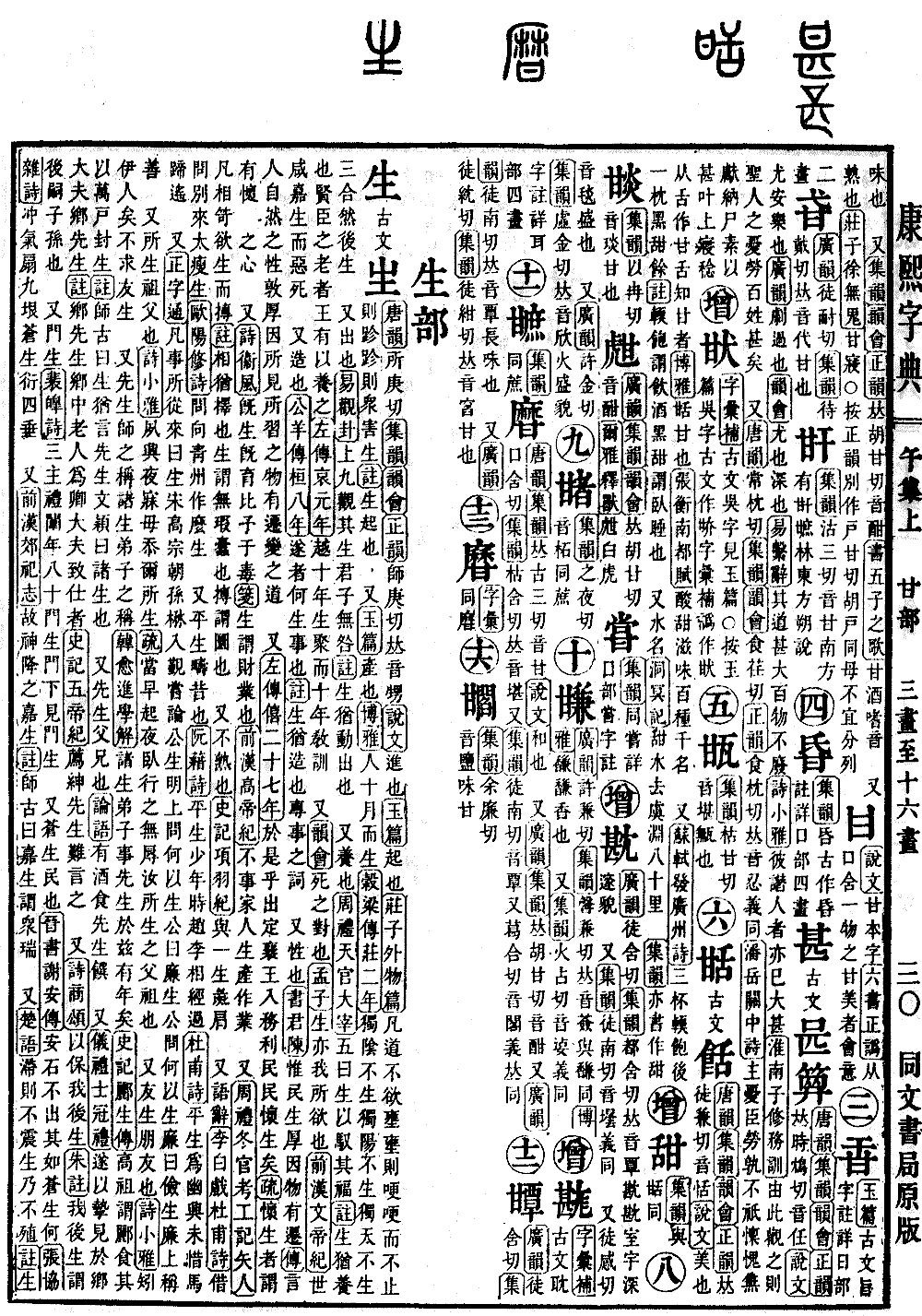
Wu Collection, Upper Volume
Radical: Life (shēng)
Page 754, Entry 26
Pronounced shēng.
In Tang Yun, Jiyun, Yunhui, and Zhengyun, it is pronounced shēng (level tone).
According to Shuowen, it means to advance.
According to Yupian, it means to rise.
In the chapter on external objects in the Zhuangzi, it states that if the Way is not obstructed, it will not be blocked; if it is blocked and does not cease, then there will be fatigue; and if there is fatigue, the masses will suffer harm. The commentary notes that to emerge means to rise.
Also, according to Yupian, it means to produce.
According to Boya, a human is born after ten months.
In the Guliang Zhuan (second year of Duke Zhuang), it states that singular yin does not produce, singular yang does not produce, and singular heaven does not produce; only when the three combine can they produce.
Also means to emerge.
In the Book of Changes (Yijing), regarding the Guan hexagram, it says to observe its emergence. The noble man has no blame. The commentary notes that emergence is similar to moving or coming out.
Also means to nourish.
In the Rites of Zhou (Zhouli), under the Heavenly Officials, it says the fifth is to nourish to harness their fortune. The commentary notes that to nourish means to care for. It refers to a worthy minister who is elderly, whom the king has means to support.
In the Zuo Zhuan (first year of Duke Ai), it says that in ten years, they accumulated resources, and in ten years, they taught and trained.
Also, according to Yunhui, it is the opposite of death.
In the Mencius, it says life is also what I desire.
In the History of the Former Han (Qianhan Shu), in the annals of Emperor Wen, it says the world all values life and hates death.
Also means to create.
In the Gongyang Zhuan (eighth year of Duke Huan), it asks what is meant by creating. The commentary notes that to create is a term for starting an affair.
Also means nature.
In the Book of Documents (Shangshu), under Jun Chen, it says the people's nature is thick, and according to the objects they see, they change. The commentary explains that people's natural disposition is honest and thick, and because of the things they see and practice, they have ways of changing.
In the Zuo Zhuan (twenty-seventh year of Duke Xi), it says they then went out to stabilize Duke Xiang and entered to work for the benefit of the people; the people cherished their lives. The sub-commentary explains that cherishing life means having a heart that cares.
In the Book of Odes (Shijing), in the Airs of Wei, it says having given birth and raised, comparing me to poison. The commentary notes that life here refers to property and industry.
In the History of the Former Han, in the annals of Emperor Gao, it says one does not work in family matters, nor engage in production.
In the Rites of Zhou, under the winter officials, in the records of the bow-maker, it says that when selecting materials for the shaft, one wants it fresh and round. The commentary notes that to select means to choose, and fresh means without decay or worms. Round means circular.
Also means raw or uncooked.
In the Records of the Grand Historian (Shiji), in the annals of Xiang Yu, it mentions a piece of raw pig's shoulder.
Also a sentence particle.
In a poem by Li Bai teasing Du Fu, it asks why you are so thin since we parted.
In a poem by Ouyang Xiu, it asks what you are doing in Qingzhou.
Also means lifetime or the past.
In a poem by Ruan Ji, it says in my lifetime, when I was young, Zhao and Li visited each other.
In a poem by Du Fu, it says in my lifetime, because of my refined interests, I have not begrudged the distance traveled by my horse.
According to Zhengzitong, all things that have a source are called生. During the reign of Emperor Gaozong of the Song Dynasty, Sun Mao was granted an audience and discussed how impartiality produces clarity. The Emperor asked what produces impartiality. He replied that integrity produces impartiality. When asked what produces integrity, he replied that frugality produces integrity. The Emperor praised this.
Also means parents or grandparents.
In the Book of Odes, in the Lesser Odes, it says do not disgrace your parents. The sub-commentary says one should rise early and sleep late, and act in a way that does not disgrace the father or grandfather who gave you life.
Also means friends.
In the Book of Odes, in the Lesser Odes, it says that even for a person, one should not cease seeking friends.
Also means teacher. Students are called pupils.
In Han Yu's Jin Xue Jie, it says the teacher of the National University enters the academy in the morning to summon the students.
In the Records of the Grand Historian, in the biography of Li Sheng, it says Emperor Gao addressed Li Yiji, promising to enfeoff him with ten thousand households. The commentary by Shiguli says the term Sheng is used like the term teacher. Wen Ying says it refers to students.
Also means father or elder brother.
In the Analects, it says if you have wine and food, let the teacher eat.
In the Book of Etiquette and Ceremonial (Yili), it says one then uses a formal gift to see the local official and the local elders. The commentary notes that local elders are those in the village who have served as ministers or high officials and have retired.
In the Records of the Grand Historian, it says the elders of the scholar class found it difficult to speak.
In the Book of Odes, in the Eulogies of Shang, it says to protect our descendants. The commentary by Zhu Xi says our descendants refer to offspring and grandchildren.
Also means a pupil.
In a poem by Pei Hao, it mentions serving as an official for the examinations for eighty years, with pupils seeing pupils under the master's gate.
Also means the common people.
In the History of the Jin Dynasty (Jin Shu), in the biography of Xie An, it asks if Anshi does not come out, what will happen to the common people?
In a miscellaneous poem by Zhang Xie, it describes the vital energy fanning the world, and the common people multiplying in all directions.
In the History of the Former Han, in the records of suburban sacrifices, it says the spirits sent down auspicious signs. The commentary by Shiguli says auspicious signs refer to many omens.
In the Discourses of Chu (Chuyu), it says if the flow is stagnant it will not shake; if the living creatures do not multiply, they will not survive. The commentary notes that living creatures refer to people and things.
Also a river name.
In the Classic of Mountains and Seas (Shanhaijing), it says two hundred and twenty li to the north is Mount Yu. The Sheng River rises there and flows east into the Yellow River. The commentary notes this is the Sheyan River. The water flows west from the southwest of Sheyan County and flows northeast.
Also a surname.
According to Zhengzitong, in the Han Dynasty, there was Sheng Lin, and in the Ming Dynasty, there was Sheng Fu Shen.
Also refers to compound surnames like Weisheng and Haosheng.
Also synonymous with cattle.
In the History of the Former Han, in the annals of Emperor Zhao, it says to order the breaking of the Wuhuan, and those who behead the enemy and capture prisoners have merit. The commentary says capturing prisoners means capturing live captives.
Also synonymous with a creature.
In the Jizhong Zhou Shu, it mentions Guo Du Sheng Sheng.
Pronounced shèng.
Means to produce.
In Zihui, it is colloquially said that a chicken lays an egg.
Pronounced shèn.
Means to raise.
In the commentary to the Analects, it says four births produced eight children. Lu Deming's notes say it is pronounced shèn or read as written.
Pronounced xìng.
In the Rites of Zhou, under the land officials, it says to use the law of combining land to identify the things produced by the five types of soil. The commentary by Du Zichun reads this as nature.
Also, in poetic rhyme usage, it rhymes with shāng.
In a poem by Fu Yi, it says in the mountains it is towering, in the water it is vast; changing with one's aspirations, the appearance is not in vain.
Also rhymes with xīng.
In the Book of Odes, in the Lesser Odes, it says though you have brothers, they are not as good as friends.
Also rhymes with shān.
In a poem by Dongfang Shuo, it says watching the flames of the heavenly fire, listening to the waves of the great sea; guiding oneself by the eight directions, and containing the essence of the stars to live long.
Also rhymes with shàn.
In the Huangting Jing, it says internally nourishing the three spirits allows one to live long; the soul wants to ascend to heaven while the spirit enters the abyss, returning to nature is the Way.