Zi Collection, Page Position: Lower
Radical: Right hand (yòu)
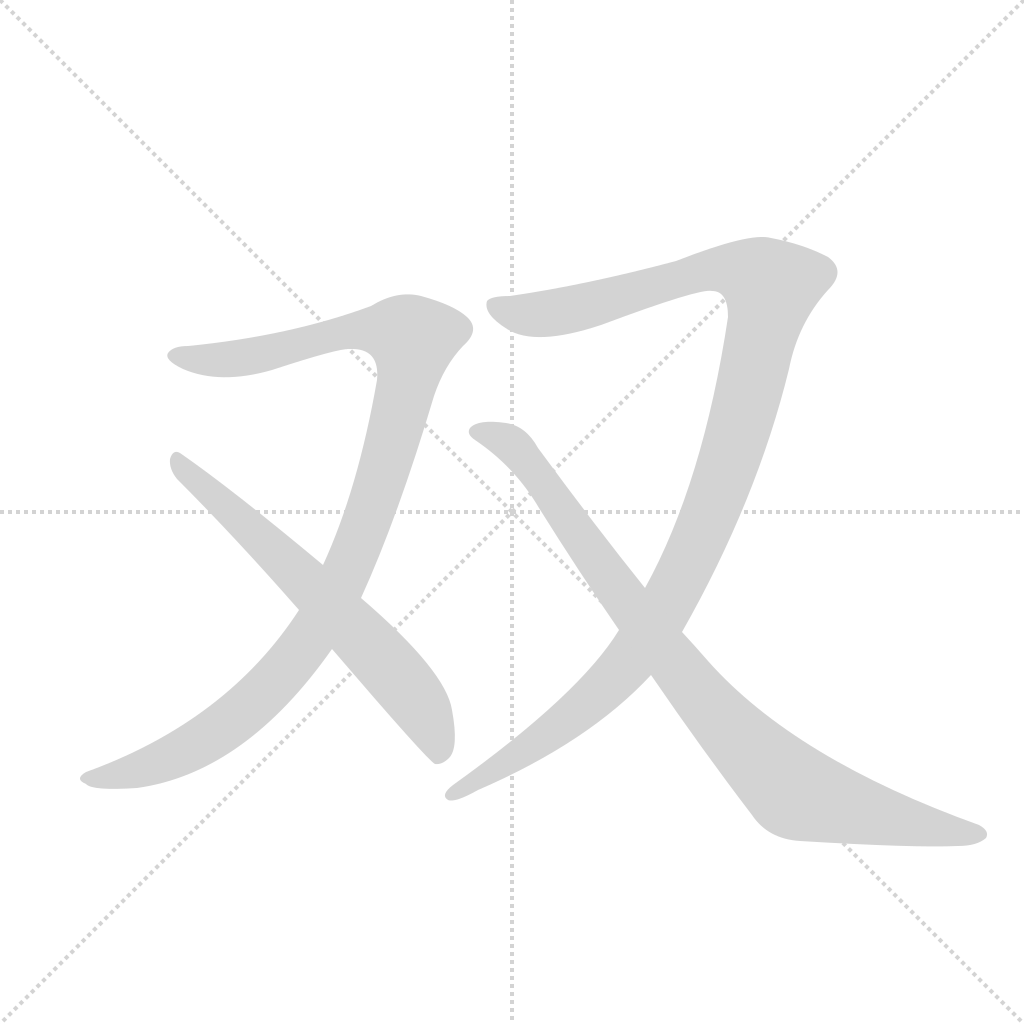
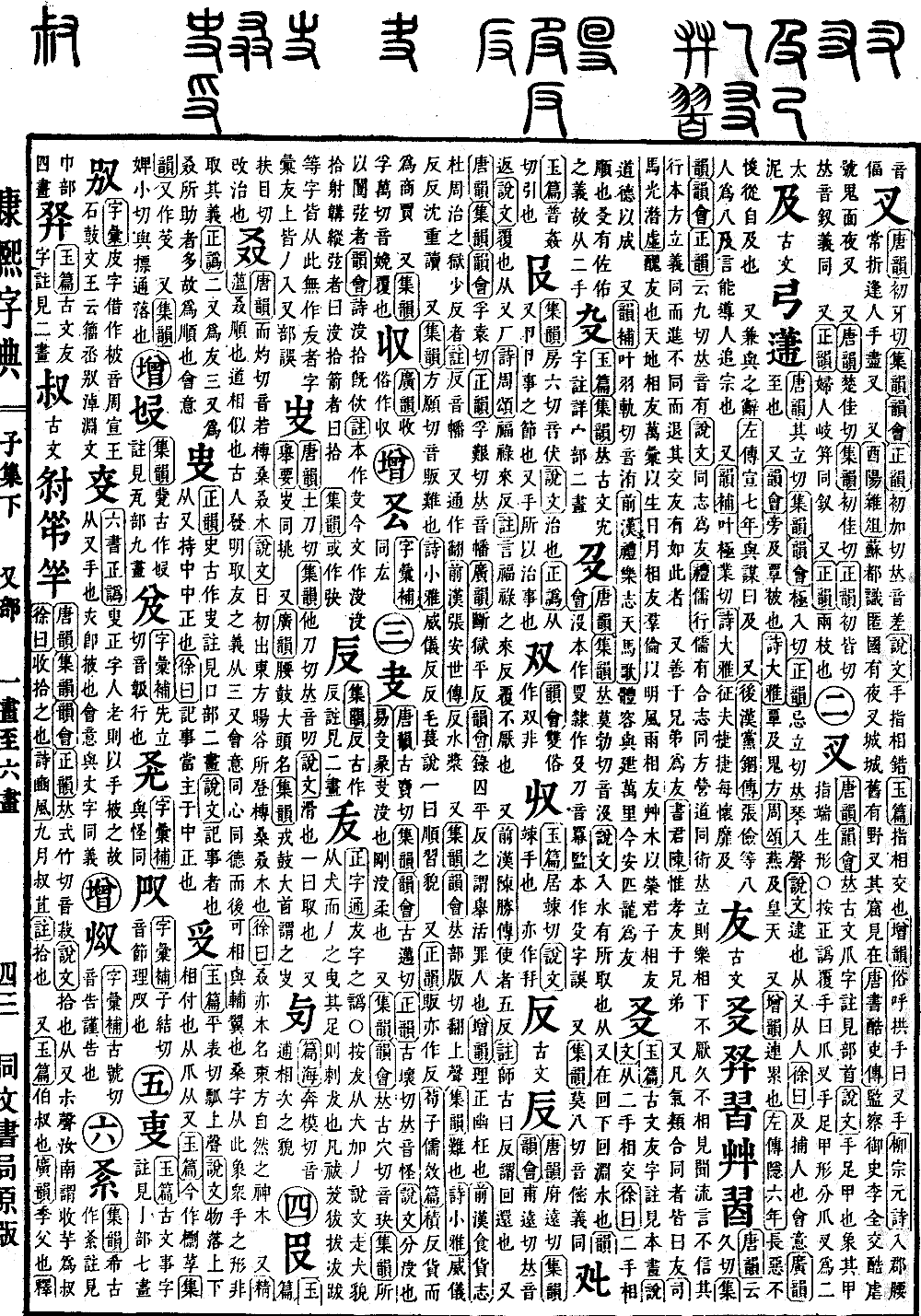
Double; Kangxi stroke count: 18; Page 165, Entry 17
Rhyme Collection (Yunhui): Shuang, commonly written as double, which is incorrect. Shuang
Tang Rhyme (Tangyun): Pronounced shuang; Collection of Rhymes (Jiyun), Rhyme Collection (Yunhui): Pronounced shu, tone unknown.
Explanation of Simple and Compound Characters (Shuowen): Two birds. Composed of two birds (chou), and a hand (you) holding them.
Biography of Wang Qiao in the History of the Later Han (Houhan Shu): A pair of wild ducks flew in from the southeast.
Also, Jade Chapters (Yupian): Two.
Book of Etiquette and Ceremonial (Yili): When making an offering, hold one pair.
Also, Jade Chapters (Yupian): Even or paired.
Book of Odes (Shijing), Odes of Qi: Hat ribbons paired together.
Commentary (Jian): Five people form an odd number, and Duke Xiang went to follow them and made them a pair.
Also, the name of a beast.
Classic of Mountains and Seas (Shanhaijing): Outside the Southern Sea, west of the Red River, east of the Drifting Sands, there are three green beasts joined together, named shuangshuang.
Commentary (Zhu): Guo Pu says: It means their bodies are joined as one. What is mentioned in the Commentary of Gongyang (Gongyang Zhuan) as arriving together as a pair refers to this.
Wu Renchen says: The Classic of Beasts (Shoujing) says: Wenwen is good at calling, shuangshuang is good at walking. The Records of Joined Creatures (Pianzhi) says: Shuangshuang join their bodies; qiongqiong share feet. The Book of the Qilin (Linshu) says: Shuangshuang come together, and the mengji covers them.
Also, the name of a bird.
Commentary of Gongyang (Gongyang Zhuan), Fifth Year of Duke Xuan: Perhaps it is because they arrived together as a pair.
Commentary (Shu): Old traditions state: The bird called shuangshuang has one body and two heads and tails. It has male and female, and they pair up as they please, never separating, hence it is used as a metaphor. Note: The commentary on the Commentary of Gongyang differs from the commentary on the Classic of Mountains and Seas.
Also, Zhengzitong: A poem by Wen Tingyun: Inviting guests, first opening forty pairs.
Wang Yanzhou notes: A pair is five mu. Forty pairs is two hundred mu.
Others say, History of the Tang (Tang Shu), Record of Nanzhao: The government provides fields, four pairs equals two hundred mu.
Also, Yunnan Miscellaneous Records: In local farming, three people use two oxen, one pulling in front, one pressing in the middle, one driving from the back; one plowing is called one pair.
Also, Tao Jiucheng in the Records of Ploughing (Chuogenglu) states one pair is four mu, and in Buddhist lands two mu is one pair, as each follows its own local custom and terminology; there is no fixed number.
Also, a surname.
Zhengzitong: The filial son Shuang Taizhen of the Northern and Southern Dynasties.
Also, Collection of Rhymes (Jiyun): Pronounced cong. Even or paired.
Also, rhymes with zhong. Xie Huilian, Qixi Poem: Playing with the shuttle but not completing the pattern, raising the reins and galloping toward the previous tracks. In the past, the autumn separation already reached two, now gathered on this evening, there is none that is a pair.