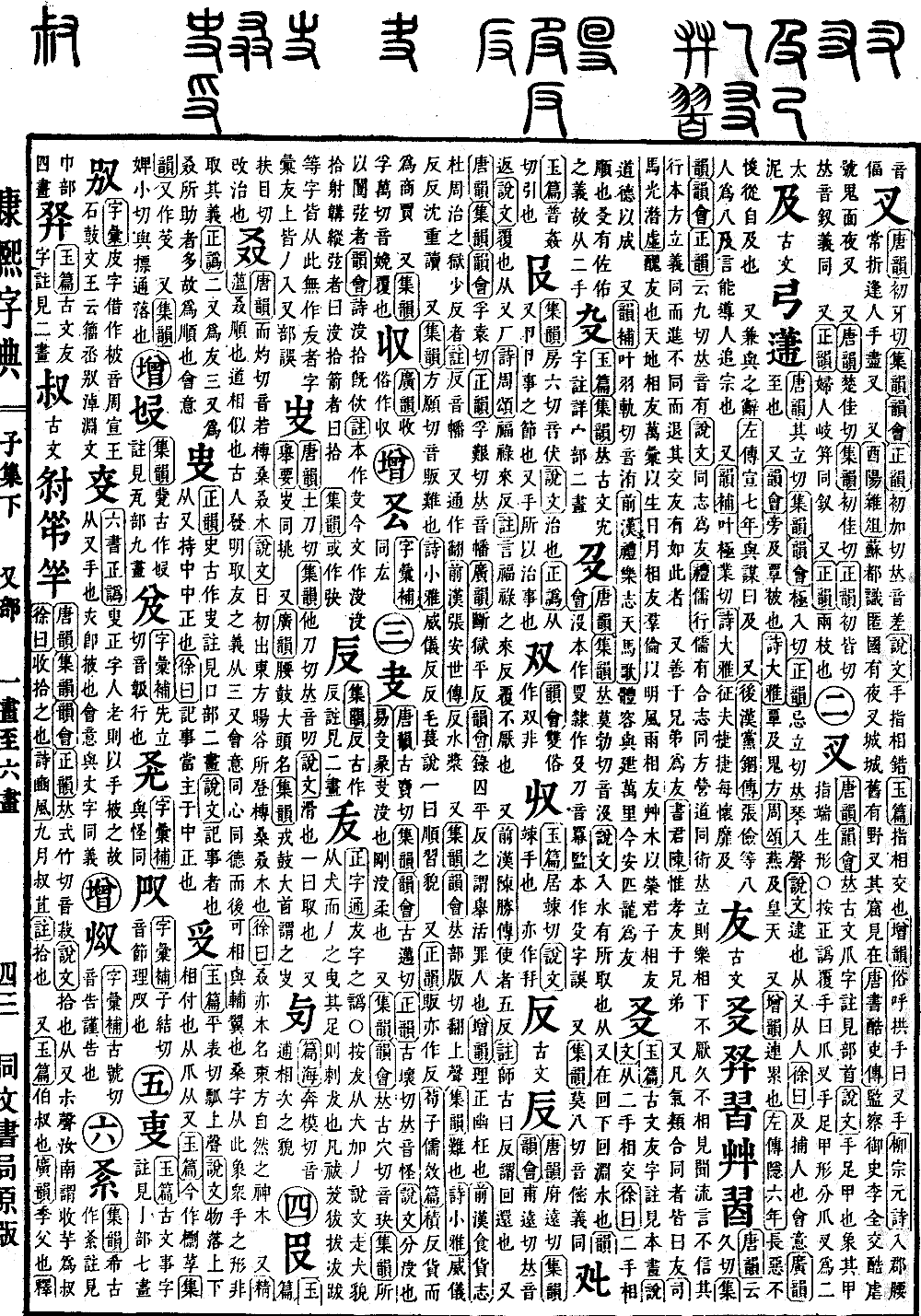
Xu Collection, Middle Volume
Radical: Short-tailed bird (zhuī)
Kangxi strokes: 18
Page 165, Entry 01
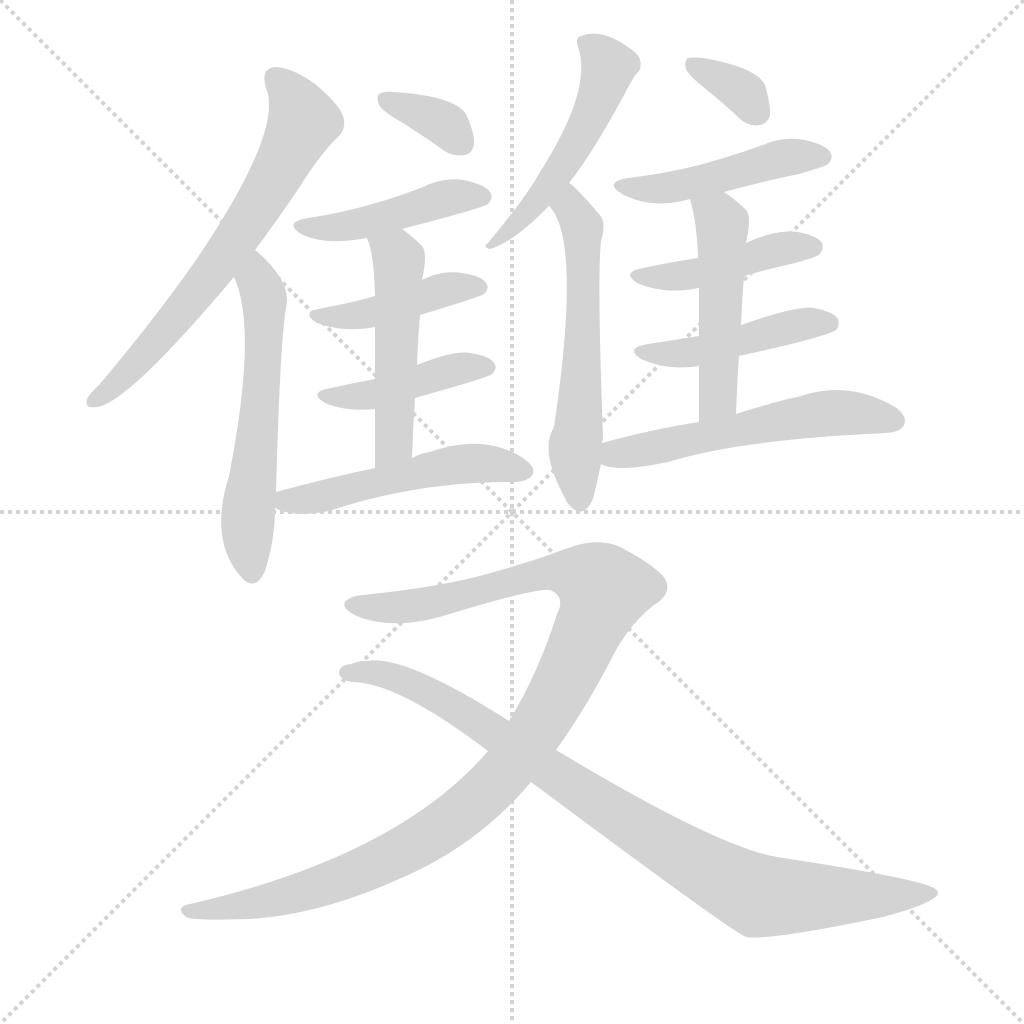
Pronounced shuang.
In the Explanation of Characters (Shuowen), it is defined as two short-tailed birds. Formed from the character for a pair of birds, and the component indicating holding them.
From the Biography of Wang Qiao in the History of the Later Han (Hou Hanshu): There was a pair of wild ducks flying in from the southeast.
Also, per the Jade Treasury (Yupian), it means two.
In the Book of Etiquette and Ceremonial (Yili), in the section on visiting rites: Generally, when offering gifts, one holds a pair.
Also, per the Jade Treasury (Yupian), it means a couple or an even number.
In the Book of Odes (Shijing), in the Odes of Qi: The crown ribbons are a pair.
The commentary (Jian) states: Five people make an odd number, and Duke Xiang went to follow them and make it an even pair.
Also, the name of a beast.
In the Classic of Mountains and Seas (Shanhaijing): Beyond the southern seas, west of the Red River and east of the Flowing Sands, there are three green beasts joined together, called shuangshuang.
The commentary by Guo Pu states: This refers to bodies joined into one. What is mentioned in the Commentary of Gongyang (Gongyang Zhuan) as arriving together as a pair refers to this.
Wu Renchen says: The Classic of Beasts (Shoujing) says: The wenwen is good at calling, the shuangshuang is good at walking. The Pianzhi says: The shuangshuang are joined in body, the qiongqiong borrow legs. The Linshu says: The shuangshuang arrive together, the mengji covers them.
Also, the name of a bird.
In the Commentary of Gongyang (Gongyang Zhuan), fifth year of Duke Xuan: Perhaps it is because they arrive together in a pair?
The sub-commentary (Shu) states: Old traditions say that the shuangshuang bird has one body but two heads and tails, possessing both male and female characteristics, always remaining together and never separating, and thus it is used as a metaphor. Note that the sub-commentary of the Commentary of Gongyang differs from the commentary in the Classic of Mountains and Seas.
Also, in the Correct Character Guide (Zhengzitong): In a poem by Wen Tingyun: Inviting guests, first open forty pairs.
Wang Yanzhou’s commentary states: A pair refers to five mu of land. Forty pairs equal two hundred mu.
Alternatively, it is said in the Record of Nanzhao in the Book of Tang (Tangshu): Officials grant land, and four pairs equal two hundred mu.
Also, in the Yunnan Miscellany (Yunnan Zazhi): In local farming customs, three people use two oxen, one to pull in front, one to press in the middle, and one to drive from behind; one plowing session is called a pair.
Also, in the Records After Retiring from Plowing (Chuogenglu) by Tao Jiucheng, it is stated that one pair is four mu, while in Buddhist lands, two mu are considered one pair. It is likely that these are named according to local customs and there is no fixed standard measure.
Also, a surname.
In the Correct Character Guide (Zhengzitong): The filial son Shuang Taizhen of the Northern and Southern Dynasties.
Also, pronounced cong. Means a couple or even number.
Also, used as a rhyme ending in the sound zhong.
In the Qixi Poem by Xie Huilian: Handling the shuttle, the pattern remains unfinished, raising the reins, I rush forward in tracks. In the past, the autumn of separation was already two, now gathered this evening, there is no peer.