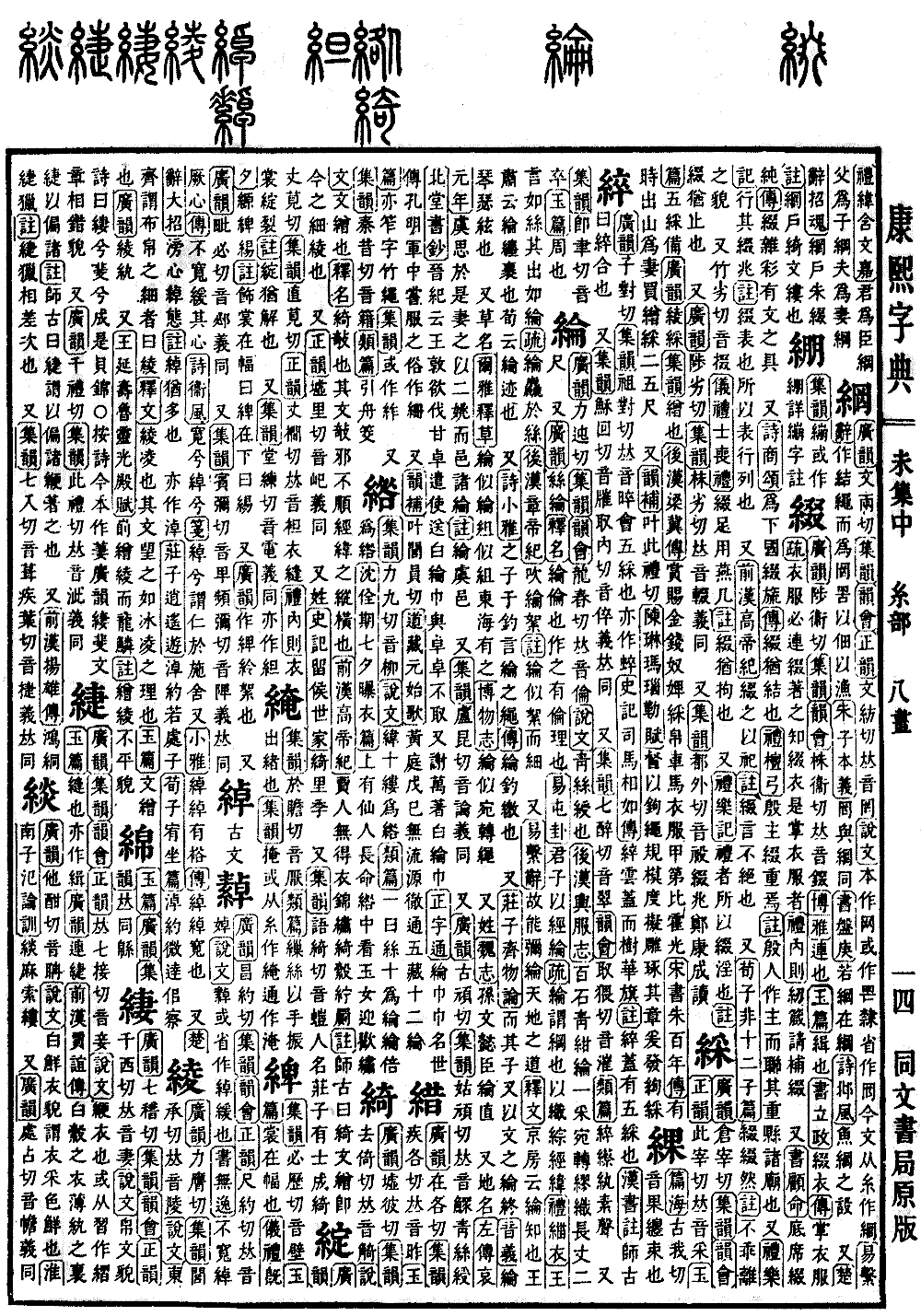
Wei Collection, Middle Volume
Radical: Silk (mì)
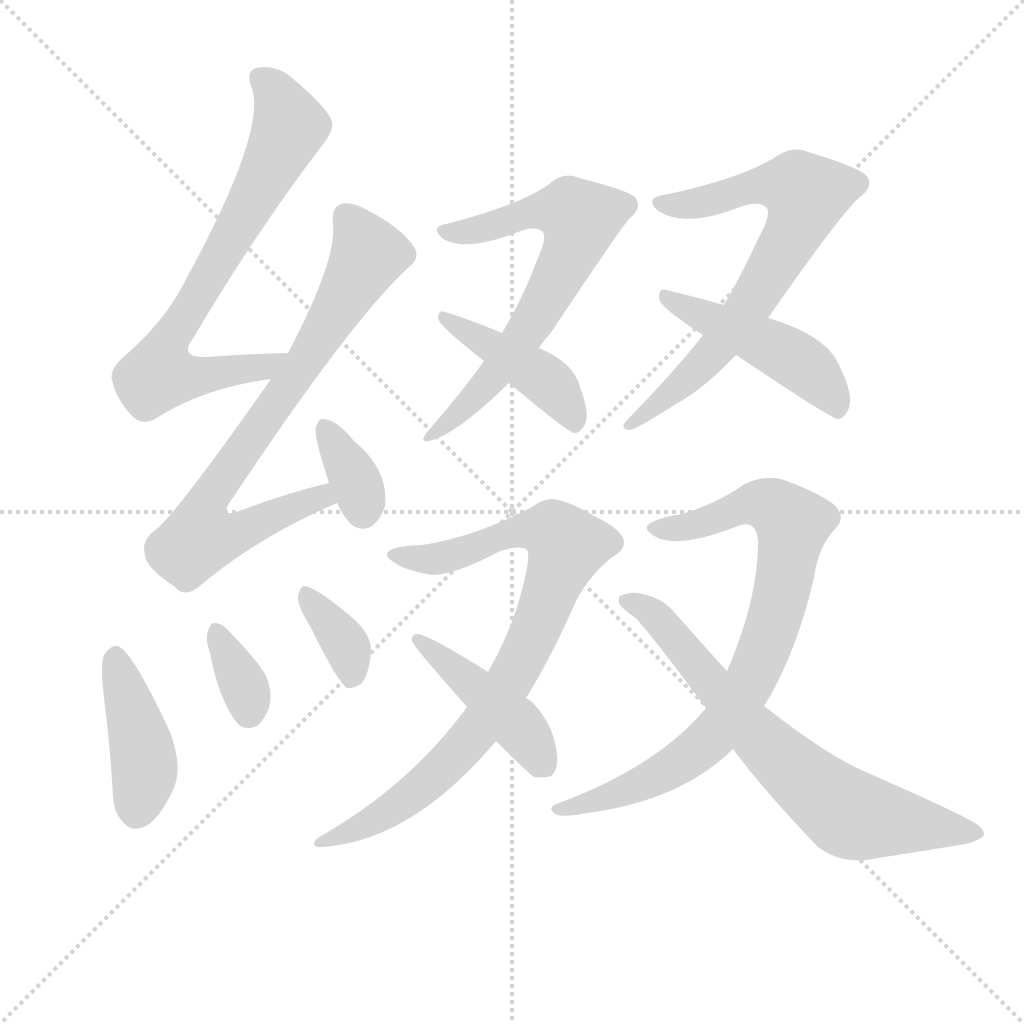
綴
Kangxi strokes: 14
Page 928, Entry 03
Broad Rimes (Guangyun): Pronounced zhui (falling tone).
Collected Rimes (Jiyun) and Rhyme Collection (Yunhui): Pronounced zhui (falling tone).
Defined as to connect.
Jade Chapter (Yupian): Defined as to sew or gather.
Book of Documents (Shangshu): To manage clothing.
Commentary: This refers to an official position responsible for garments.
Sub-commentary: Garments must be connected or sewn to be worn; thus, this official manages clothing.
Book of Rites (Liji): Using a needle to request mending or stitching.
Also in the Book of Documents (Shangshu): The base mats were adorned with decorative borders.
Commentary: This refers to an ornamental border featuring multicolored patterns.
Also in the Book of Odes (Shijing): Serving as a dangling banner for the states below.
Commentary: This implies something tied or bound.
Also in the Book of Rites (Liji): The Yin ancestral tablets were attached to the support frame.
Notes: The people of the Yin dynasty crafted ancestral tablets and hung them by connecting them to a wooden support.
Also in the Book of Rites (Liji): Following the markings and positions.
Notes: These are markers used to indicate the location of ranks or lines.
Also in the History of the Former Han (Hanshu): To continue them in sacrifice.
Notes: This implies something continuous and unbroken.
Also in the Xunzi: The appearance of being closely connected.
Notes: Describing the state of being inseparable.
Also pronounced duo.
Ceremonial and Ritual (Yili): To secure the feet using a small side table.
Notes: This implies binding or fixing in place.
Also in the Book of Rites (Liji): Ritual is that by which excessive behavior is restrained.
Notes: The meaning here is to restrain or stop.
Also in the Broad Rimes (Guangyun) and Collected Rimes (Jiyun): Pronounced chuo (entering tone). The meaning remains the same.
Also in the Collected Rimes (Jiyun): Pronounced dui (falling tone). Refers to the markers and positions. This is the reading provided by Zheng Kangcheng.