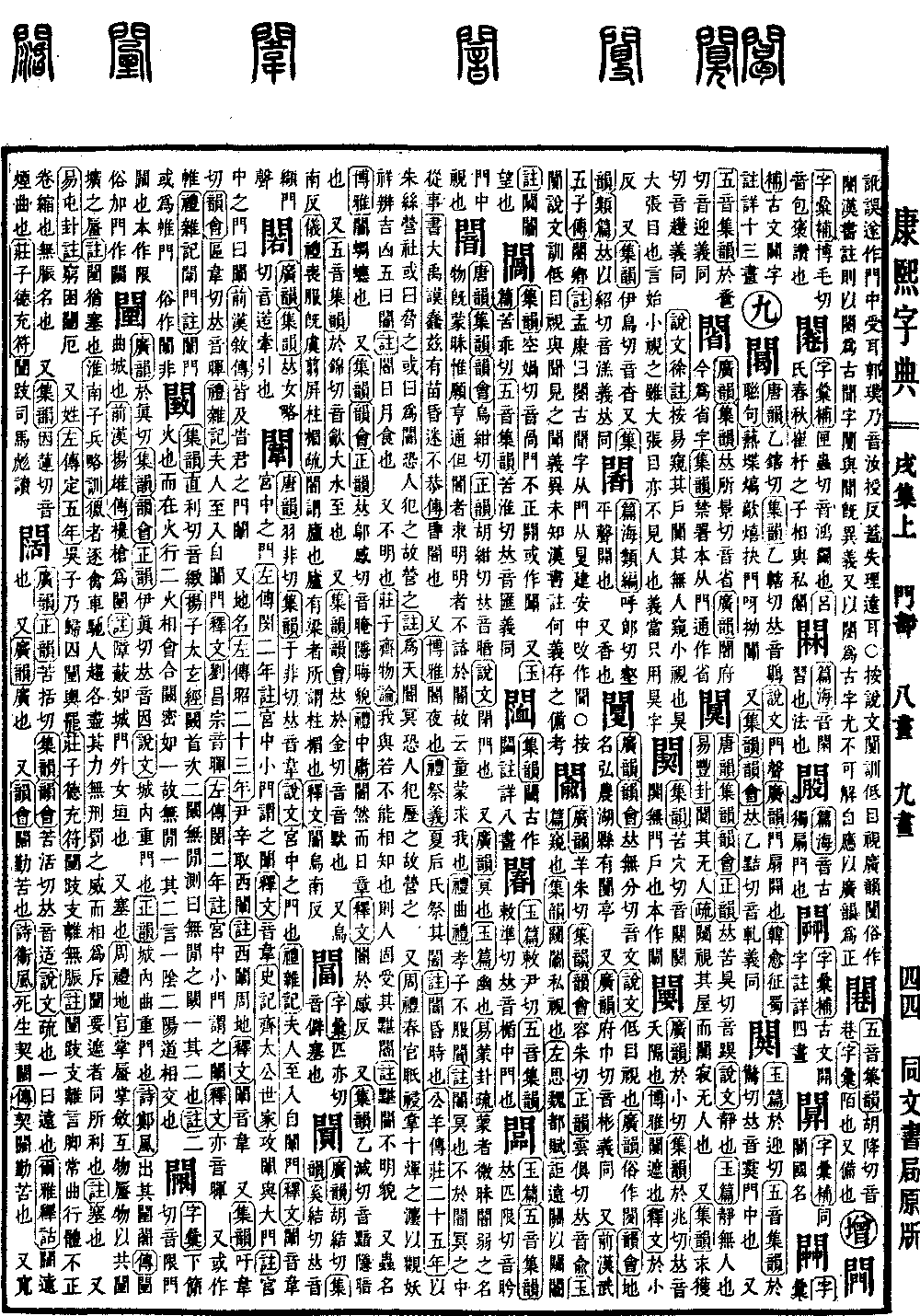
Xu Collection, Upper Volume
Radical: Gate (mén)
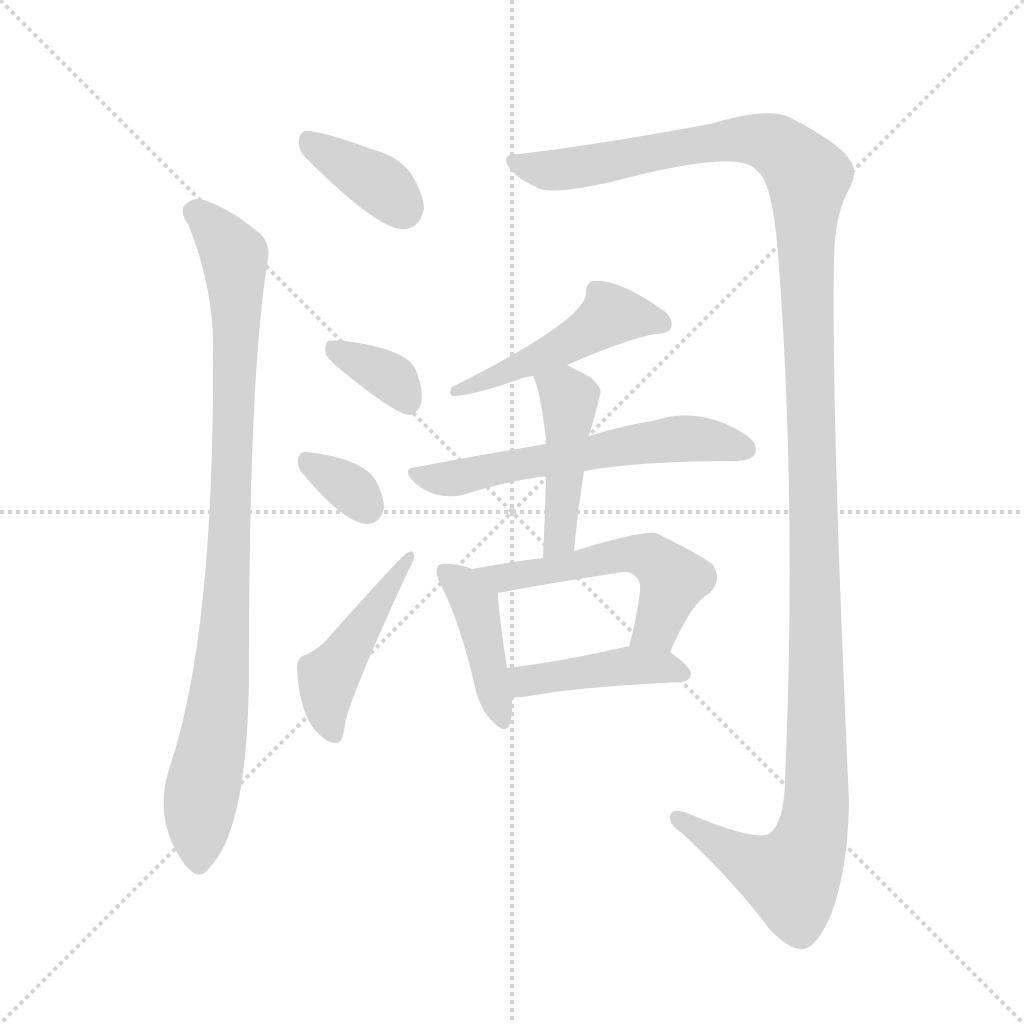
闊
Kangxi stroke count: 17
Page 1338, Entry 01
Pronounced kuò.
According to the Explaining Graphs and Analyzing Characters (Shuowen Jiezi), it means to be sparse. It also means distant. In the Approaching Elegance (Erya), entry on Interpreting Glosses, it states that kuò means distant.
Also, per the Broad Rhymes (Guangyun), it means wide. According to the Collection of Rhymes (Yunhui), kuò means laborious and bitter.
In the Book of Odes (Shijing), Beifeng section: "In life and death, through distance and bitterness." The commentary states that the phrase refers to laborious and bitter conditions.
It also means lenient. In the History of the Former Han (Qianhan Shu), Biography of Wang Mang: "To relax the taxes and levies." The commentary states that kuò means lenient.
It also refers to being separated or estranged. In the Book of Odes (Shijing), Beifeng section: "Alas, we are separated." The commentary notes that this refers to the soldiers who are separated from me today.
It also means broad. In the History of the Later Han (Houhan Shu), Biography of Ma Rong: "When the Han ancestor relied on his sword, warriors rose in power. The laws were lenient and generous, and the literary rites were broad."
It also means impractical or detached from reality. In the History of the Later Han (Houhan Shu), Treatise on Harmonics and Calendars: "By the time of the Yuanfeng era, it was impractical and inaccurate."
According to the Correct Rhymes (Zhengyun), prolonged periods of not meeting are called jiankuò. In the History of the Later Han (Houhan Shu), Biography of Zhuge Feng: "Why has it been so long since we met?"
According to the Collection of Rhymes (Jiyun), also pronounced kuà. The meaning is the same.
According to the Rhyme Supplement (Yunbu), it rhymes with quē. In Cheng Gongsui’s Rhapsody on Heaven and Earth: "How can these matters be verified? It is as if the speaker is merely making empty claims. How unfathomable are the yin and yang; how vast and great are the two elemental forces (heaven and earth)."
Textual Research:
In the Book of Odes (Shijing), Beifeng section: "In life and death, through distance and bitterness." The original text cited Weifeng, which has been corrected to Beifeng.
In the Book of Odes (Shijing), Beifeng section: "Alas, we are separated." The original text cited Weifeng, which has been corrected to Beifeng.