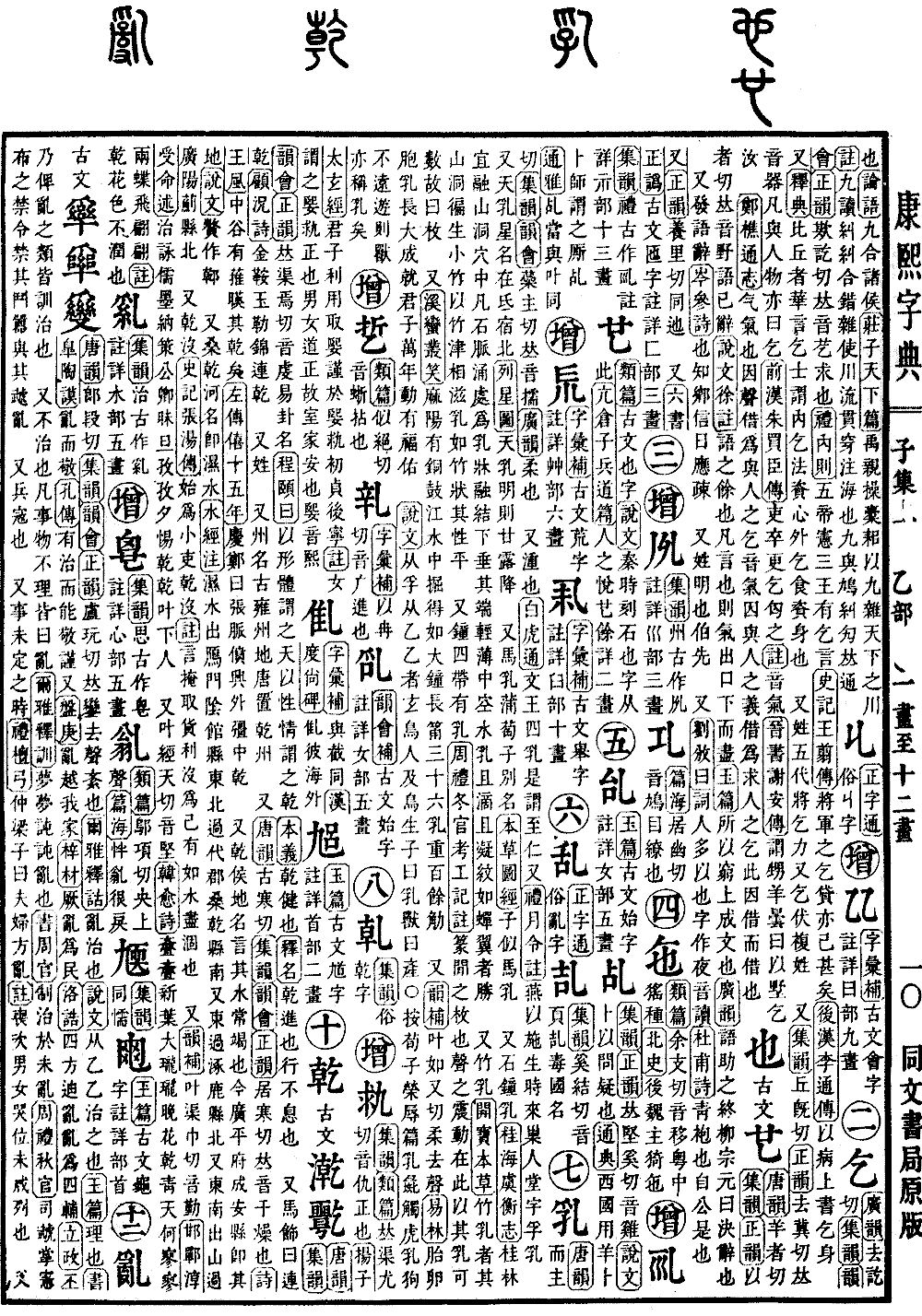
Zi Collection, Page Position: Upper. Radical: Second (yǐ). Luàn. Kangxi Dictionary Stroke Count: 13. Page 84, Line 15.
Correct Character Mastery (Zhengzitong) explains that this character is a vulgar form of the character pronounced luàn. Tang Rhymes (Tangyun) provides the fanqie pronunciation láng-duàn. Collected Rhymes (Jiyun), Rhyme Assembly (Yunhui), and Correct Rhymes (Zhengyun) provide the fanqie pronunciation lú-wàn, read like the departing tone of the character pronounced luán. It means disorder. The Literary Expositor (Erya) also says it means to govern. The Explanation of Graphs and Analysis of Characters (Shuowen Jiezi) explains the character structure as following the radical Second (yǐ), which signifies governing it. The Jade Chapters (Yupian) explains it as to organize. Governing and respectful — Book of Documents (Shangshu). The Commentary of Kong (Kong Zhuan) explains this as having the talent for governance while being respectful and cautious. Also, Governing and surpassing my house — Book of Documents. That governance is for the people — Timber of the Catalpa (Zicai). The four directions are guided toward order, and order serves as the four supports — Luo Announcement (Luogai). Greatly then cause order — Establishment of Government (Lizheng). In these sentences, the word is explained as governance. It also means a lack of governance; whenever things lack order, it is called disorder. Muddled and confused is disorder — Literary Expositor. Establish order before there is disorder — Offices of Zhou (Zhouguan). The Administrator of Violence oversees the prohibitions of the market laws, forbidding fighting, clamor, violence, and disorder — Rites of Zhou (Zhouli). It also refers to military disasters or banditry. It also refers to a time when matters are not yet settled. Zhongliangzi said: The husband and wife are just then in disorder — Book of Rites (Liji). The commentary notes this refers to the funeral rites where the positions for men and women to wail have not yet been arranged. The final section of a musical piece is called the finale. The finale of the Ospreys — Analects (Lunyu). Also, at the end of ancient rhapsodies (fu), there is often a concluding section which summarizes the entire work and reveals the main points. A place where a water current is crossed is called a crossing — Literary Expositor. The commentary notes this refers to crossing a stream. Crossing at the Yellow River — Tribute of Yu (Yugong). Crossing the Wei River — Book of Odes (Shijing). Rhyme Supplement (Yunbu) provides a rhyming pronunciation read like the character pronounced liàn. The Duke of Zhou received the sacrificial meat, and the white pheasant was offered. King Zhao declined in power, and the House of Zhou fell into confusion and disorder — Admonition for the Governor of Jiaozhou (Jiaozhou Mu Zhen) by Yang Xiong. It also provides a rhyming pronunciation read like the departing tone of the character pronounced lîng. Not in harmony or accord, forgetting moderation and speaking in disorder. Hurrying to the end but regretting the beginning, such was truly his nature — Praise for Li Zhengfang (Yang戏 Li Zhengfang Zan). Textual Research: In the Rites of Zhou, the section originally cited as Autumn Official is corrected to Earth Official. The term for laws of the cloth is corrected to laws of the market.