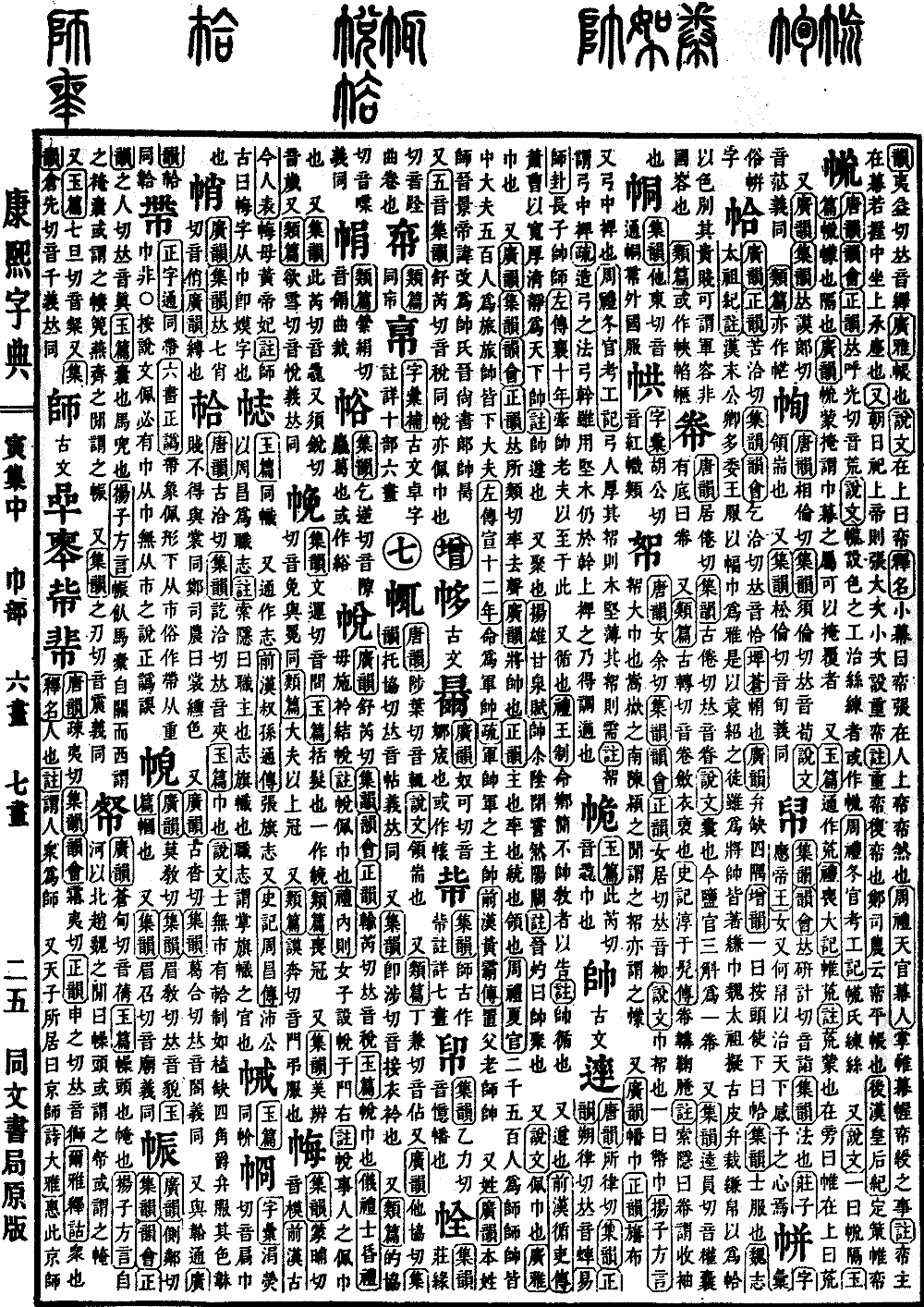
Yin Collection, Middle Volume
Radical: Turban (jīn)
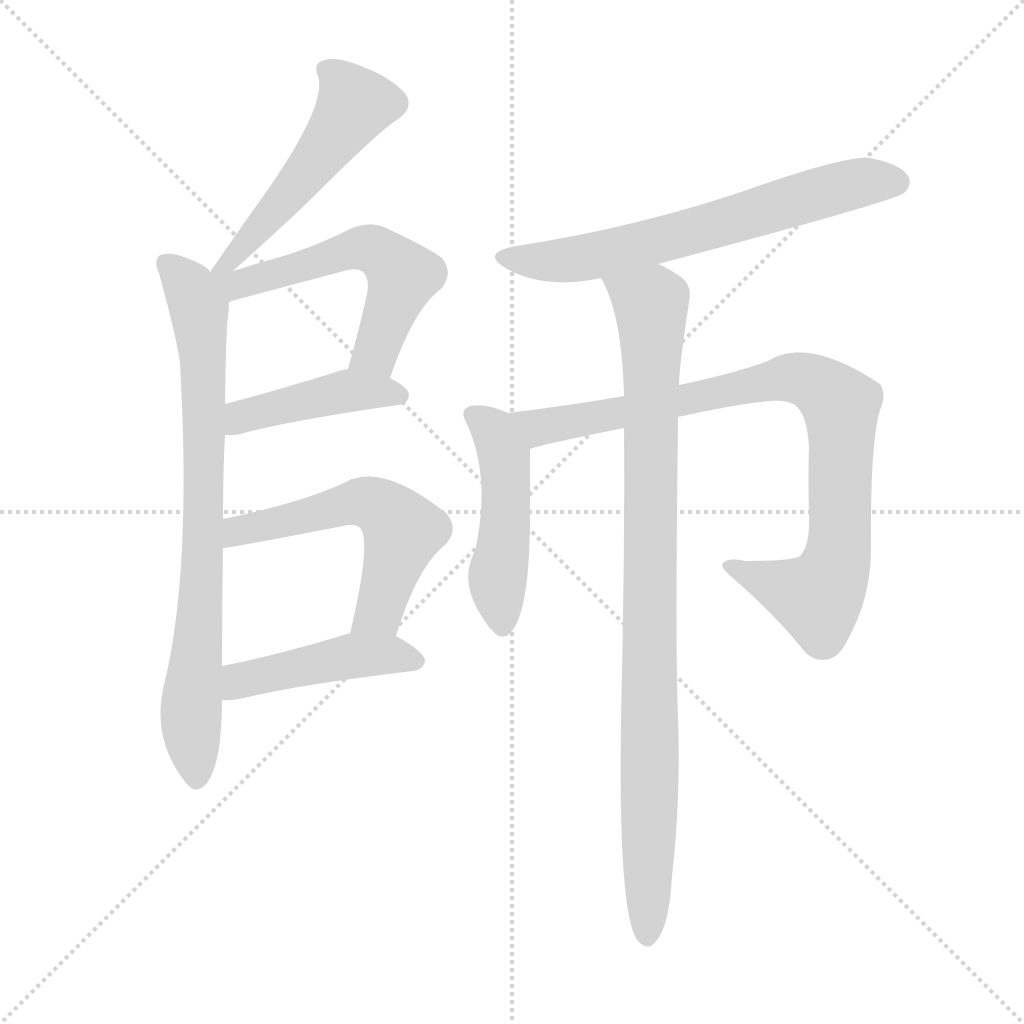
Character: Master
Kangxi Stroke Count: 10
Page 331, Entry 35
In ancient scripts. Pronounced shi.
Book of Erya (Erya): A multitude.
Book of Explanation of Words (Shiyan): Man.
Guo commentary: Refers to a multitude of people.
Also, the residence of the Son of Heaven is called the capital (jingshi).
Book of Odes (Shijing): Be kind to this capital.
Gongyang Commentary (Gongyang Zhuan), 9th Year of Duke Huan: The capital means a great multitude.
Also, per the Analytical Dictionary of Characters (Shuowen): Two thousand five hundred people constitute a shi.
Rites of Zhou (Zhouli), Earth Official: Five brigades constitute a shi.
Commentary: Two thousand five hundred people.
Book of Odes (Shijing): The King of Zhou traveled, and the six armies accompanied him.
Commentary: The six armies of the Son of Heaven.
Sub-commentary: During the Spring and Autumn period, even if it were a multitude of tens of thousands, they were all called shi. The six armies in the Book of Odes refer to the troops of the six armies.
Book of Changes (Yijing), commentary on the Shi hexagram: A large group is named an army, a medium group is named a shi, and a small group is named a brigade. Shi refers to a moderate size.
Also, per the Jade Book (Yupian): A model. A title for one who teaches people the Way.
Book of Documents (Shujing), Great Declaration: Act as their teacher.
Book of Rites (Liji), Hereditary Officials: When they go out, there are teachers. A teacher is one who instructs in affairs and enlightens through virtue.
Also, per the Jade Book (Yupian): To emulate others.
Expanded Dictionary (Zengyun): Law; to imitate.
Book of Documents (Shujing), Counsels of Gao Yao: The hundred officials emulate one another.
Commentary: To emulate one another's methods.
Also, a leader.
Book of Documents (Shujing), Plans of Yi and Ji: The twelve leaders of the provinces.
Commentary: Leader.
Also, the name of deities.
Rites of Zhou (Zhouli), Spring Official: Sacrifice to the Wind Master and Rain Master using burnt offerings.
Commentary: The Wind Master is the Ji constellation; the Rain Master is the Bi constellation.
Qu Yuan, Encountering Sorrow (Lisao): The Thunder Master informed me that it was not yet ready.
Commentary: The Thunder Master is Fenglong.
Also, name of a state.
Records of the Grand Historian (Shiji), Account of Dayuan: Loulan and Gushi.
Commentary: Two state names. Gushi is the same as Cheshi.
Also, name of a district.
Records of Commanderies and States in the Later Han (Houhan Jun Guo Zhi): Under the Henan Yin, there is Yanshi.
Commentary: Where Emperor Ku resided.
Also, a title for an official.
Zuo Commentary (Zuozhuan), 17th Year of Duke Zhao: The Yellow Emperor used clouds to record, so he had cloud masters and cloud titles. The Flame Emperor used fire to record, so he had fire masters and fire titles. The Gonggong clan used water to record, so he had water masters and water titles. The Taihao clan used dragons to record, so he had dragon masters and dragon titles. When Shaohao Zhi ascended, the phoenix arrived, so he recorded by birds, becoming bird masters with bird titles.
Book of Documents (Shujing), Offices of Zhou: Establish the Grand Master, Grand Tutor, and Grand Guardian; these are the Three Dukes. The Junior Master, Junior Tutor, and Junior Guardian are called the Three Solitaries.
Also, Shide, a palace name.
History of the Former Han (Qianhan), Biography of Yang Xiong: Zhique and Louhan, Tangli and Shide.
Commentary: Yan Shigu says, the Shide Palace was in the territory of Yueyang.
Also, name of a beast. Interchangable with lion.
History of the Former Han (Qianhan), Record of the Western Regions: Wuyi Mountain produces lions.
Also, a surname.
History of the Former Han (Qianhan), Biography of Shi Dan: Dan was a man of Dongwu in Langya, who served as Grand Minister of Works during the reign of Emperor Ai.
Also, You-shi and Zuo-shi are both compound surnames.