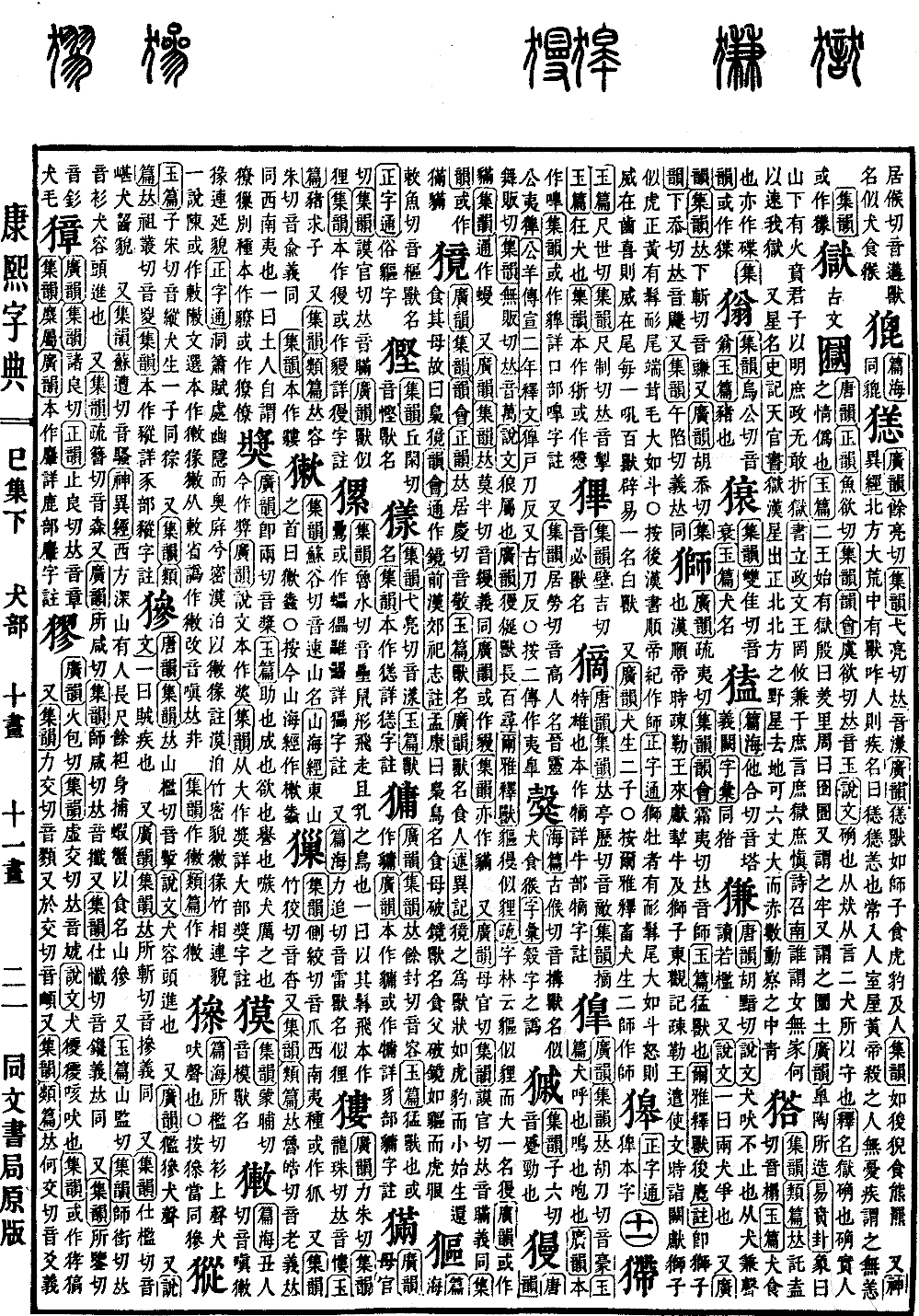
Si Collection, Lower Volume
Radical: Dog (quǎn)
Entry: Lion
Kangxi strokes: 14
Page 717, Entry 10
Pronounced shi.
In the Jade Pavilion (Yupian), it is described as a fierce beast. In the Literary Expositor (Erya), section on beasts, it is called suanni. Note: This refers to the lion. During the reign of Emperor Shun of the Han dynasty, the King of Shule presented a zebu and a lion. According to the Records of the Eastern Pavilion (Dongguan Ji), the King of Shule sent an envoy named Wenshi to the imperial court to present a lion, which resembled a tiger, was solid yellow, possessed a mane and beard, and had a tail with a tuft of hair as large as a peck measure. Note: In the History of the Later Han (Hou Hanshu), in the annals of Emperor Shun, it is written as shi.
According to the Correct Meaning of Characters (Zhengzitong), the male lion has a mane and beard, and a tail as large as a peck measure. When angry, its power resides in its teeth; when pleased, its power resides in its tail. With every roar, a hundred beasts retreat in fear. Another name for it is the white beast.
Also, pronounced shi. It refers to a dog giving birth to two offspring. Note: In the Literary Expositor (Erya), section on domestic animals, it is written that a dog giving birth to two is called shi, written as shi.