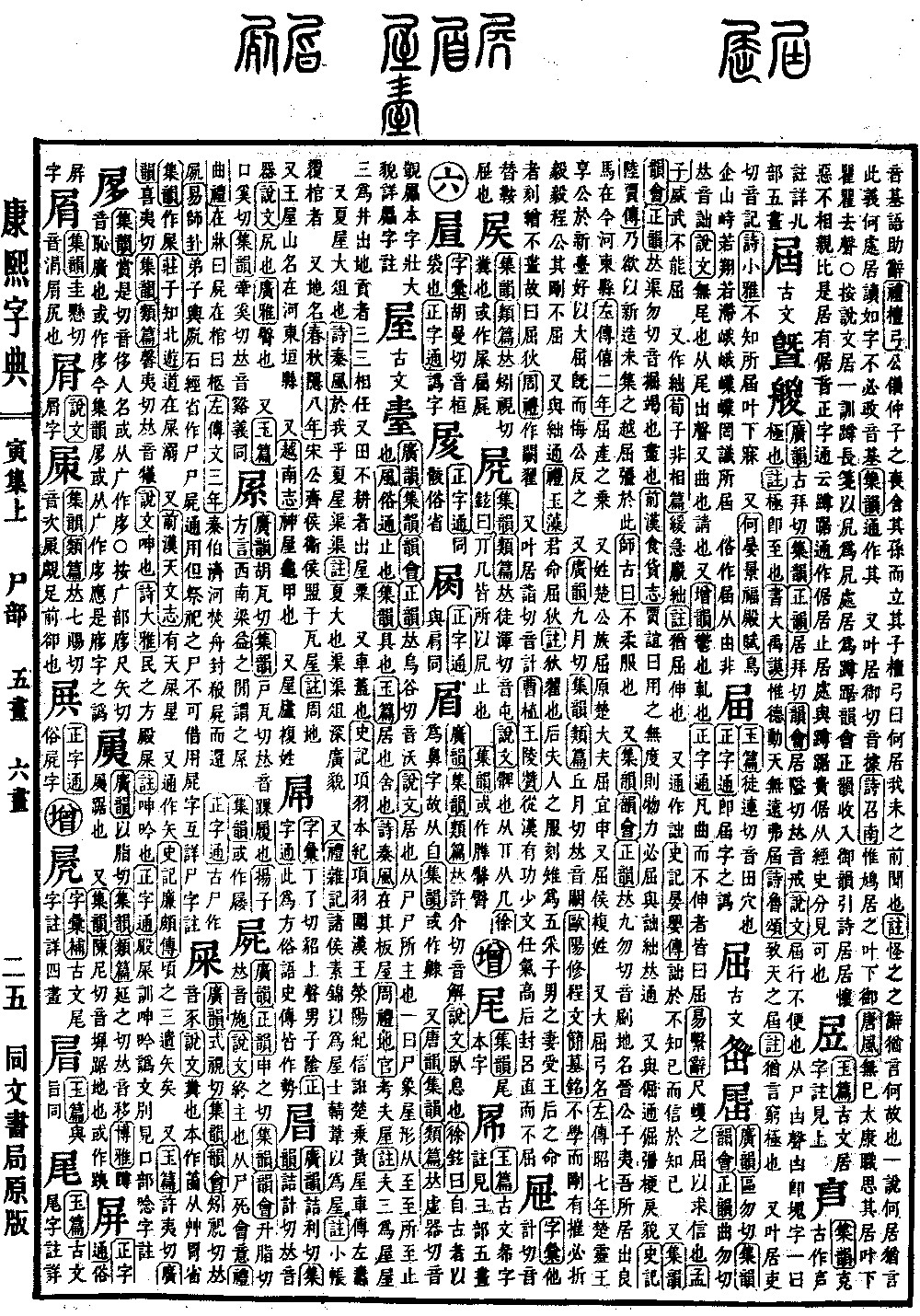
Yin Collection, Upper Volume
Radical: Corpse (shī)
屆
Kangxi stroke count: 8
Page 301, Entry 03
In classical texts, it is written in variant forms (jì) and (zòng).
Pronounced gài. Pronounced gài. Pronounced jiè. The pronunciation is the same as jiè.
Explanatory Dictionary of Characters (Shuowen Jiezi) interprets this as follows: 屆 means difficulty in walking. The character is formed with the radical for corpse (shī), conveying the meaning; the pronunciation is the same as kuài (lump). Another interpretation is that it means extreme.
Note: Here, extreme means to reach or to arrive.
Book of Documents (Shangshu), Chapter Great Plans of Yu the Great (Dayu Mo): Only virtue can move Heaven, there is no place, however far, that it does not reach.
Book of Odes (Shijing), Odes of Lu (Lu Song): To summon the arrival of Heaven.
Note: Here, it is explained as meaning the end point or the ultimate limit.
Also pronounced jì. The pronunciation is the same as jì.
Book of Odes (Shijing), Minor Odes of the Kingdom (Xiaoya): Knowing not where the limit lies. This rhymes with the word mè (sleep) in the following line.
Also seen in He Yan’s Rhapsody on the Jingfu Hall (Jingfu Dian Fu): With birds poised and mountains standing, as if soaring and as if lingering, towering and lofty, with no one knowing where they end.
The popular simplified form is written as 届, using the radical for reason (yóu); this is incorrect.