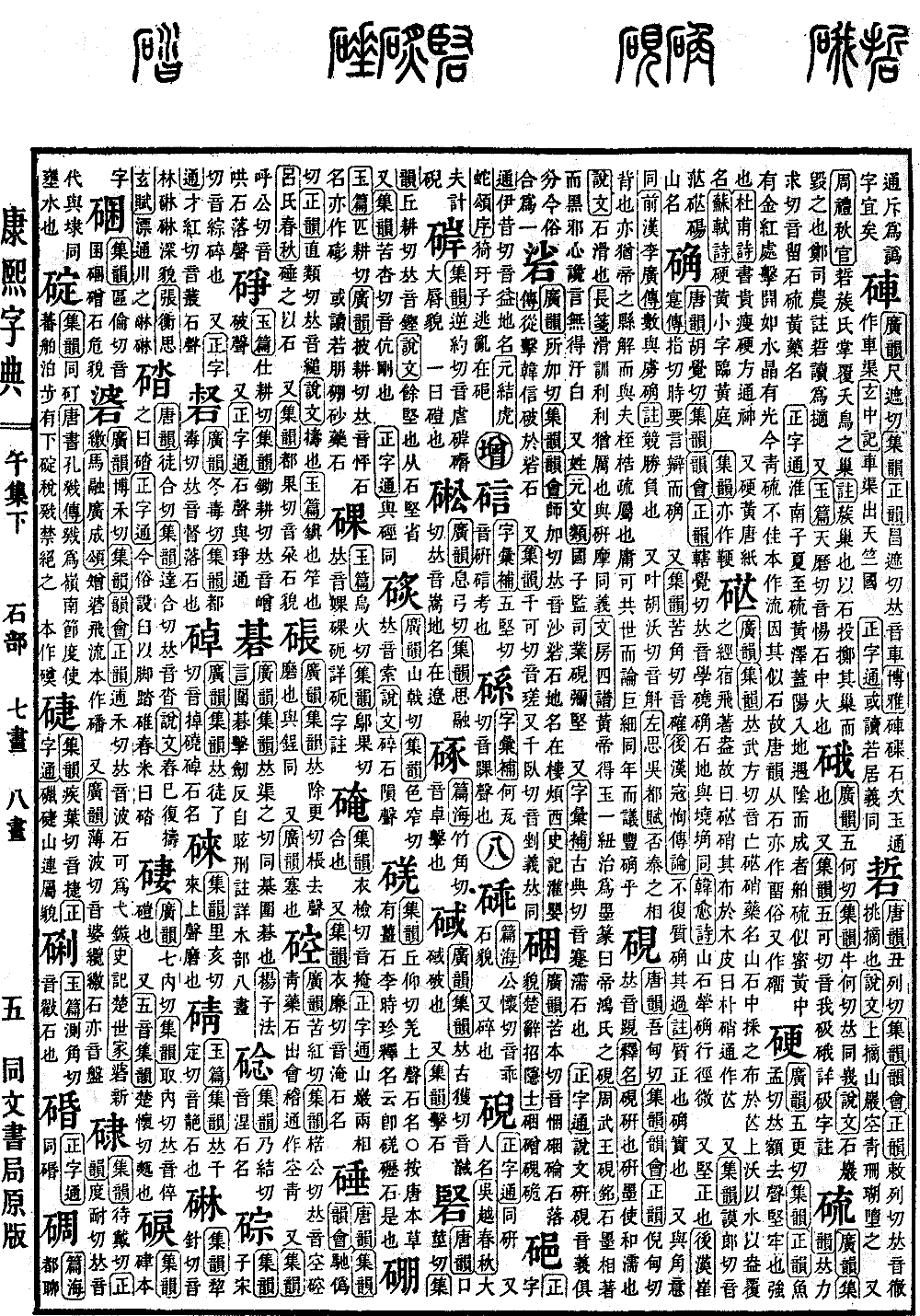
Wu Collection, Lower Volume
Radical: Stone (shí)
Kangxi Strokes: 15
Page 831, Entry 07
Pronounced xue (entering tone). Refers to hard, stony land. Similar in meaning to qiaoqiao (a type of rocky, barren soil). As cited in the poetry of Han Yu: The mountain stones are rocky and hard, the path is narrow. Also refers to being firm and upright. As cited in the Biography of Cui Shi in the Book of the Later Han (Hou Hanshu): Pointing out current essentials, speaking eloquently and firmly. Also, pronounced que (entering tone). As cited in the biography commentary of Xun in the Book of the Later Han (Hou Hanshu): Not again verifying the error. Commentary: Zhi means to evaluate; que means to verify. Also the same in meaning as jiao (contend). As cited in the Biography of Li Guang in the Book of the Former Han (Hanshu): Frequently contending with the enemy. Commentary: Comparing victory and defeat. Also pronounced hu (entering tone). As cited in the Rhapsody on the Capital of Wu (Wu Du Fu) by Zuo Si: The cycle of fortune and misfortune is like the emperor suspending judgment; how can one discuss the great and small as if they were the same, or debate the abundant and the firm as if they were of the same year?
The character is also pronounced que (entering tone). Hard, solid. As cited in the Book of Changes (Yijing), Hexagram Qian: Firm, it cannot be pulled up. As cited in the Zhuangzi, Outer Chapters: Firmly able to perform its task. Commentary: The appearance of being solid. Also refers to being vigorous. As cited in the Book of Changes (Yijing), Appended Statements: The Qian hexagram shows its firmness to people. Sometimes also written in a variant form (qiao) and (que).