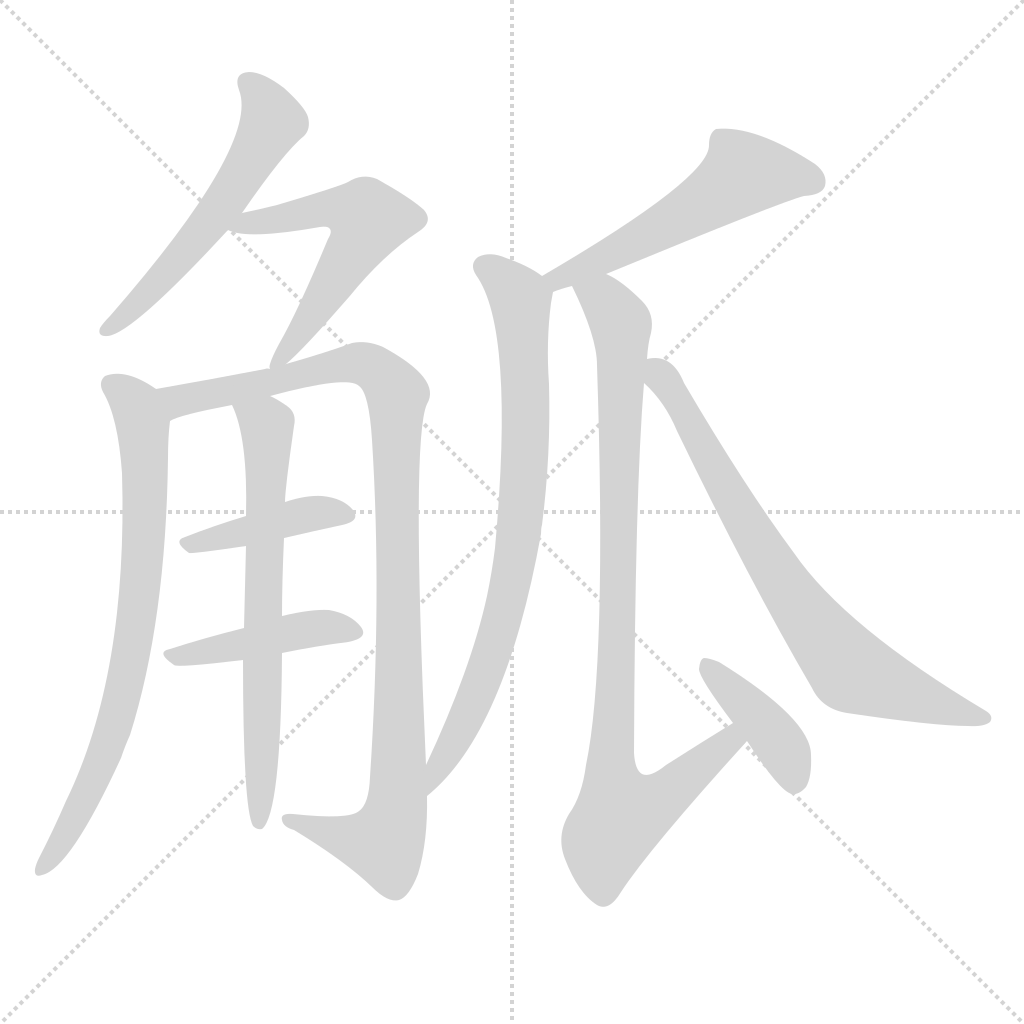
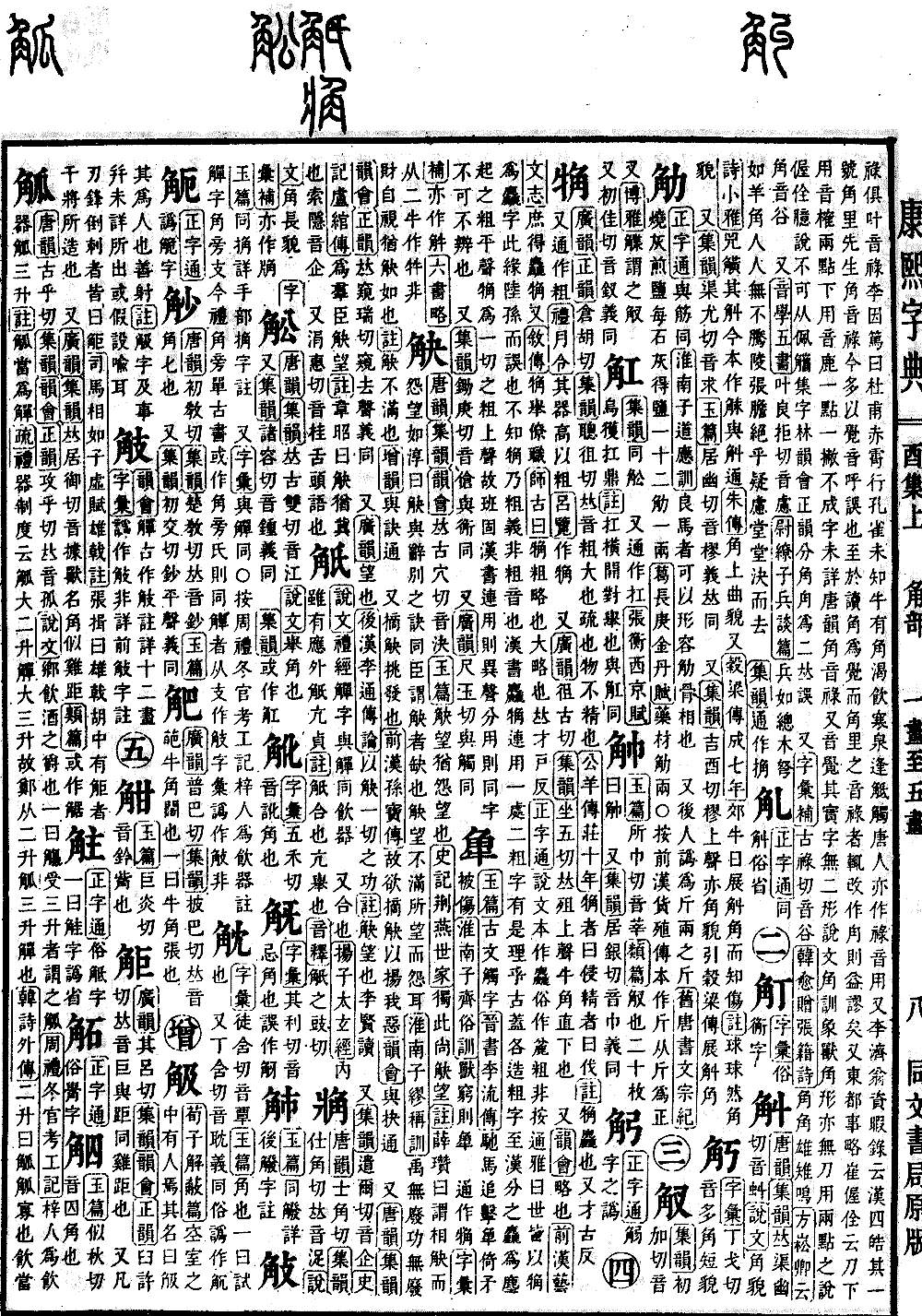
You Collection, Upper Volume
Radical: Horn (jiǎo)
Kangxi Strokes: 12
Page 1140, Entry 31
Tang Rhymes (Tangyun): Pronounced gu.
Collection of Rhymes (Jiyun), Rhymes of the Empire (Yunhui), Correct Rhymes (Zhengyun): Pronounced gu.
Explanations from the Script (Shuowen Jiezi): A drinking vessel used in village wine ceremonies. Another theory states that a vessel capable of holding three sheng of wine is called a gu.
Record of Trades (Kaogongji), Rites of Zhou (Zhouli): The carpenter crafts drinking utensils; the capacity of a gu is three sheng.
Commentary: The gu refers to a zhi vessel.
Sub-commentary: The records regarding the system of ritual vessels state that a gu holds two sheng and a zhi holds three sheng. Therefore, Zheng Xuan follows the tradition that two sheng defines a gu and three sheng defines a zhi.
Exoteric Commentary on the Han Version of the Book of Odes (Hanshi Waizhuan): A two-sheng vessel is called a gu. Gu means "few." When drinking, one should be moderate.
Analects (Lunyu): If a gu is not like a gu.
Sub-commentary: A gu is a type of ritual vessel capable of holding two sheng of wine. It also refers to a square shape.
Sub-commentary on the Lesser Minister, Rites of Zhou (Zhouli): Military texts refer to people of jue gu, meaning those who are crafty, outstanding, and unconventional in nature.
Records of the Grand Historian (Shiji): When the Han dynasty rose, it broke the square and made it round.
Zhuangzi: Calmly holding onto squareness without being stubborn.
Commentary: To maintain integrity without being rigid.
Also refers to legal principles.
Taixuanjing: Use its principles to divine.
Commentary: To use principles for divination refers to calculating the auspicious and inauspicious signs of the meridian lines.
Also refers to a corner or angle.
History of the Former Han (Qian Hanshu): Its calculation method uses bamboo, one fen in diameter and six cun long; two hundred and seventy-one pieces form six angles (liu gu), making a single grasp.
Su Lin says: Six gu means six angles.
History of the Former Han (Qian Hanshu): The eight-cornered (ba gu) structure radiates in all directions, symbolizing the eight directions.
Shi Gu says: Gu means angle.
Fu Qian says: The eight-cornered structure is like a modern altar for earth deities.
Also refers to the lintel of a stove.
Learned Reflections (Kunxue Jiwen): Confucius read the Spring and Autumn Annals (Chunqiu), while Laozi leaned against the stove lintel to listen.
Also refers to a sword hilt.
New Discourses (Xinlun): If one is forced to grasp a sword by the blade and shake the hilt, one will surely cut their own fingers without being able to pierce rotten wood.
Also refers to an official title.
Records of the Three Kingdoms (Sanguozhi): In the land of Idu, the official is called Erzhi, the vice-official is called Xiemogu, and the next is called Bingqugu. In the land of Nu, the official is called Sımagu.
Also refers to a person's name.
History of Northern Dynasties (Beishi): The youngest son of Empress Xianming of Wei was the Prince of Qin, Gu.
There is also Guzhu City, located in Liaoxi.
Erya: Guzhu, Beihu, Xiwangmu, and Rixia are known as the Four Desolations.
Commentary: Guzhu is in the north.
There is also Chungu, a county name. See History of Jin (Jinshu). During the Tang dynasty, it was renamed Lingtai, belonging to Jingzhou. In the History of the Former Han (Qian Hanshu), it is written as Chungu.
Also interchangeable with a character referring to a bracket or corner.
Ban Gu: Western Capital Rhapsody (Xidu Fu): Above, there are corners where golden birds perch.
Commentary: Gu refers to the eight-sided corners. Another theory states it refers to the highest corner of a palace. In the History of the Later Han (Hou Hanshu), it is written as a compound indicating a corner or beam end.
Also interchangeable with a character for a wooden tablet.
Lu Ji: Rhapsody on Literature (Wen Fu): Sometimes holding a wooden tablet to write spontaneously.
Commentary: Gu refers to a square piece of wood used in ancient times for writing, similar to modern bamboo slips.
Rhymes of the Empire (Yunhui): It means bamboo slips. Interchangeable with a character for a tablet.
Also interchangeable with a character for a water plant.
History of the Former Han (Qian Hanshu): Lotus roots and water plants (gu lu).
Zhang Yan says: Gulu refers to water plants. In the Records of the Grand Historian (Shiji), it is written as a different character for water plants. In the Explanations from the Script (Shuowen Jiezi), it was originally written as yet another character for the same plant.