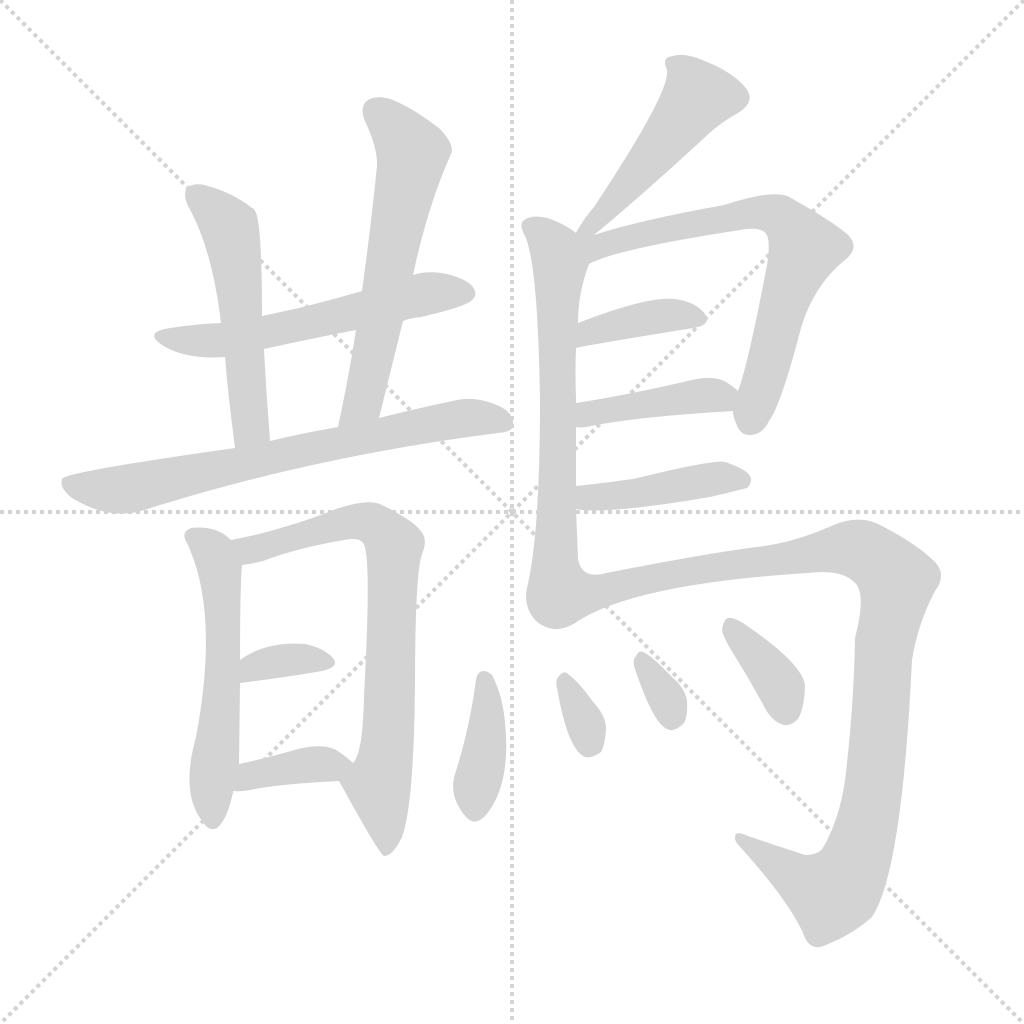
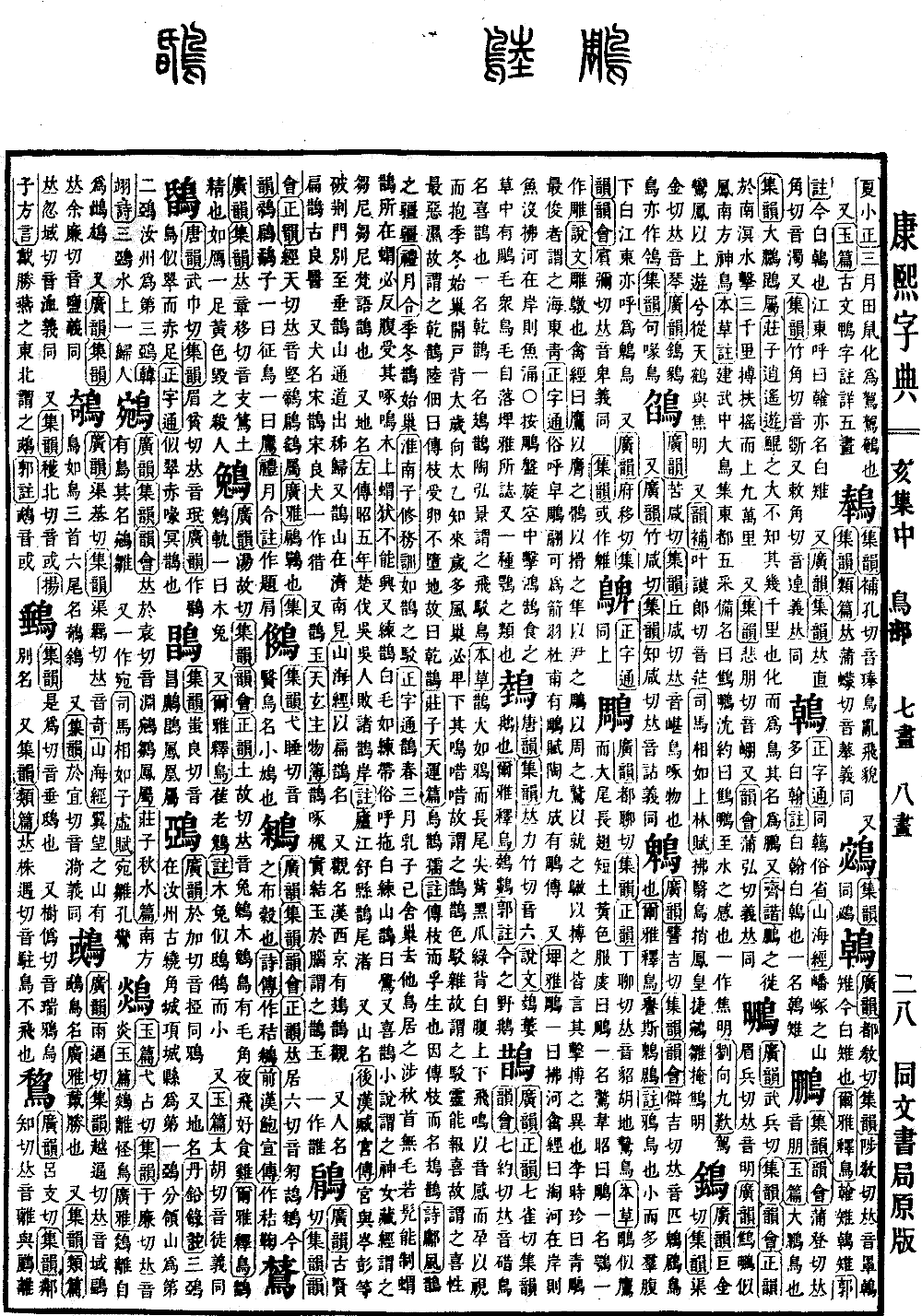
Hai Collection, Middle Volume. Radical: Bird (niǎo). Character: Magpie. Kangxi strokes: 19. Page 1492, Entry 13.
Pronounced que. Pronounced que. The pronunciation is the same as the character que. It is the name of a bird, the magpie. Another name for it is ganque, and it is also called zhique. Tao Hongjing refers to it as the piebald-flying bird. Compendium of Materia Medica (Bencao) records: The magpie is the size of a crow but has a long tail, a sharp beak, and black claws; its back is green and its belly is white. It flies and calls, conceiving through the induction of sound and hatching through visual focus. It begins building its nest at the end of winter, avoiding the direction of the Grand Year (Taisui) and facing the direction of the Great One (Taiyi), knowing that the coming year will be windy and thus building the nest low. Its call sounds like qie qie, hence it is called que; its plumage is mottled, hence it is called bo; it is auspicious and predicts good news, hence it is called xi; its nature strongly dislikes dampness, hence it is called ganque. Lu Dian states: It transfers and incubates eggs among branches without dropping them to the ground, which is why it is called ganque. The Book of Zhuangzi (Zhuangzi), Chapter on the Revolutions of Heaven (Tianyun) mentions the magpie brooding. The commentary explains this as the act of transferring eggs among branches to hatch and rear them. Because it transfers branches, it is named zhique. The Book of Odes (Shijing), Odes of Yong (Yongfeng) contains the line "the magpie is vigorous." The Book of Rites (Liji), Monthly Ordinances (Yueling) records: At the end of winter, the magpie begins to build its nest. The Huainanzi (Huainanzi), Training in Cultivation and Service (Xiuwuxun) mentions "like the mottled magpie." The Zhengzitong records: The magpie rears its young in the third month of spring; after this is finished, it leaves the nest, and other birds come to inhabit it. By autumn, its head is featherless as if shaved; it can subdue hedgehogs. Where a magpie is present, a hedgehog will turn over its belly to accept the magpie's pecking; when the magpie calls from the tree, the hedgehog lies prone and cannot rise. There is also the lianque (ribbon magpie), with white feathers like white silk ribbons, commonly known as the dragging white ribbon. The mountain magpie is called xue. Furthermore, the magpie is referred to in fiction as the Spirit Maiden. In Buddhist scriptures, it is called chuni. Chuni is the Sanskrit word for magpie.
Also a place name. The Zuo Tradition (Zuozhuan), Year 5 of Duke Zhao records: The State of Chu attacked the State of Wu, and the people of Wu defeated them at Que'an. The commentary notes this refers to Quweizhu in Shu County, Lujiang.
Also a mountain name. The Book of the Later Han (Hou Hanshu), Biography of Zang Gong records: Zang Gong and Cen Peng and others broke through Jingmen; Zang Gong led troops separately to Cuique Mountain, clearing a path from Zigui. There is also Queshan (Magpie Mountain) in Jinan, appearing in the Classic of Mountains and Seas (Shanhaijing), named after the physician Bian Que.
Also the name of an observatory. In the Western Han Dynasty, the Western Capital had the Zhique Observatory.
Also a person's name. Bian Que was a famous physician in ancient times.
Also a dog's name. Song Que was a fine hunting dog from the State of Song. It is also written in a variant form.
Also magpie jade (queyu). The Register of Heavenly Mysterious Objects (Tianxuan Zhubowu) records: The magpie pecks and eats the fruit of the pagoda tree, which condenses into jade in its brain, called magpie jade. It is also written in a variant form.