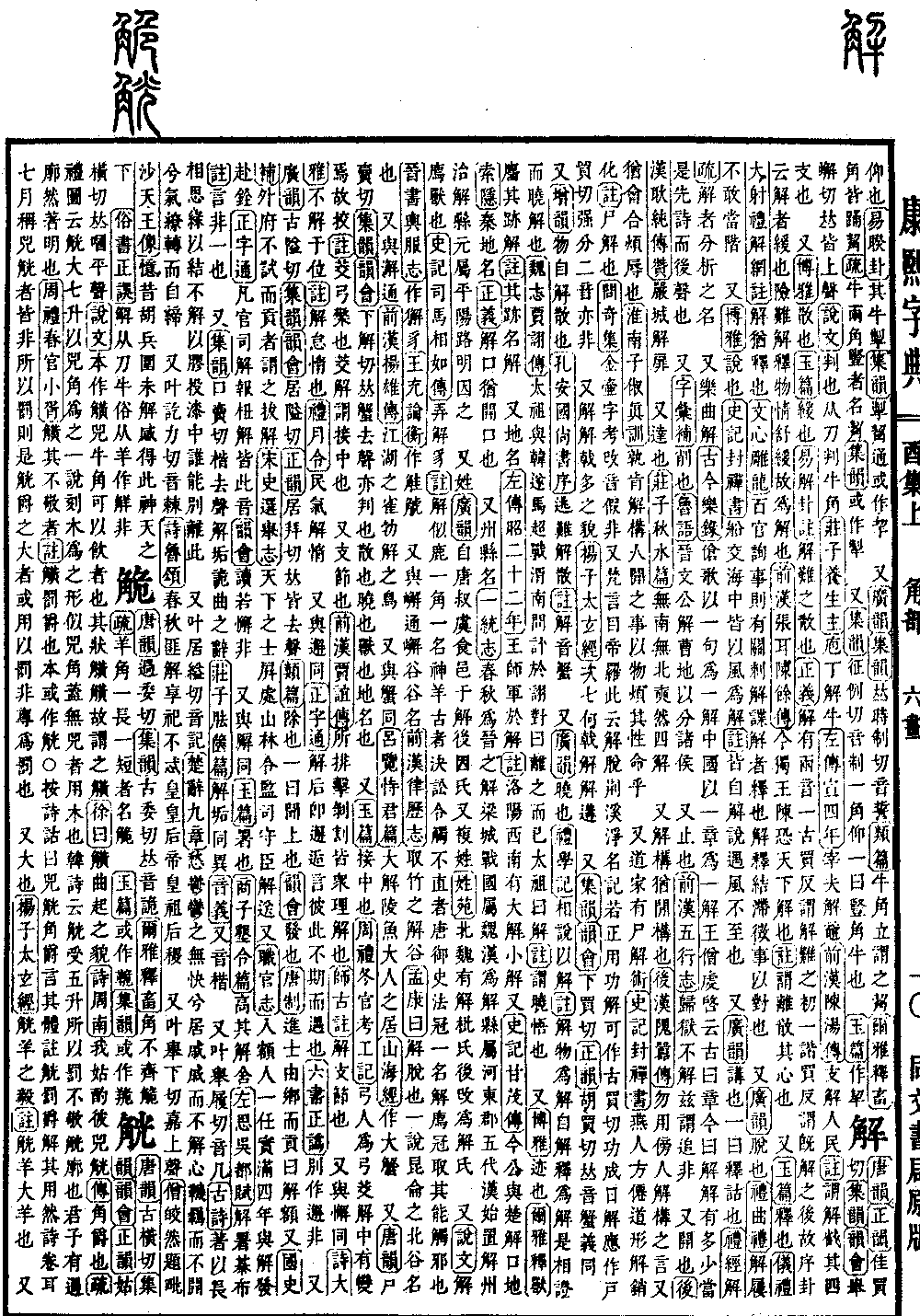
You Collection, Upper Volume
Radical: Horn (jiǎo)
Kangxi Strokes: 13
Page 1142, Entry 01
Pronounced jie (rising tone).
Pronounced jie (rising tone).
Pronounced jie (rising tone).
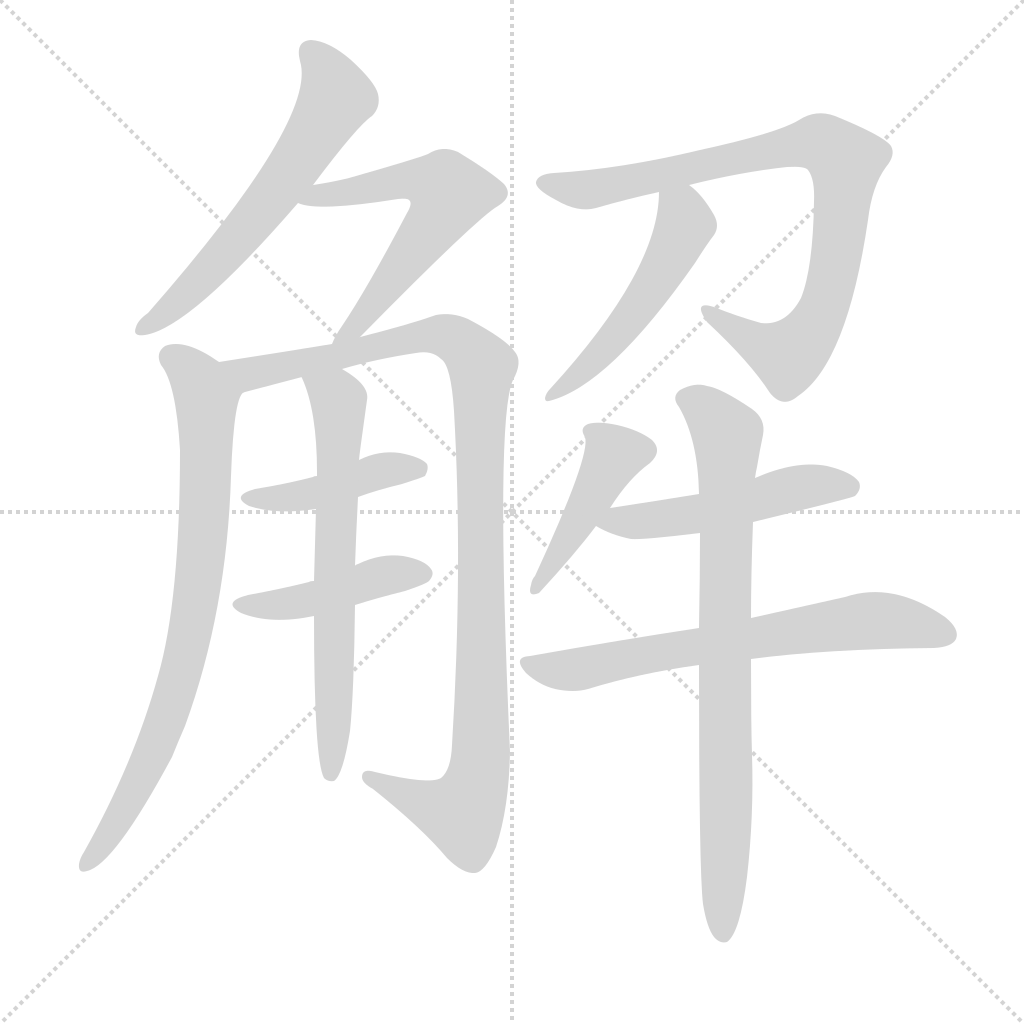
According to the Explaining Graphs (Shuowen), it means to split. Composed of knife and cow horn, it implies splitting a cow horn.
As in the Master Zhuang (Zhuangzi), Nourishing the Principle of Life: The butcher dismembers an ox.
As in the Zuo Commentary (Zuozhuan), Fourth Year of Duke Xuan: The steward dismembers a giant turtle.
As in the Former Han (Qianhan), Biography of Tang: Dismembering the people. The commentary states: This refers to separating their four limbs.
Also, as in the Guangya: To disperse.
As in the Jade Chapters (Yupian): To loosen.
As in the Book of Changes (Yijing), commentary on the Release hexagram: Release means the dispersion of difficulty.
As in the Correct Meaning (Zhengyi): Release has two pronunciations. One is pronounced jie (rising tone), referring to the initial stage of resolving difficulties. One is pronounced jie (rising tone), referring to the time after it has been resolved. Therefore, the Sequence of the Hexagrams states: Release means to loosen. When perils and difficulties are explained, the situation becomes relaxed, so it is called Release.
As in the Former Han (Qianhan), Biography of Zhang Er and Yu: If only you are king now, I fear the world will loosen. The commentary states: This refers to the scattering of their hearts.
Also, as in the Jade Chapters (Yupian): To explain.
As in the Ceremonial Rites (Yili), Record of Great Archery, commentary on untying the bowstrings: Release means to let go.
As in The Literary Mind and the Carving of Dragons (Wenxin Diaolong): When the hundred officials consult on matters, there are inquiries, criticisms, interpretations, and secret reports. To interpret means to explain. It means to resolve knots and obstructions and to present facts in response.
Also, as in the Guangyun: To remove.
As in the Book of Rites (Liji), Songs of Qu: One does not dare to untie one's shoes while facing the steps.
Also, as in the Guangya: To explain/speak.
As in the Records of the Grand Historian (Shiji), Treatise on the Feng and Shan Sacrifices: The ships intersected on the sea, and they all explained it as the wind. The commentary states: They all offered their own explanations, saying the wind did not arrive.
Also, as in the Guangyun: To lecture. Also, to interpret glosses.
As in the Book of Rites (Liji), Commentary on the Meaning of the Classics: Release is a term for analysis.
Also, musical movements.
As in the Ancient and Modern Music Records (Gujin Yue Lu): In nomadic songs, one phrase is one movement (jie). In China, one section is one movement. Wang Sengqi says: In ancient times it was called a chapter (zhang), now it is called a movement (jie). There are many types of movements; they must have first had poetry and then sound.
Also, as in the Character Collection Supplement (Zihui Bu): To shave or scrape.
As in the Discourses of Lu (Luyu): Duke Wen of Jin scraped off曹 land to divide among the feudal lords.
Also, to stop.
As in the Former Han (Qianhan), Treatise on the Five Elements: Returning from prison without ceasing, this is called following error.
Also, to open.
As in the Later Han (Houhan), Praise for the Biography of Geng Chun: The strict city opened its doors.
Also, to reach/understand.
As in the Master Zhuang (Zhuangzi), Autumn Floods: Neither south nor north, completely enlightened and at ease.
Also, to plot/dismantle, as in slanderous plotting.
As in the Later Han (Houhan), Biography of Wei Xiao: Do not use the slanderous words of bystanders.
Also, to imply worldly annoyance or hardship.
As in the Huainanzi, Chapter on Returning to Truth: Who is willing to dismantle the affairs of the world and trouble their nature and life with objects?
Also, in Daoism, there is the technique of corpse-release.
As in the Records of the Grand Historian (Shiji), Treatise on the Feng and Shan Sacrifices: Engaging in the way of the square immortals, the form is released and dissolved. The Collected Commentaries state: This is corpse-release. The Ask the Strange Collection (Wenqi Ji) says the Golden Pot Character Examination (Jinhu Zikao) changes the pronunciation to jia, which is incorrect. Also, the Sanskrit term for mukti (liberation) is transliterated as mu-di-luo. Jingxi Jingming Record says if one is strictly applying effort, the character may be pronounced jie (rising tone). On the day the effort is completed, it should be pronounced jie (rising tone). To force two pronunciations is also incorrect.
Also, descriptive of the abundance of halberds.
As in Yangzi's Great Mystery (Taixuan): Seventh position: What halberds, abundant and meeting.
Also, pronounced xie (rising tone). Same meaning.
Also, as in the Expanded Rhymes (Zengyun): Things dissipating on their own.
As in Kong Anguo's Preface to the Book of History (Shangshu): Escaping hardship and scattering. The commentary states: Pronounced xie (rising tone).
Also, as in the Guangyun: To understand.
As in the Book of Rites (Liji), Record of Learning: Discussing with each other to reach understanding. The commentary states: Explaining things for others is one form, explaining to oneself is another; this is mutual verification and reaching understanding.
As in the Records of the Three Kingdoms (Weizhi), Biography of Jia Xu: The Great Ancestor fought Ma Chao and Han Sui at Weinan and asked Jia Xu for a plan. He replied: Simply alienate them. The Great Ancestor said: I understand. The commentary states: This means to be enlightened or to realize.
Also, as in the Guangya: A footprint.
As in the Erya, Explanation of Beasts: Its tracks are called jie. The commentary states: Its tracks are named jie.
Also, a place name.
As in the Zuo Commentary (Zuozhuan), Twenty-second Year of Duke Zhao: The King's army camped at Jie. The commentary states: Southwest of Luoyang there is Greater Jie and Lesser Jie.
Also, as in the Records of the Grand Historian (Shiji), Biography of Gan Mao: Now you and Chu are dividing the mouth-land. The Oral Commentary states: A place name in Qin. The Correct Meaning states: Jie-kou refers to an opening or mouth.
Also, a prefecture and county name.
As in the Comprehensive Geography (Yitongzhi): In the Spring and Autumn period, it was the Jie-liang city of Jin; in the Warring States period, it belonged to Wei; in the Han dynasty, it was Jie County, belonging to Hedong Commandery. In the Han dynasty of the Five Dynasties, Jie Prefecture was established, with its seat in Jie County. In the Yuan dynasty, it belonged to Pingyang Route; the Ming dynasty followed this.
Also, a surname.
As in the Guangyun: Tang Shuyu of Zhou held a fief at Jie, and later the descendants used it as a surname.
Also, a compound surname.
As in the Surname Garden (Xingyuan): In Northern Wei, there was the Jie-pi clan, later changed to the Jie clan.
Also, as in the Explaining Graphs (Shuowen): The xiezhi, a beast.
As in the Records of the Grand Historian (Shiji), Biography of Sima Xiangru: Playing with the xiezhi. The commentary states: The xiezhi resembles a deer, has one horn, and is also called the divine sheep. In ancient times, when resolving lawsuits, it was ordered to butt the guilty party. The Tang dynasty official hat for censors, also called the xiezhi hat, signifies its ability to butt against evil.
As in the History of Jin (Jinshu), Records of Carriages and Clothing: Written as xiezhi.
As in Wang Chong's Balanced Discourses (Lunheng): Written as huo.
Also, interchanged with xie. Xie Valley, a valley name.
As in the Former Han (Qianhan), Treatise on Harmonics and Calendars: Obtaining bamboo from Xie Valley. Meng Kang says: Jie means to release. Another theory states it is a valley name north of Mount Kunlun.
Also, interchanged with xie (the marsh).
As in the Former Han (Qianhan), Biography of Yang Xiong: Sparrows of the rivers and lakes, birds of the marshes.
Also, same as crab.
As in the Master Lu (Lushi Chunqiu), Chapter on Upholding the Ruler: Large crabs and mountain fish, the residence of the great person. The Classic of Mountains and Seas (Shanhaijing) writes it as large crab.
Also, pronounced jie (departing tone). Same meanings: to judge, to disperse, to understand, a beast, a place name.
Also, as in the Jade Chapters (Yupian): A connection in the middle.
As in the Book of Rites (Zhouli), Winter Official, Artificers' Record: When a bowyer makes a bow, there is a transformation in the middle connection, hence the reinforcement. The commentary states: The jiao is the bow-stretcher; the jiao-jie refers to the connection in the middle.
Also, a limb or joint.
As in the Former Han (Qianhan), Biography of Jia Yi: What is repelled and stripped away are all the joints of the masses. Master Shigu's commentary states: Jie means limb or joint.
Also, interchanged with jie (lazy).
As in the Book of Odes (Shijing), Great Odes: Do not be lazy in your position. The commentary states: Jie means lazy or slothful.
As in the Book of Rites (Liji), Monthly Ordinances: The people's energy is sluggish and lazy.
Also, interchanged with xie (unexpected).
As in the Correct Meaning of Characters (Zhengzitong): Jie-hou is the same as unexpected encounter, meaning meeting without prior arrangement. The Six Scripts Corrected (Liushu Zhenge) states that writing it as xie is incorrect.
Also, pronounced jie (departing tone).
As in the Classified Chapters (Leipian): To remove. Another meaning is to hear about something.
As in the Rhyme Collection (Yunhui): To issue or present.
According to Tang system: Candidates submitting from the countryside were called jie-e.
Also, as in the Record of National History (Guoshi Bu): Those in outer prefectures who are recommended without taking examinations are called ba-jie.
As in the History of Song (Songshi), Treatise on Elections: Scholars of the world living in seclusion in mountains and forests are ordered by local officials to be recommended and sent up.
As in the Treatise on Officials: Those who have served in established positions for four full years are recommended for official examinations.
As in the Correct Meaning of Characters (Zhengzitong): All official reports of shackles or bonds are pronounced this way. The Rhyme Collection (Yunhui) suggests reading it like lazy, which is incorrect.
Also, interchanged with jie (government office).
As in the Jade Chapters (Yupian): An office.
As in the Book of Master Shang (Shangjunshu), Chapter on Encouraging Agriculture: Heighten their office buildings.
As in Zuo Si's Rhapsody on the Capital of Wu (Wudufu): Office buildings spread out like a chessboard. The commentary states: This means there is not just one.
Also, as in the Classified Chapters (Leipian), pronounced jie (departing tone). Jie-gou, deceitful and twisted speech.
As in the Master Zhuang (Zhuangzi), Opening Trunks: Jie-gou on same and different. The Sound and Meaning states: Also pronounced kai.
Also, rhymes with ji (rising tone).
As in Old Poems: Woven with long-lasting longing, tied with a knot that will not release. Placing glue in lacquer, who can separate this?
Also, rhymes with ji (departing tone).
As in the Songs of Chu (Chuci), Nine Declarations: Sorrowful and without relief, living in anxiety and not releasing. My heart is tied and cannot open, my spirit spins and binds itself.
Also, rhymes with ji (entering tone).
As in the Book of Odes (Shijing), Odes of Lu: Spring and Autumn sacrifices are not neglected, the sacrificial offerings are without error. The august Emperor, the august ancestor Houji.
Also, rhymes with jia (rising tone).
As in Monk Jiaoran, Inscription on the Image of Vaisravana: Remembering when the barbarian soldiers surrounded and were not yet released, I was touched by this deity beneath the heavens.
The common character adds knife to cow. The vulgar form adding sheep is incorrect. The character for government office originally was written with a cliff radical.