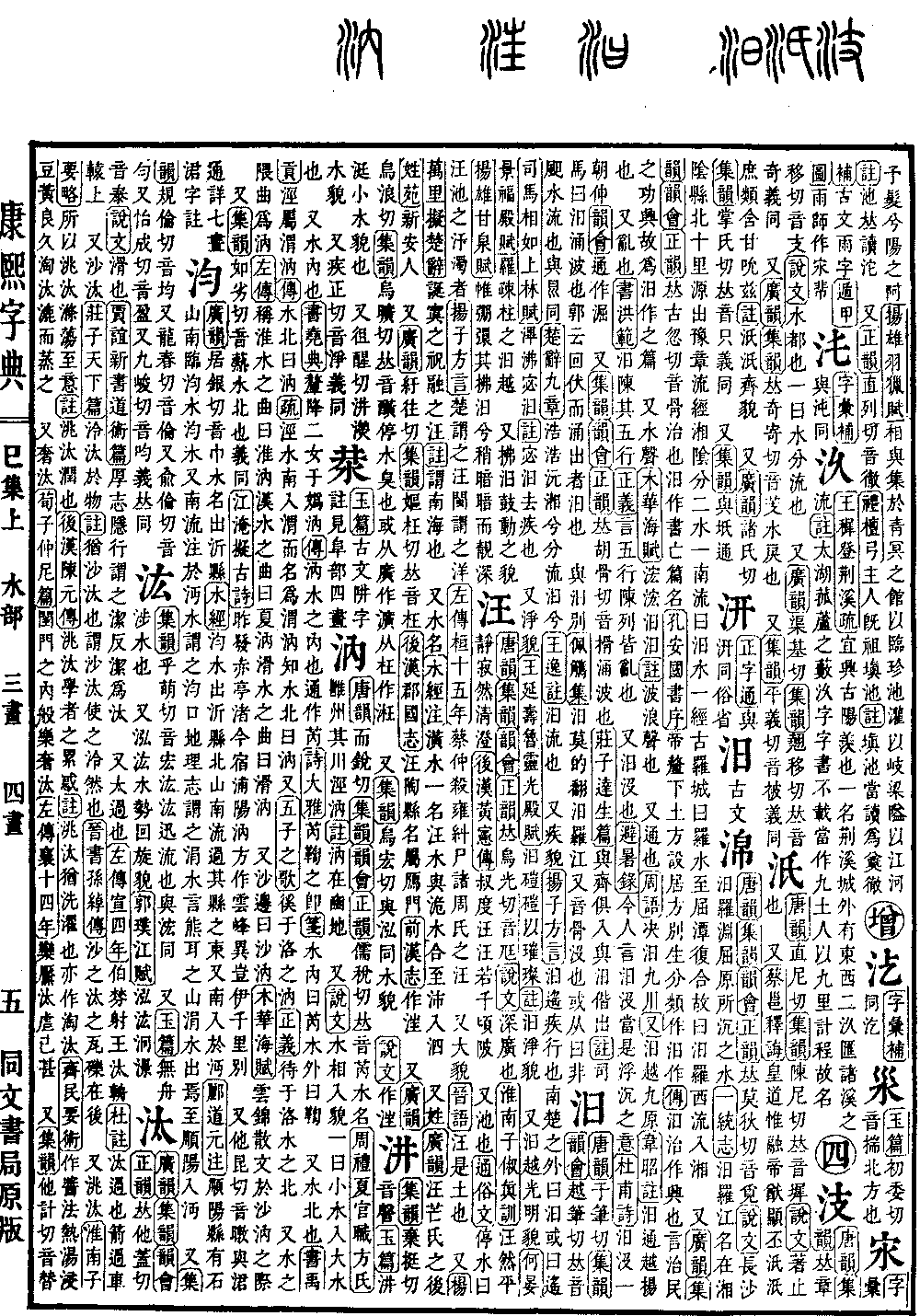
Si Collection, Upper Volume
Radical: Water (shuǐ)
Qian
Kangxi strokes: 8
Page 607, Entry 08
Correct Meaning (Zhengzitong) states it is the same as Qian, being a simplified form of the common variant.
Tang Rhymes (Tangyun) and Correct Rhymes (Zhengyun) pronounce it as kǔjiān, which is pronounced qian. Collected Rhymes (Jiyun) and Rhyme Collection (Yunhui) pronounce it as qīngyān, which is pronounced qian. It is the name of a river.
Explanation of Graphs and Analysis of Characters (Shuowen Jiezi) records: This river originates in Fufeng Qian County and flows northwest into the Wei River.
Commentary on the Water Classic (Shuijing Zhu) records: The Qian River originates in the middle valley of Xuan, Pu Valley Township, Qian County.
Approaching the Standard (Erya), section on Explaining Water, records: The Qian River does not continue to flow after emerging.
Commentary: This refers to spring water gushing from the ground, collecting on its own to form a still pool. Additionally, a marsh created by a man-made breach is also called qian.
Sub-commentary: All water areas created by man-made breaches and enclosed by dams are also referred to as qian, similar to water that emerges and does not flow.
Also Qianyang, which is a county name.
Record of the Vast Territories (Guangyu Ji) records: Subject to Fengxiang Prefecture, it was called Yumi during the Han dynasty, and renamed Qianyang during the Later Zhou dynasty.
Also pronounced as kǔjiàn (Tang Rhymes).
Also pronounced as qīngdiàn (Collected Rhymes), pronounced qian.
Also pronounced as jiédìng (Collected Rhymes), pronounced qìng. The meaning is the same.
Also pronounced as níjiān (Collected Rhymes), pronounced yán. The meaning is clean.