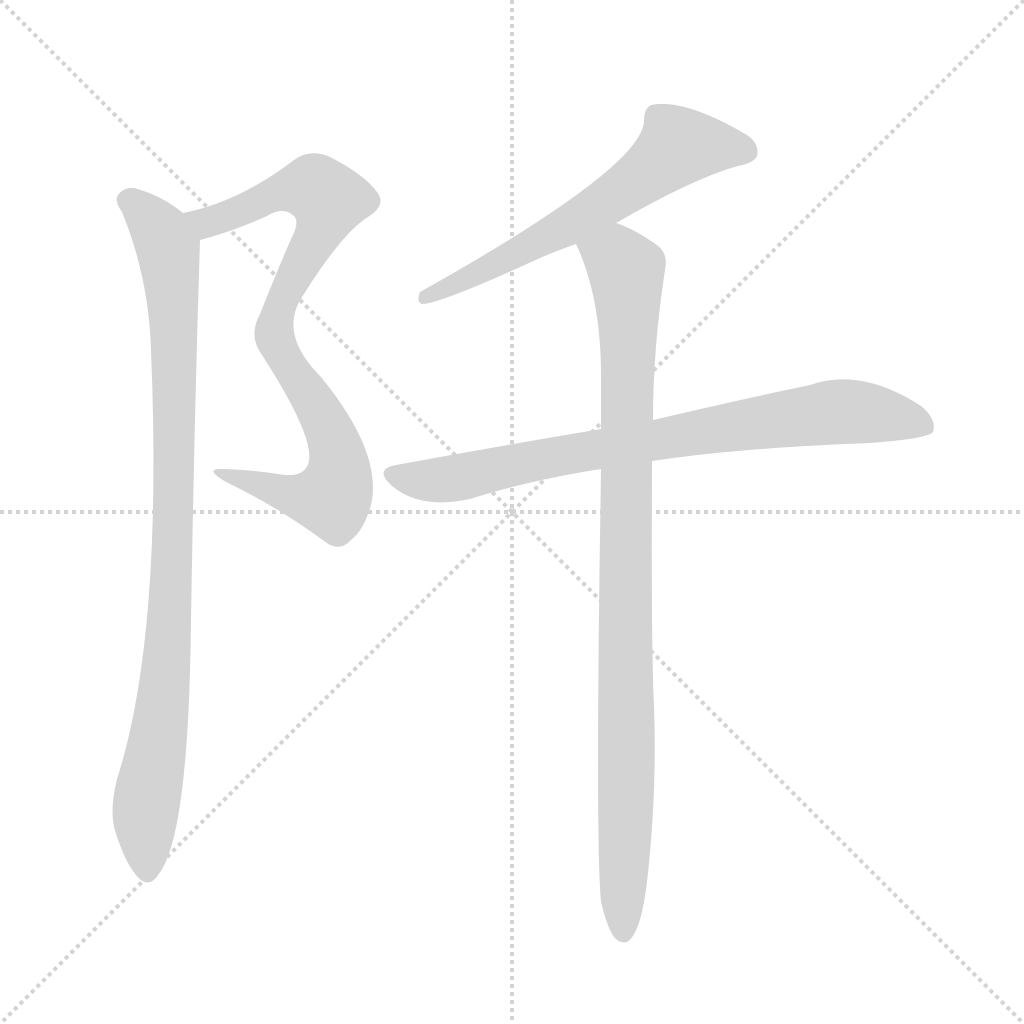
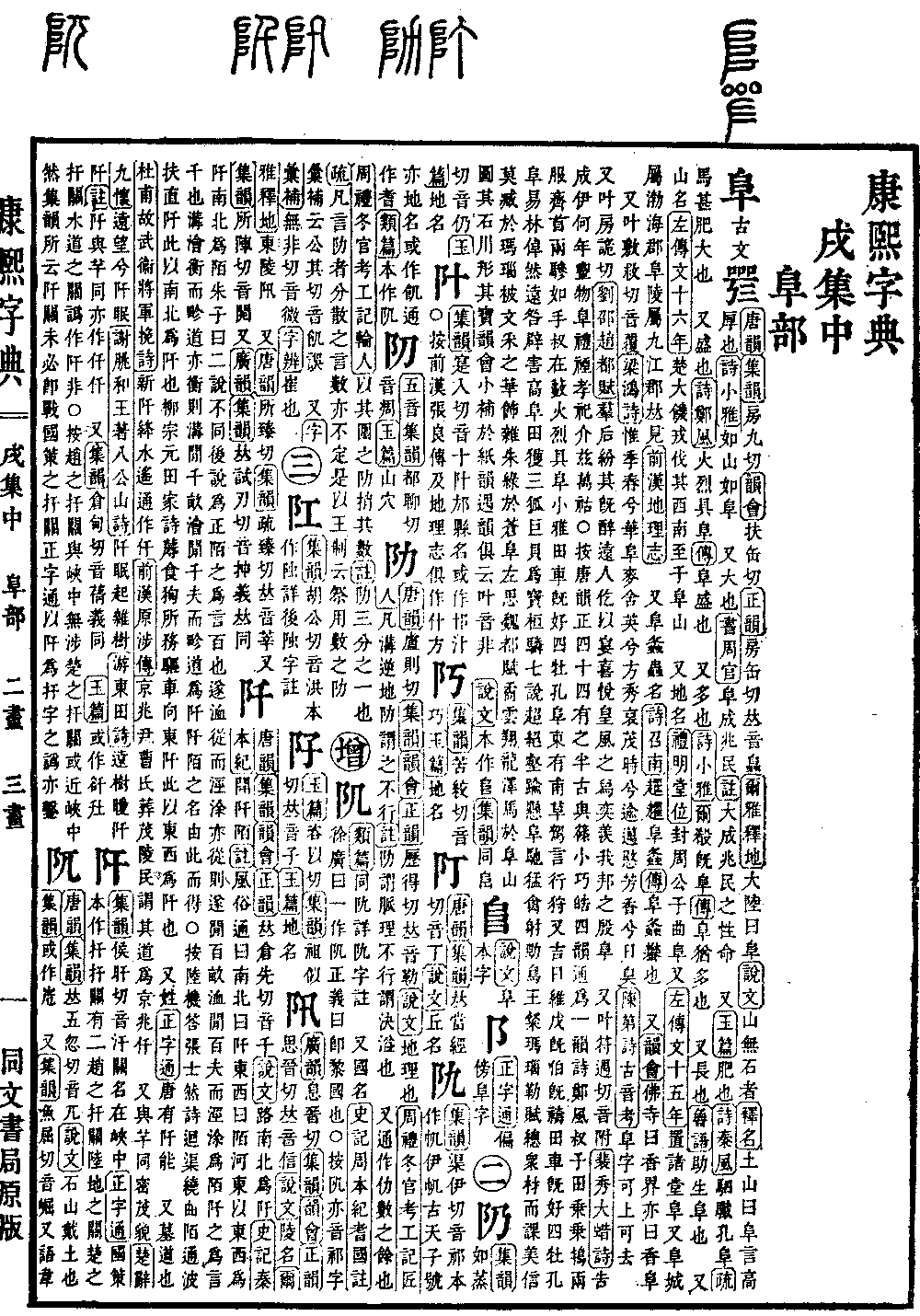
Xu Collection, Middle Volume, Radical: Mound (fù)
qian
Kangxi Stroke: 11
Page 1345, Entry 16
Pronounced qian (first tone) — Tang Yun, Ji Yun, Yun Hui, Zheng Yun
Roads running north-south are called qian. — Shuowen
Opened up the qian and mo. — Shi Ji, Annals of Qin
Commentary: Feng Su Tong says: North-south are called qian, east-west are called mo. Hedong considers east-west as qian and north-south as mo. Zhu Zi says: The two statements differ; the latter is correct. Mo means a hundred, following the xue and jing paths, it covers a hundred mu, a hundred men, and the jing path becomes mo. Qian means a thousand, a horizontal gou and hui, and a horizontal zhen path, so between gou are a thousand mu, between hui are a thousand men, and the zhen path becomes qian. The names qian and mo are thus derived. According to Lu Ji's reply to Zhang Shiran's poem: winding canals surround curved mo, connecting waves support straight qian. This considers north-south as qian. Liu Zongyuan's poem on farming: eating breakfast and attending to duties, driving a carriage towards the east qian. This considers east-west as qian.
Also a surname. — Tang had Qian Neng.
Also the path to a tomb. — Du Fu, Elegy for the Late General Wuwei: New qian, Jiangshui is far. Can be written as qian. — Former Han, Biography of Yuan She: The Cao family of Jingzhao Yin was buried in Maoling; people called the path Jingzhao qian.
Also the same as qian. Dense and flourishing appearance. — Chu Ci, Nine Sorrows: Looking afar, qian mian. — Xie Tiao, Poem in Harmony with Wang Zhu's Poem on Mount Bagong: Qian mian, miscellaneous trees grow. — Poem on Traveling to the Eastern Field: Distant trees, qian qian.
Commentary: Qian is the same as qian. Also written as qian qian.
Pronounced qian (fourth tone) — Ji Yun. The meaning is the same.
Can also be written as. — Yu Pian