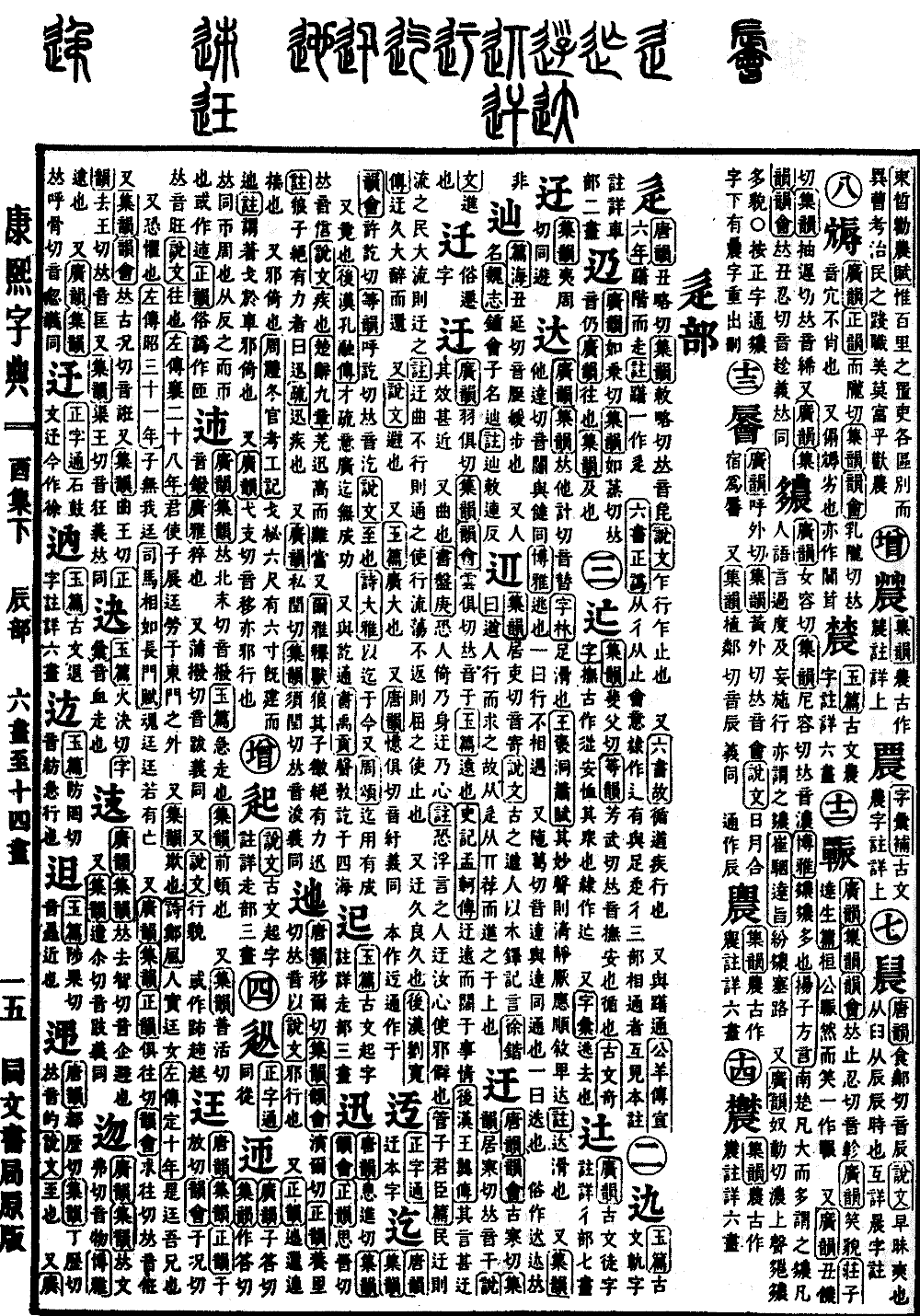
You Collection, Lower Volume
Radical: Walking (chuò)
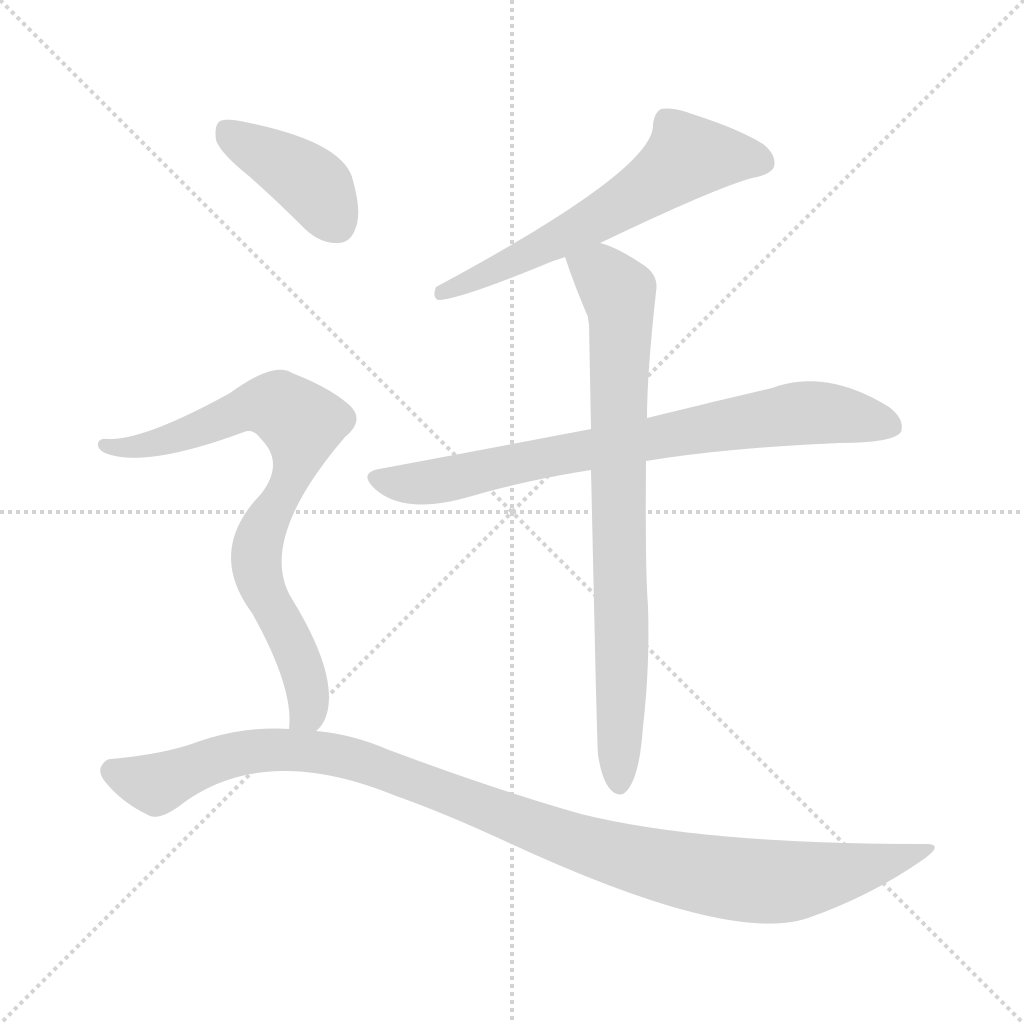
迁
Kangxi Stroke Count: 19
Page 1253, Entry 21
A common variant of the character 遷. An ancient form is written as 拪.
Pronounced qian.
According to the Shuowen Jiezi (Explanation of Graphs and Analysis of Characters), it means to ascend or move upward.
According to the Guangyun (Broad Rimes), it refers to leaving a low place to go to a high place.
As in the Book of Odes (Shijing), Small Odes: Birds fly and move to high trees.
It also refers to migration or moving house.
As in the Book of Changes (Yijing), Benefit Hexagram: When a gentleman sees good deeds, he moves to emulate them; when he has faults, he moves to correct them.
As in the Book of Documents (Shangshu), Counsels of Yu and Ji: Encouraging the people to circulate their resources and trade/exchange their stockpiled goods.
It also refers to moving objects.
As in the Book of Rites (Liji), Songs of Qu: If one is sitting and needs to move the books, zithers, or lutes of one's teacher, one must do so while kneeling.
It also refers to change or modification.
As in the Zuo Commentary (Zuozhuan), Fifth Year of Duke Zhao: You have governed the state affairs without amending the rites, yet you have changed them.
It also refers to a state moving its capital.
As in the Rites of Zhou (Zhouli), Autumn Official, Minor Minister: The second duty is to consult on the matter of the state moving its capital.
It also refers to the reassignment of an official's post.
As in the History of the Former Han (Hanshu), Biography of Jia Yi: Jia Yi was promoted out of turn, reaching the rank of Grand Master of the Palace within one year.
It also refers to demotion, known as zuoqian (left-demotion).
As in the Records of the Grand Historian (Shiji), Biography of King Xin of Han: The King of Xiang enfeoffed the various generals as kings in the central regions, but sent you to reside far away; this is a demotion.
Also in the Biography of Zhang Cang: I am very clear that this is a demotion.
Note: At that time, the right was considered superior and the left inferior, which is why demotion is called left-demotion.
Also, according to the Zheng Yun (Correct Rimes), it means to exile or banish.
As in the Counsels of Gao Yao: Why was the Youmiao tribe banished?
It also refers to the Junqian, a type of tree.
As in the Rhapsody on the Capital of Wu (Wudu Fu) by Zuo Si: The Pingzhong tree and the Junqian tree.
It is also a surname.
Also pronounced xian.
As in the History of the Former Han (Hanshu), Biography of Wang Mang: Established Liu An as the King of Xintian.
Note: Fu Qian said the pronunciation is the same as xian. Yan Shigu said the meaning is the same as xian, with no need for a phonetic loan.
Also rhymes with qing.
As in the Rhapsody on the Great Heat (Dashu Fu) by Lin: Happiness leads to forgetting sorrow, the breath changes, and the heart's intent shifts. Thus, noble guests are invited and banquets are hosted with deep, earnest affection.
As in the Eulogy for Han Yu by Li Ao: The memorials were always rejected, and upon leaving, one was restored to office; whether promoted or demoted, the character remained unchanged, and righteous speech was frequently heard.
Verification of Textual Errors:
Book of Documents (Shangshu), Counsels of Yu and Ji: He Qian Hu Youmiao. Corrected to Counsels of Gao Yao according to the original text.
Rhapsody on the Capital of Wu (Wudu Fu) by Zuo Si: Junqian Pingzhong. Corrected to Pingzhong Junqian according to the original text.