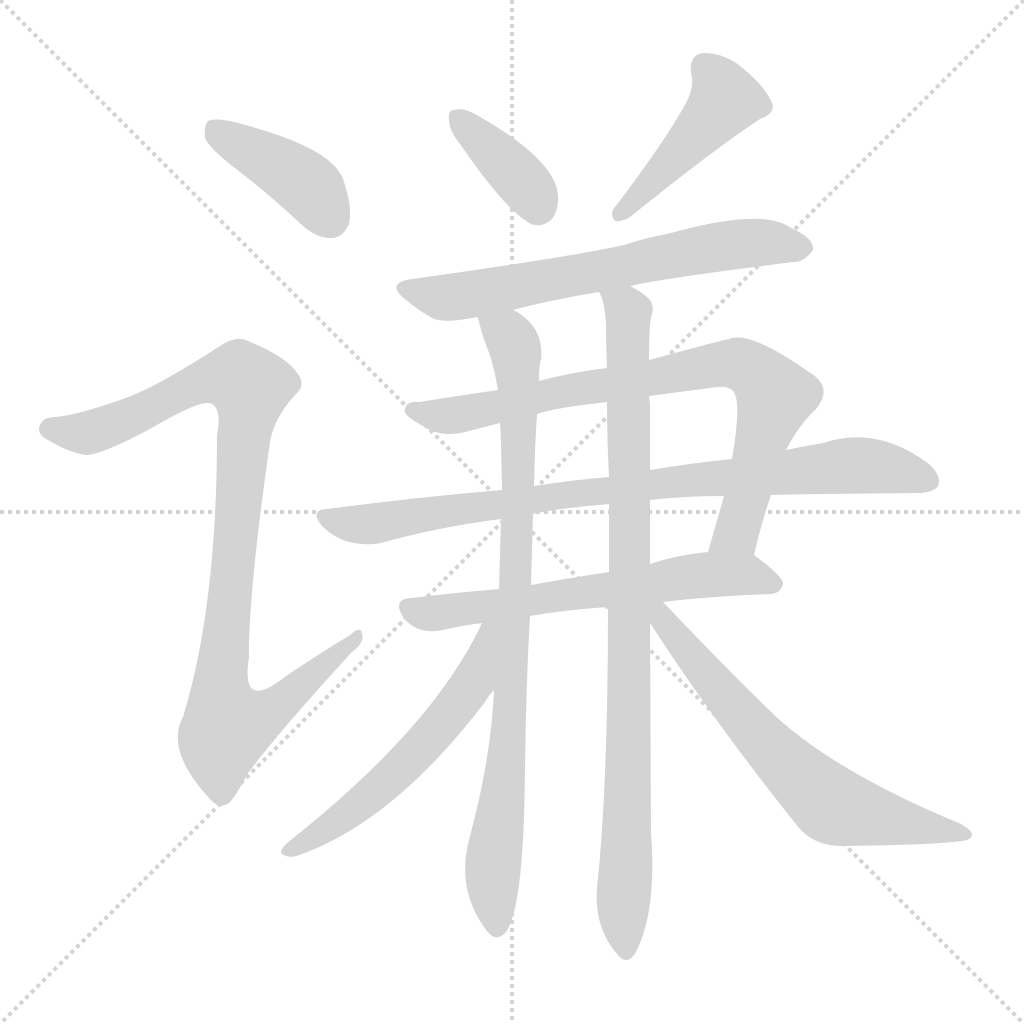
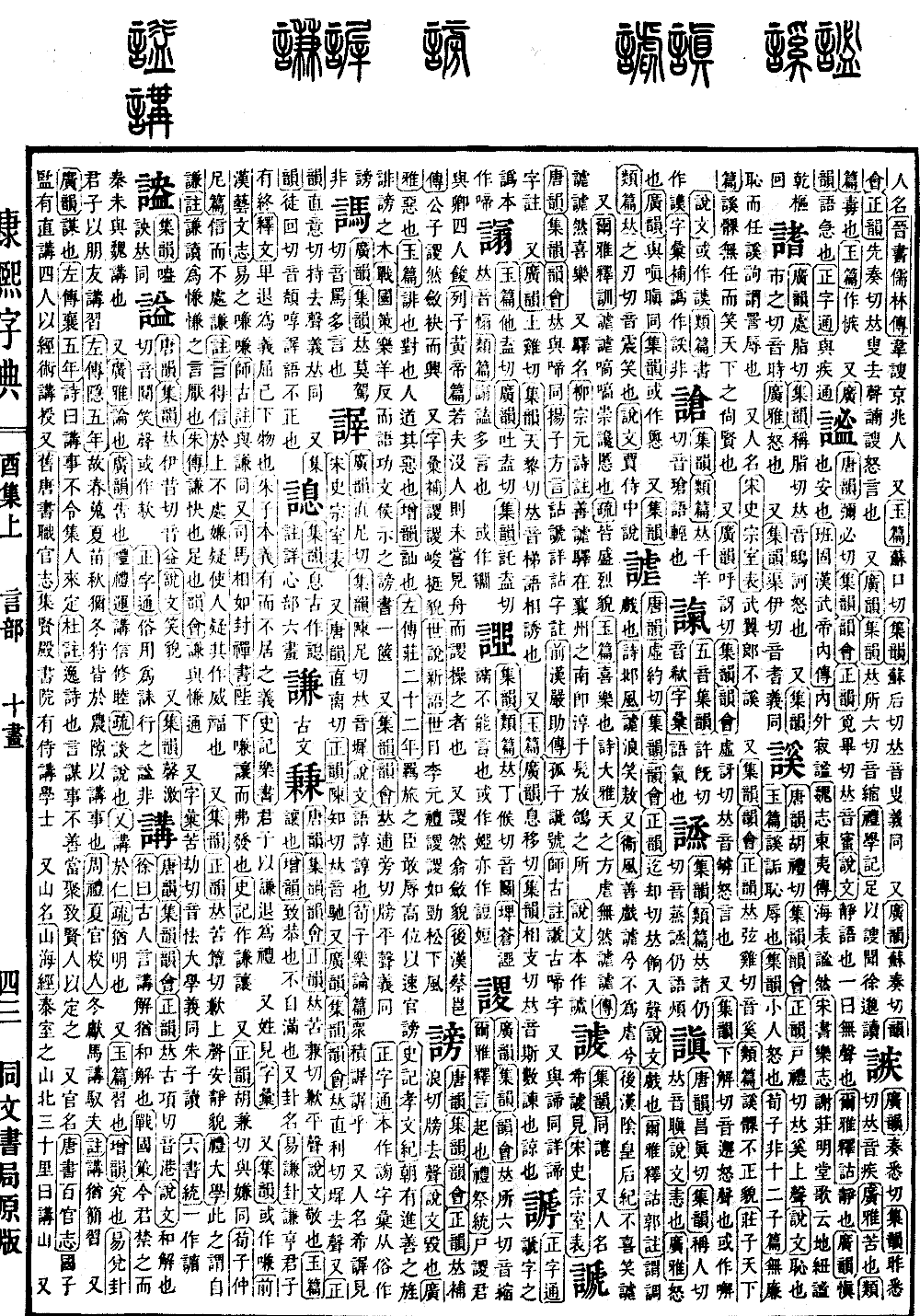
You Collection, Upper Volume
Radical: Speech (yán)
Kangxi brush strokes: 17
Page 1175, Entry 04
Ancient form. Pronounced qian (level tone).
Shuowen Jiezi (Dictionary of Explaining Characters): To respect.
Yupian (Jade Chapters): To yield.
Zengyun (Expanded Rhymes): To manifest reverence; not being self-satisfied.
Also the name of a hexagram. Book of Changes (Yijing), Humility Hexagram: Humility provides success; the noble person will have a favorable end.
Shìwén (Explanation of Text): To withdraw is to act with righteousness, to humble oneself and place others above oneself.
Zhu Xi's Original Meaning: To possess but not occupy.
Records of the Grand Historian (Shiji), Treatise on Music: The noble person regards humble withdrawal as ritual.
Also a surname. See Dictionary of Characters (Zihui).
Also, in Jiyun (Collected Rhymes), sometimes written in a variant form (qian).
Book of Han (Hanshu), Treatise on Arts and Literature: The humility of the Book of Changes.
Shigu's Commentary: Same as humility (qian).
Also, Sima Xiangru, Essay on the Feng and Shan Sacrifices: Your Majesty yields with humility and does not act.
Records of the Grand Historian (Shiji) uses the character for humility (qian).
Also, in Zheng Yun (Correct Rhymes), pronounced xian (level tone). Same as suspicion (xian).
Xunzi, Zhongni Chapter: Trusted but does not dwell in suspicion.
Commentary: This means receiving trust from those above and not dwelling in suspicion, so as not to cause others to suspect one of abusing power.
Also, in Jiyun (Collected Rhymes) and Zheng Yun (Correct Rhymes), pronounced qie (rising tone). An appearance of peace and quiet.
Book of Rites (Liji), Great Learning: This is called being self-satisfied.
Commentary: Humility is read as satisfaction (qian). The word satisfaction means to be content.
Zhu's Commentary: Humility means happy and satisfied.
Rhyme Anthology (Yunhui): Humility is interchangeable with satisfaction (qian).
Also, in Dictionary of Characters (Zihui), pronounced qie. In the Great Learning, the meaning is the same. Read by Zhu Xi.
Liu Shu Tong (Six Writings Unified): One form is written as a variant.