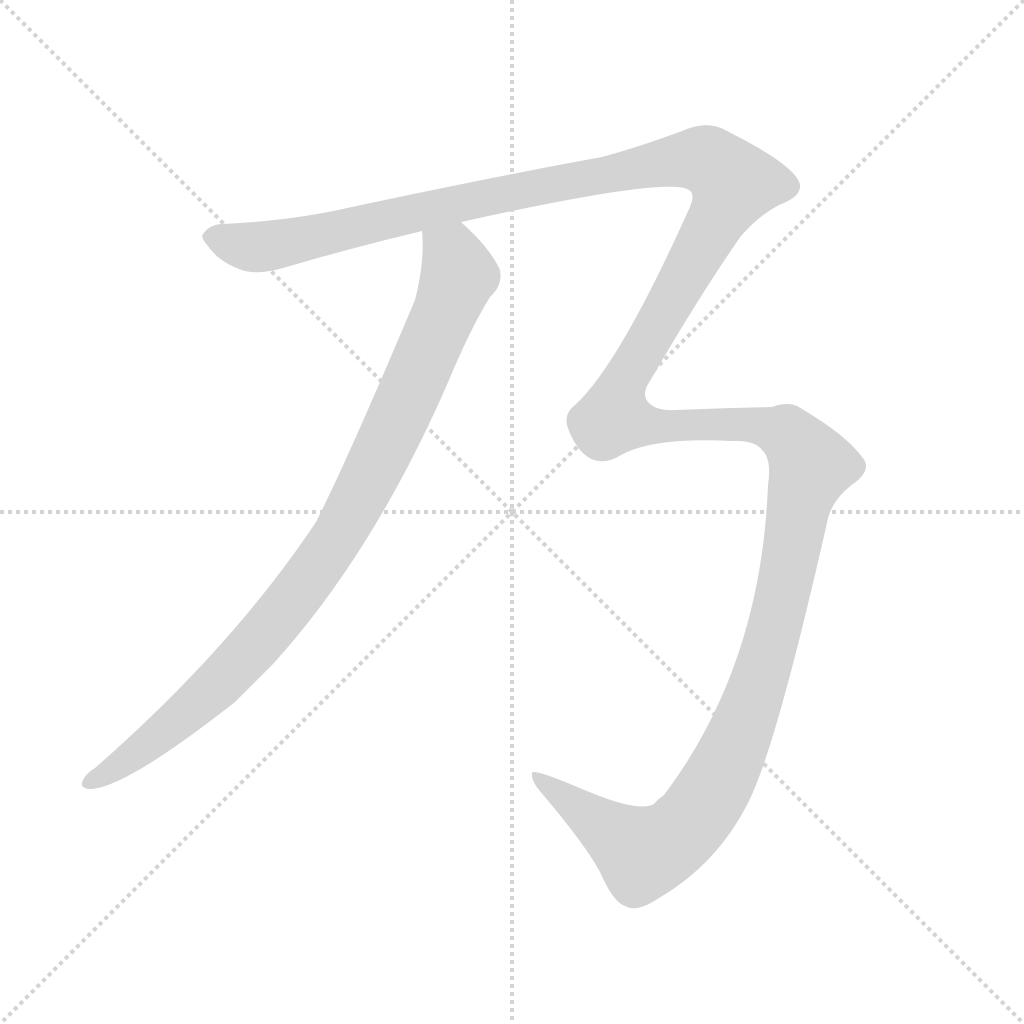
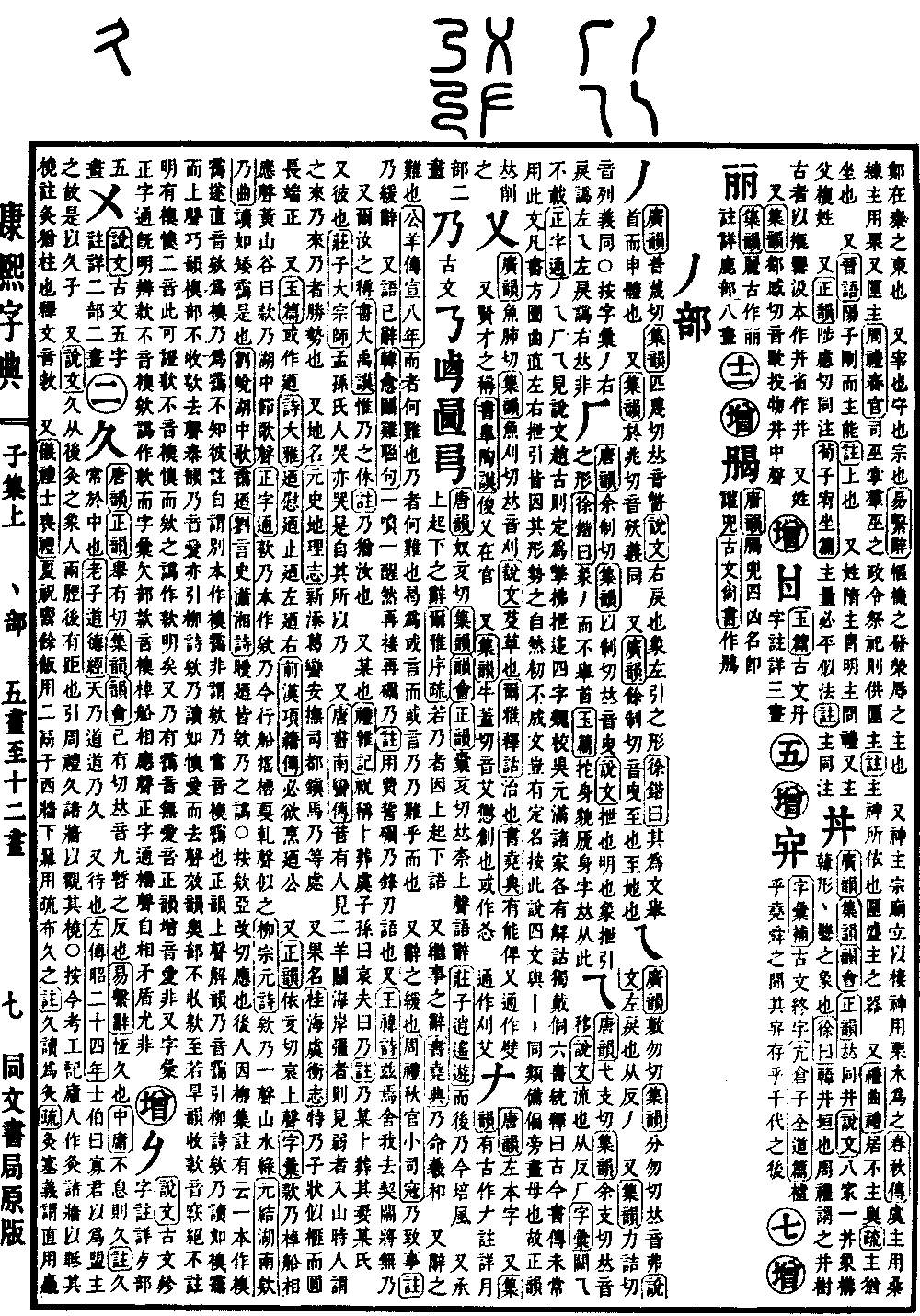
Zi Collection, Page Position: Upper. Radical: Slash (piě). Nai; Kangxi Dictionary strokes: 2; Page 81, Line 12.
Recorded in ancient texts: Tang Rhymes (Tangyun) gives the pronunciation as a combination of nu and hai; Collected Rhymes (Jiyun), Rhyme Assembly (Yunhui), and Correct Rhymes (Zhengyun) give it as a combination of nang and hai, pronounced like the rising tone of the word nai. It is a classical Chinese grammatical particle.
The phrase "and only then does it mount upon the wind" appears in the Carefree Soaring (Xiaoyaoyou) chapter of the Zhuangzi.
Also used as a transitional conjunction. The Preface and Commentary to the Approaching the Refined (Erya) states that the phrase ruonai is a term used to introduce what follows based on what preceded it.
Also indicates the continuation of an action. The Canon of Yao (Yaodian) in the Book of Documents (Shujing) contains the phrase "he then commanded Xi and He."
Also used as a particle indicating a turn in meaning or emphasis. The Gongyang Commentary (Gongyangzhuan) for the eighth year of Duke Xuan explains: What does the word er mean? It indicates a transition. What does the word nai mean? It also indicates a transition. Why is er used sometimes and nai at others? Because nai carries a stronger sense of transition than er.
Also used to soften the tone of a sentence. The Rites of Zhou (Zhouli) in the section for the Ministry of Justice (Qiuguan) contains the phrase "then he resigned from office." The commentary states that nai is a word used to ease the tone.
Also used as a sentence-final particle. Han Yu's Linked Stanzas on a Cockfight (Douji lianju) includes the line "with one spray they wake, then they sharpen themselves again." The commentary notes this is an adaptation of the phrase "sharpen your blades" from the Speech at Fei (Feishi).
Also found in the poetry of Wang Yi: "Now you leave me here; our long separation, will it not be so?"
Also used as a second-person pronoun meaning "you" or "your." The Counsels of Great Yu (Dayumo) in the Book of Documents contains the phrase "it is your excellence." The commentary explains that nai means "you."
Also used to refer to a specific person. The Miscellaneous Records (Zaji) in the Book of Rites (Liji) notes that in funeral prayers, the descendants performing the divination for burial are called ai, while the husband is called nai. The commentary explains that nai refers to the husband who is divining the burial for his wife.
Also means "he" or "that." The Great and Venerable Teacher (Dazongshi) chapter of the Zhuangzi contains the phrase "when others cry, the Mengsun clan also cries; this is just how he is."
Also recorded in the Biographies of the Southern Barbarians in the History of Tang (Tangshu): Long ago, someone saw two goats by the sea; the strong one appeared while the weak one hid in the mountains. People at the time called this phenomenon lainai. The term lainai means to have the upper hand.
Also a place name. The Treatise on Geography in the History of Yuan (Yuanshi) records that the Xintian Geman Pacification Commission governed areas including Duzhen and Manai.
Also the name of a fruit. The Treatises of the Supervisor and Guardian of the Cassia Sea (Guihai yuheng zhi) mentions the tenai fruit, which is shaped like the seed of the Chinese torreya but is more rounded, elongated, and symmetrical.
The Jade Chapters (Yupian) states that it is sometimes written in a variant form pronounced nai. The Greater Odes (Daya) in the Book of Odes (Shijing) contains the phrase "then they were comforted, then they settled; then to the left, then to the right." The Biography of Xiang Ji in the History of the Former Han (Qianhanshu) includes the line "you certainly wish to boil your father."
Also, the Correct Rhymes gives the pronunciation as a combination of yi and hai, sounding like the rising tone of ai. The Lexicon (Zihui) records that kuannai is the call of rowers responding to one another. Huang Tingjian stated that kuannai is the rhythmic singing on a lake. The Correct Character Mastery (Zhengzitong) argues that kuannai should originally be written as enai, and that the current sound of oars creaking is similar to it. Liu Zongyuan’s poetry contains the line "the sound of enai as the mountains and waters turn green." The Song of Enai in Hunan by Yuan Jie is correctly pronounced like aiai. The Song on the Lake by Liu Tui writes it as ainai, and Liu Yanshi’s Poem of Xiaoxiang writes it as ainai; these are all erroneous transcriptions of enai.
Note: The character e is pronounced as a combination of ya and gai, representing the sound of a response. Later people, because of a note in the collected works of Liu Zongyuan mentioning that some editions write it as aoai, directly assigned the pronunciation ao to the first character and ai to the second. They did not realize that the note merely mentioned other editions used those characters, not that enai should be pronounced that way. The Correct Rhymes places nai under the rising tone jie rhyme with the pronunciation ai, citing Liu’s poem and stating enai is read as aoai. However, under the rising tone qiao rhyme for the sound ao, the character kuan is not included. In the departing tone tai rhyme, nai is pronounced ai and again cites Liu’s poem, stating enai is read as aoai. Yet under the departing tone xiao rhyme for the sound ao, the character kuan is also not included. As for the han rhyme, kuan is included with the pronunciation kuan, with no mention of the sounds ao or ao. This proves that kuan is not pronounced ao or ao, and that the erroneous writing of e as kuan is obvious.
Additionally, nai has the sound ai but not the sound ai. The addition of the ai sound in the Correct Rhymes is incorrect. Furthermore, since the Lexicon and Correct Character Mastery have already clearly distinguished that kuan does not sound like ao and that e was mistakenly written as kuan, it is contradictory and particularly erroneous for the Lexicon to then provide the pronunciation ao for kuan under the Radical: Lack (qiàn) and define it as the sound of rowers, or for the Correct Character Mastery to define it as the sound of oars.