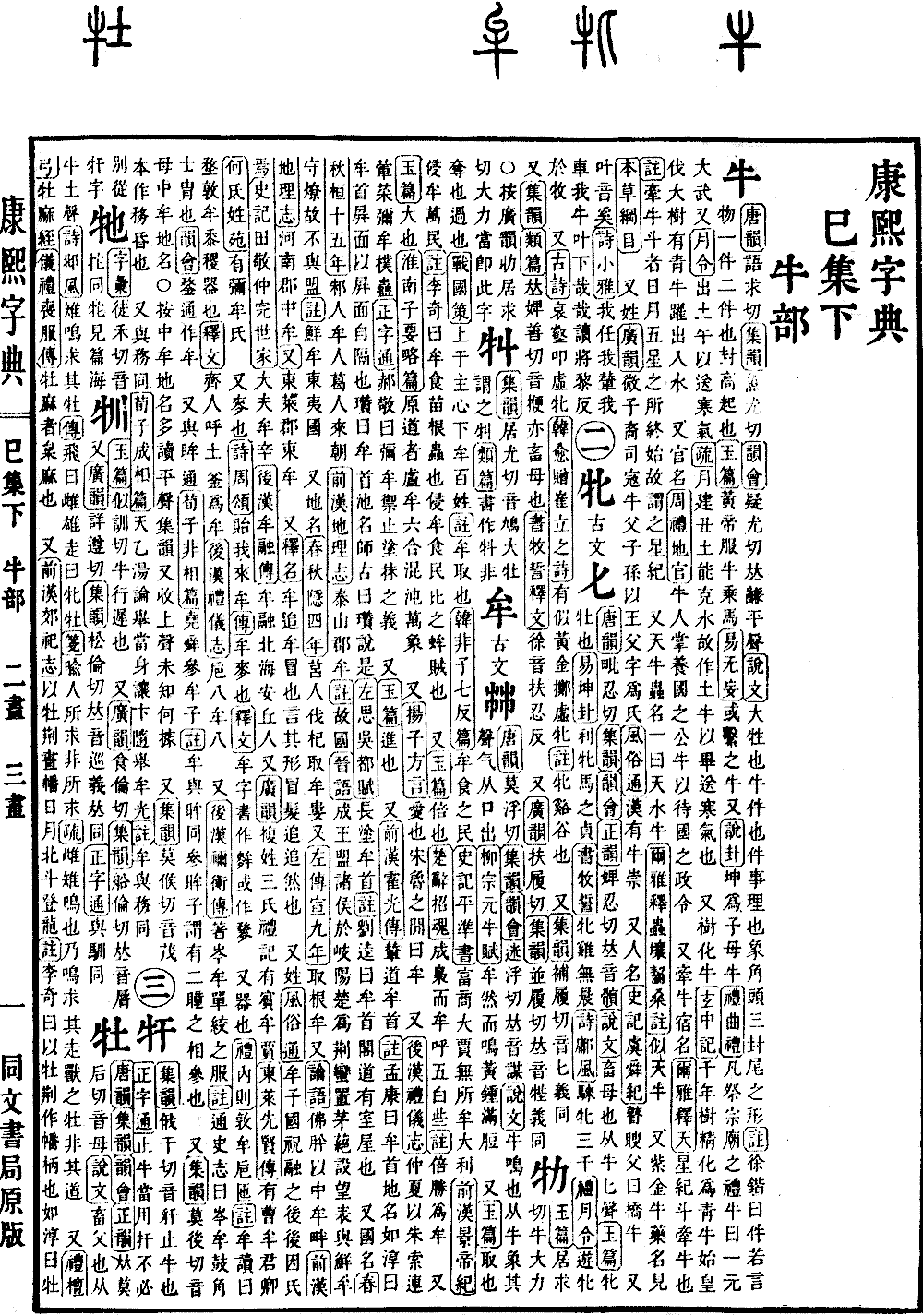
Si Collection, Lower Volume
Radical: Ox (niú)
Kangxi Strokes: 4
Page 697, Entry 01
Pronounced niú (level tone).
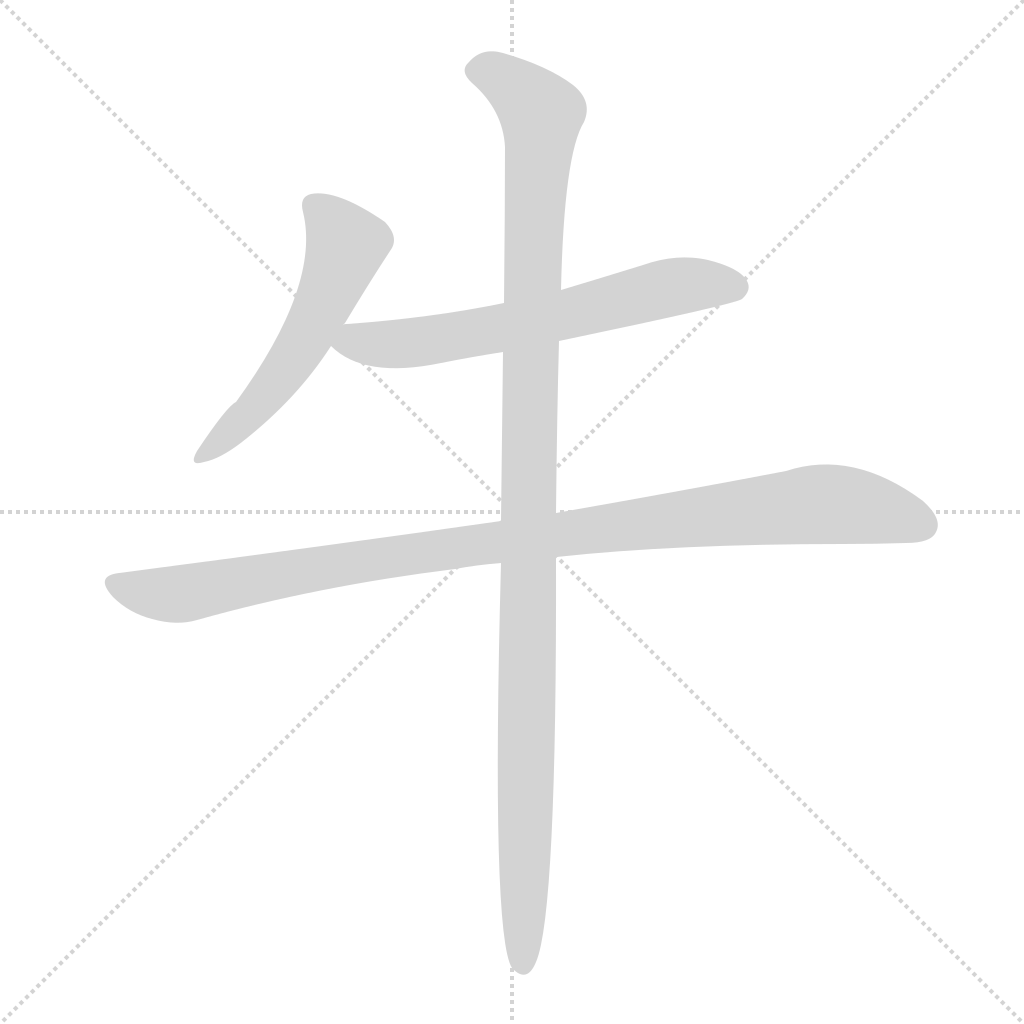
According to the Explaining Graphs and Analyzing Characters (Shuowen Jiezi), it refers to large livestock. The character ox implies the word item, signifying the principles of matters. It is a pictograph depicting the horns, head, hump, and tail.
Annotation: Xu Kai states that an item is like saying one piece or two pieces of a thing. A hump is a raised part.
According to the Jade Chapters (Yupian), the Yellow Emperor harnessed oxen and rode horses.
Book of Changes (Yijing), Hexagram Wuwang: Or tether an ox.
Also in Explanation of Trigrams (Shuogua): The Kun trigram represents a cow with a calf.
Book of Rites (Liji), Section on Regulations for Everyday Life (Quli): In the rituals for ancestral temples, the ox is referred to as the Great Warrior.
Also in Monthly Ordinances (Yueling): Bring out the clay ox to dismiss the cold air.
Commentary: The month corresponds to the Chou position; earth can overcome water, therefore a clay ox is made to finish sending away the cold air.
Also refers to trees transforming into oxen.
According to Records of the Mysterious World (Xuanzhongji), a thousand-year-old tree spirit transforms into a green ox. When the First Emperor of Qin cut down a large tree, a green ox leaped out and entered the water.
Also an official title.
Rites of Zhou (Zhouli), Section on Earth Officers: The Ox Official, who manages the state-owned oxen to await government decrees.
Also Qianniu, the name of a star constellation.
Literary Expositor (Erya), Section on Explaining the Heavens: The Star Record corresponds to the Dipper and the Qianniu constellation.
Annotation: The Qianniu and the Dipper are where the sun, moon, and five planets begin and end their cycles, hence they are called the Star Record.
Also Tianniu, the name of an insect. One name is Tianshui-niu.
Literary Expositor (Erya), Section on Explaining Insects: The rang (a type of insect) that gnaws on mulberry trees resembles the Tianniu.
Also Zijinniu, a type of medicinal plant. See Compendium of Materia Medica (Bencao Gangmu).
Also a surname.
Broad Rhymes (Guangyun): Descendants of Weizi, where Siniufu's offspring adopted the name of their grandfather as their surname.
Comprehensive Record of Customs (Fengsutong): During the Han dynasty, there was Niu Chong.
Also a person's name.
Records of the Grand Historian (Shiji), Annals of the Sage King Shun: Guso's father was called Qiaoniu.
Also rhymes with ni (level tone).
Book of Odes (Shijing), Lesser Odes: I handle my handcart, my carriage, and my ox. It rhymes with the character zai below. Zai is read as jiangli (falling tone).
Textual Research: Regarding Tianniu, the name of an insect. Literary Expositor, Section on Explaining Insects: The rang that gnaws on mulberry trees resembles the Tianniu. The character rang has been corrected to xiang based on the original text. Also, regarding the rhyme with xi. Book of Odes, Lesser Odes: I handle my handcart, my carriage, and my ox. It rhymes with the character zai below. Zai is read as jiangli (falling tone). Note that niu and xi belong to different phonetic categories, so the character niu cannot rhyme with xi. Based on the phonetic categories, the rhyme with xi has been corrected to rhyme with ni.