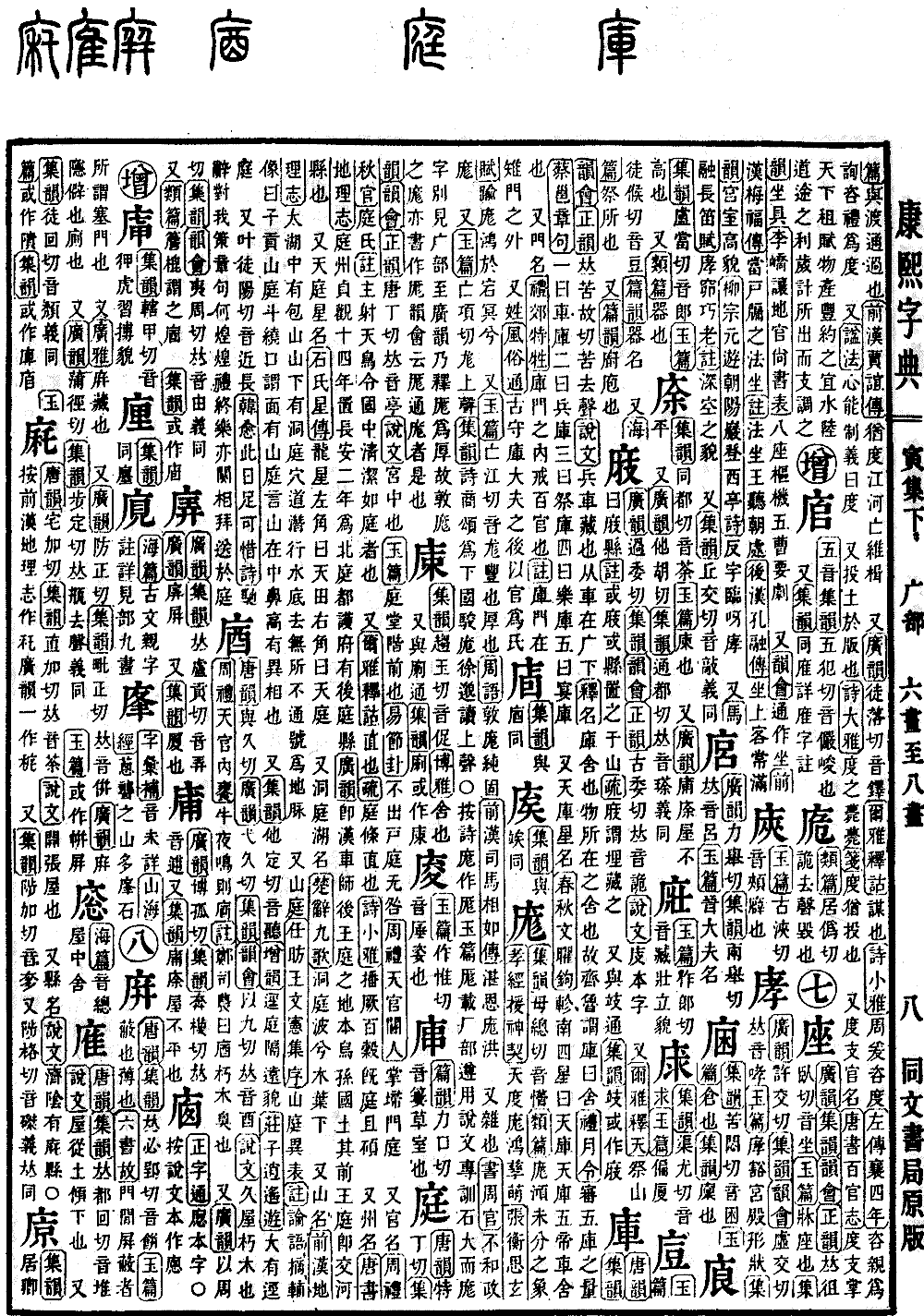
Yin Collection, Lower Volume
Radical: Wide (guǎng)
Kangxi Strokes: 10
Page 346, Entry 01
Pronounced ku (falling tone).
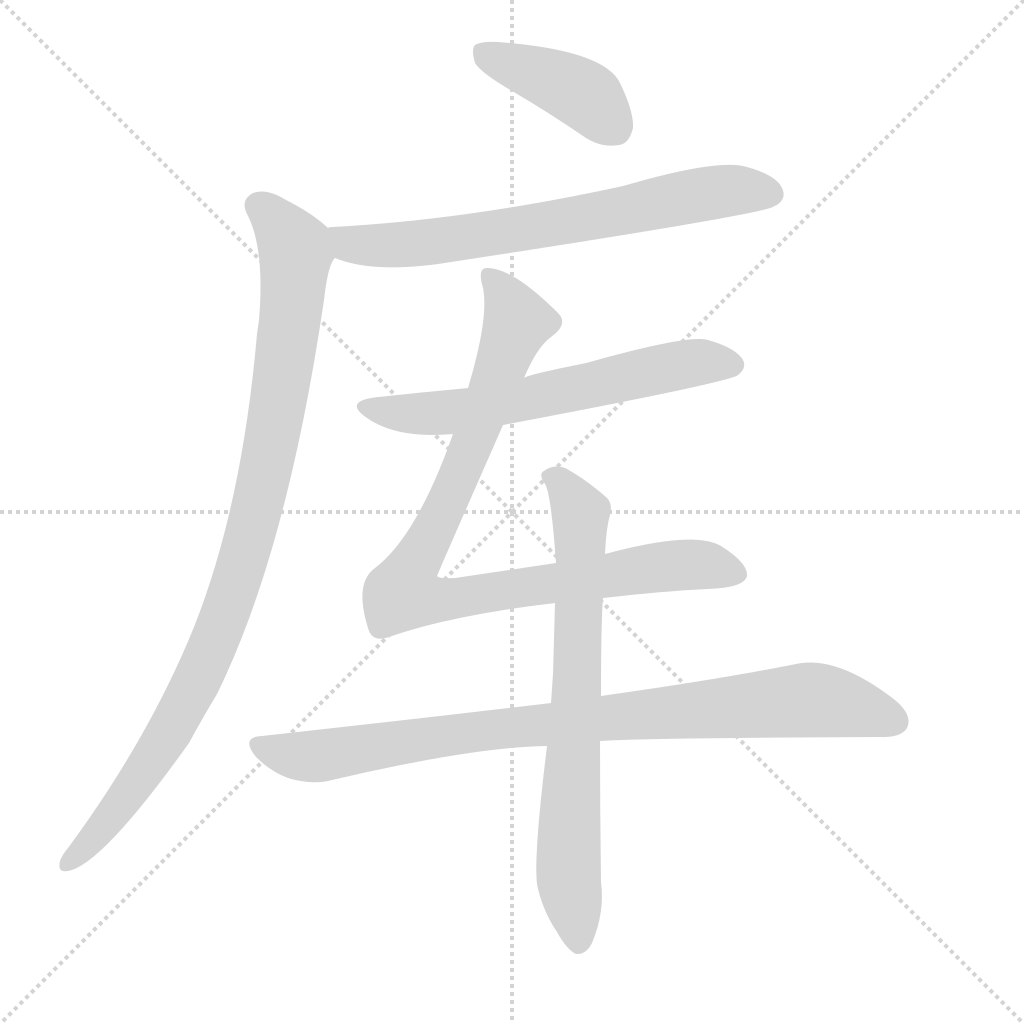
Shuowen Jiezi (Shuowen) defines this as a place for storing military vehicles. The character structure consists of Carriage (chē) beneath Wide (guǎng).
Explanations of Names (Shiming) states that a storehouse is a building. Since it is a structure where goods are stored, in the regions of Qi and Lu, a storehouse is referred to as a dwelling.
Book of Rites (Liji), Monthly Ordinances (Yueling) mentions examining the contents of the five storehouses.
Cai Yong's Commentary (Zhangju) explains that the five storehouses consist of: first, the vehicle storehouse; second, the military storehouse; third, the sacrificial storehouse; fourth, the musical instrument storehouse; and fifth, the banquet storehouse.
There is also the Heavenly Storehouse, which is the name of a constellation. The Spring and Autumn Annals: Apocryphal Treatise on the Luminaries (Chunqiu Wenyaogou) states that the four stars south of the Chariot constellation (Zhen) are called the Heavenly Storehouse. The Heavenly Storehouse serves as the carriage house for the five emperors.
It also refers to the name of a palace gate. Book of Rites (Liji), Suburban Sacrifices (Jiaotesheng) mentions that within the storehouse gate, one must be vigilant toward all officials. The commentary notes that the storehouse gate is located outside of the Pheasant Gate.
It is also a surname. Customs and Traditions (Fengsutong) states that it originated from the descendants of ancient officials in charge of storehouses, who adopted their official title as a surname.