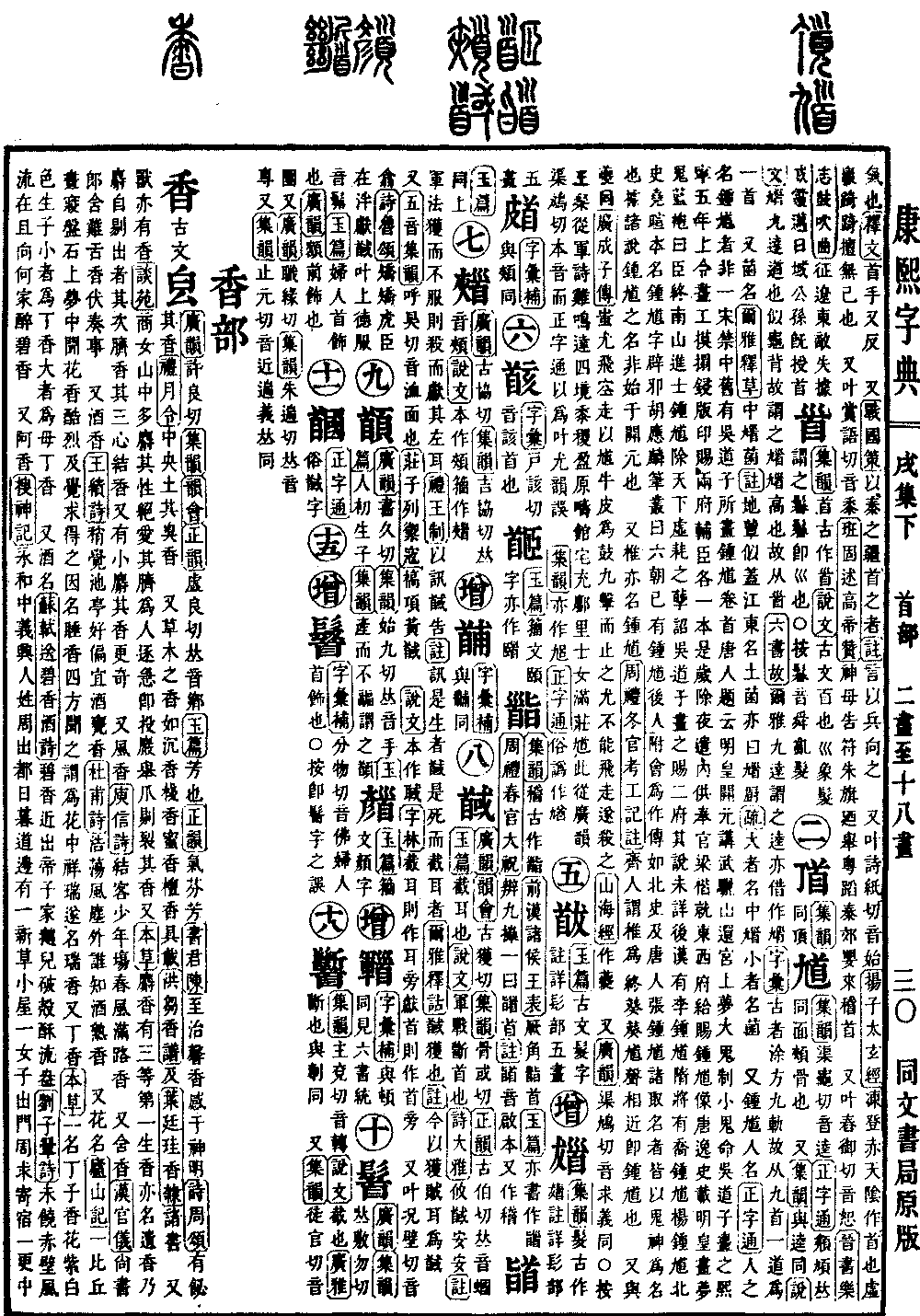
Xu Collection, Lower Volume
Radical: Head (shǒu)
Page 1428, Entry 03
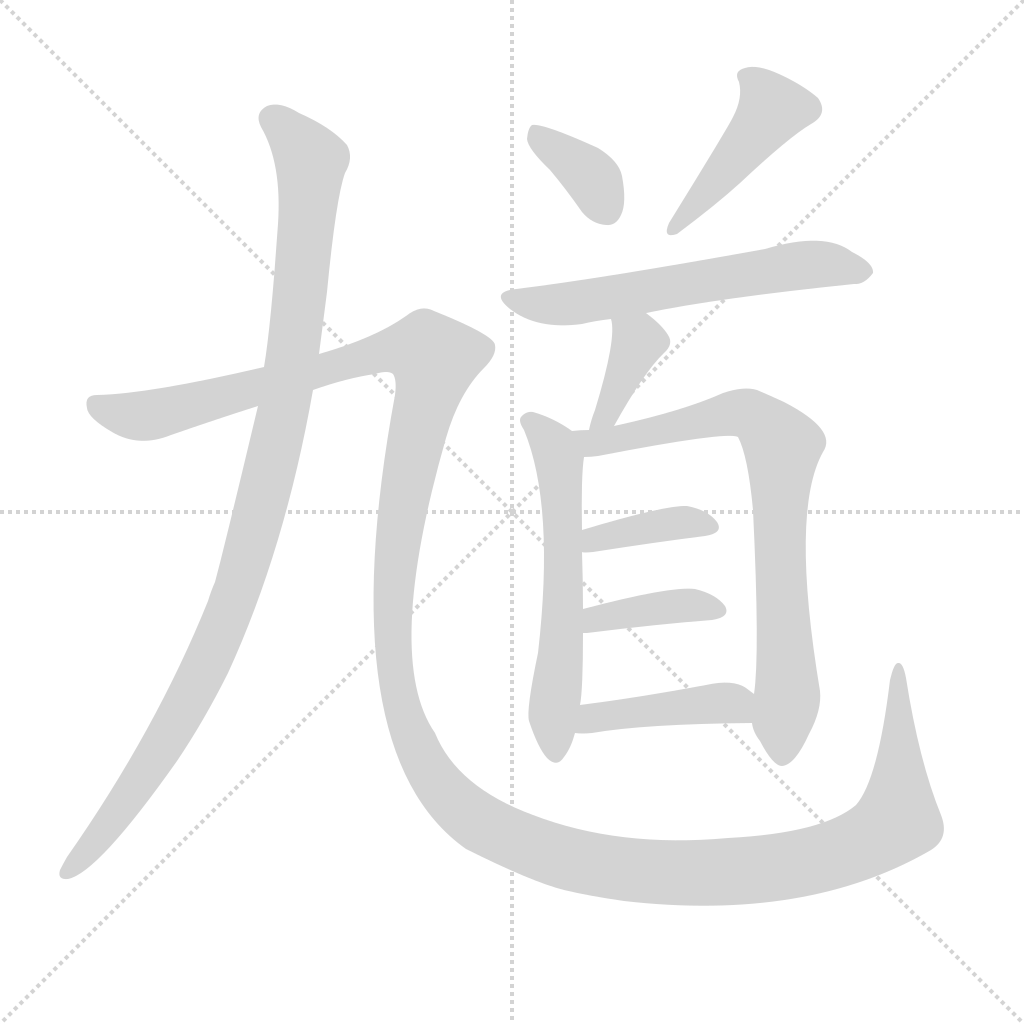
Jiyun: Pronounced kui.
Zhengzitong: Identical to kui (referring to cheekbones). Refers to the cheekbones. Also, Jiyun states it is the same as kui (thoroughfare).
Shuowen: A nine-way intersection. Because it resembles the shell of a turtle (gui), it is called this. It signifies height, hence the composition from head (shou).
Liushugu: Er Ya states a nine-way intersection is called a kui. Also borrowed as a variant.
Zihui: In ancient times, a road was nine tracks wide, hence it is composed of nine and head, with one path forming one road.
Also the name of a fungus. Er Ya, Shicao: Zhongjun. Commentary: A ground mushroom that looks like a parasol; in the Jiangdong region it is called tujun, also known as chu. Sub-commentary: The large ones are called zhong, the small ones are called jun.
Also Zhong Kui, a person's name. Zhengzitong: There is more than one person who has been named Zhong Kui. In the Song dynasty, the imperial palace contained a painting of Zhong Kui by Wu Daozi. At the beginning of the scroll, there is an inscription from the Tang dynasty stating: During the Kaiyuan era of Emperor Xuanzong of Tang, while inspecting military exercises at Mount Li, the Emperor dreamt of a large ghost capturing smaller ghosts and ordered Wu Daozi to paint it. In the fifth year of the Xining era, the Emperor had court painters copy the image, carved into woodblocks, and printed copies were bestowed upon the ministers of the two secretariats. On New Year's Eve of that year, the inner attendant Liang Kai was dispatched to the eastern and western secretariats to bestow the Zhong Kui portraits. The Tangdai Yishi records that the Emperor dreamt of a ghost in a blue robe who said: I am Zhong Kui, a scholar from Zhongnan Mountain, and I wish to remove the demonic spirits of waste and calamity for Your Majesty. The Emperor issued an edict for Wu Daozi to paint him and bestowed the image upon the two secretariats, though this account is not detailed. During the Later Han there was Li Zhong Kui, and in the Sui dynasty there were generals named Qiao Zhong Kui and Yang Zhong Kui. The History of the Northern Dynasties records that Yao Xuan was originally named Zhong Kui, with the courtesy name Bixie. Hu Yinglin, in his Bicong, says: During the Six Dynasties period, there was already the name Zhong Kui; later generations fabricated biographies for him. Accounts such as the History of the Northern Dynasties and the Tang dynasty figure Zhang Zhong Kui show that these names were all derived from spirits and deities. According to these accounts, the name Zhong Kui did not originate in the Kaiyuan era.
Also, a mallet is called Zhong Kui. Zhou Li, Dongguan Kaogongji Commentary: The people of the Qi state called a mallet zhongkui. Kui and kui have similar sounds; thus it is Zhong Kui.
Also the same as kui (the mythical beast). Guangchengzi Zhuan: Chiyou was flying and running through the air; a drum was made using the hide of a kui, and after nine strikes, he was subdued and could no longer fly away, after which he was killed.
Classic of Mountains and Seas (Shanhaijing): Written as kui.
Guangyun: Pronounced qiu. The meaning is the same. Note: Wang Can's Congjun poems contain the line: Roosters crow across the four borders, millet and grain fill the plains and fields. Dwellings fill the lanes and alleys, and scholars and women fill the roads (kui). This follows the original pronunciation from Guangyun, whereas the Zhengzitong incorrectly assumes it rhymes with you.
Jiyun: Also written as the variant form.
Zhengzitong: The common variant is written incorrectly.