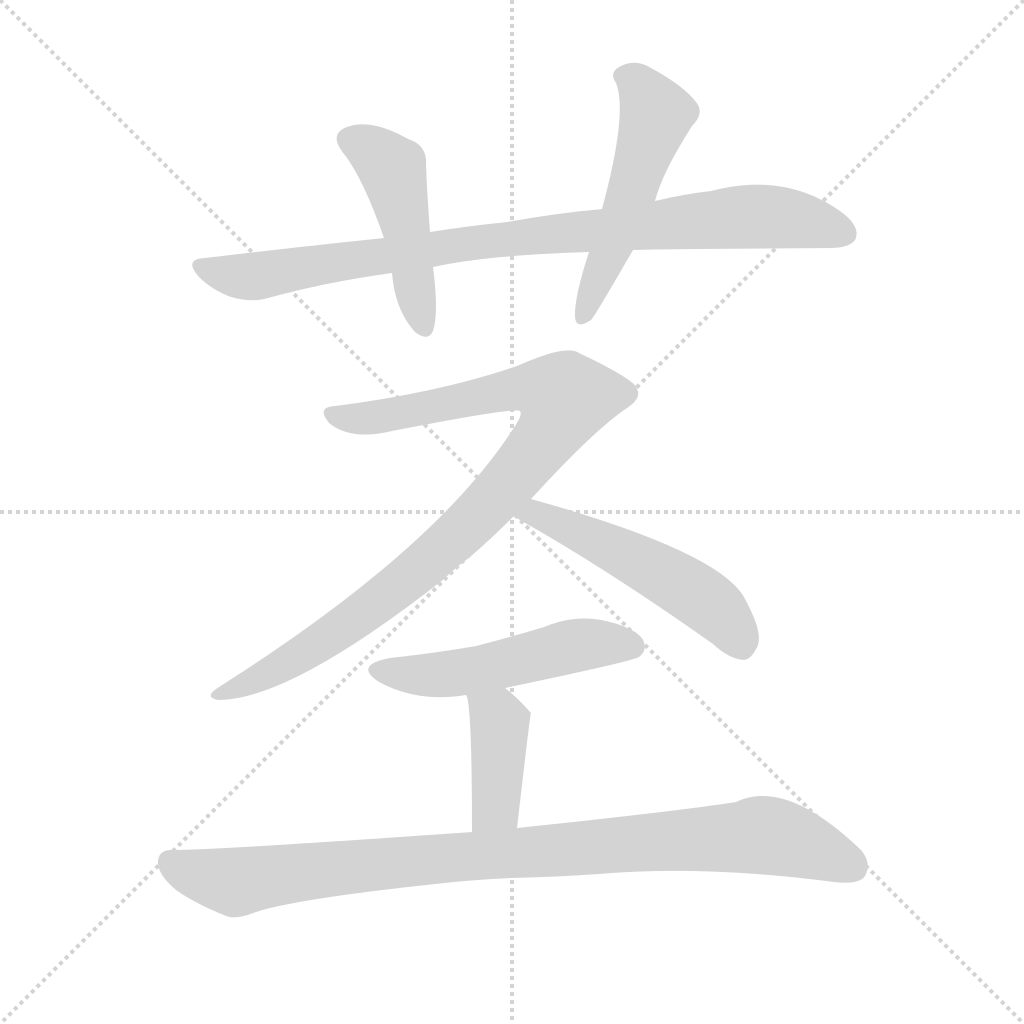
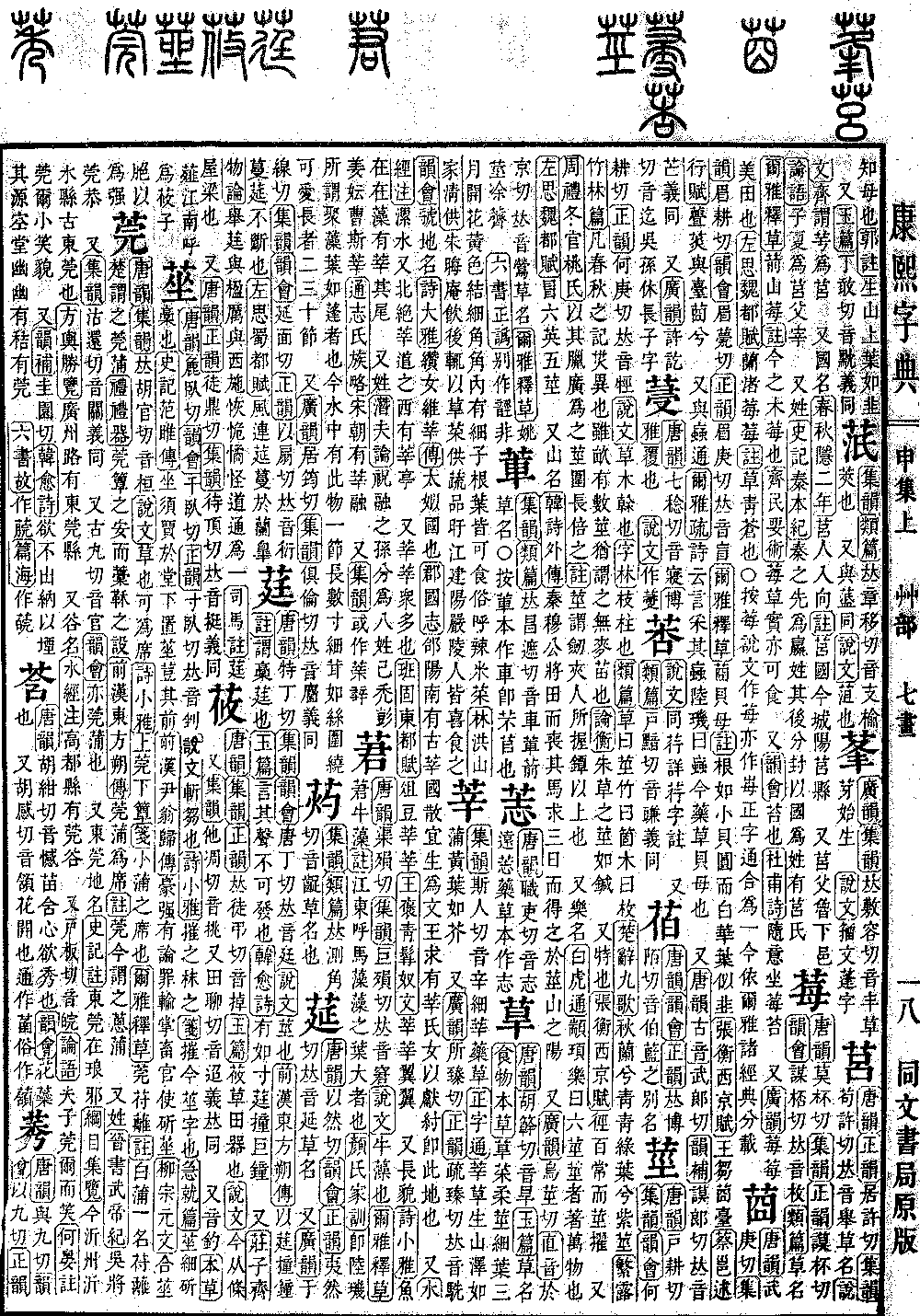
Shen Collection, Upper Volume
Radical: Grass (cǎo)
Kangxi Strokes: 13
Page 1034, Entry 06
Pronounced keng
Shuowen Jiezi: The stem of a plant or tree.
Zilin: A supporting branch or pillar.
Leipian: Grass is called jing, bamboo is called ge, trees are called mei.
Chu Ci (Chuci): Autumn orchids are verdant green, with green leaves and purple stems.
Luxu (Chunqiu Fanlu): Whenever the Spring and Autumn Annals (Chunqiu) record disasters or anomalies, even if there are several stems per acre, it is still described as having no wheat seedlings.
Lunheng: The stems of the vermilion grass are like needles.
Also, to stand out.
Zhang Heng, Western Capital Rhapsody (Xijing Fu): Narrow paths a hundred chang long, with stems rising up.
Zhou Rites (Zhouli), Winter Officials (Dongguan), Tao Shi: Use the width of the blade to determine the stem, with the circumference being double the length. Commentary: The stem refers to the sword grip, the part above the hilt held by the hand.
Also, the name of a musical piece.
Baihu Tong: The music of Zhuanxu is called Six Stems. The term stems refers to the growth of all things.
Zuo Si, Rhapsody on the Wei Capital (Wei Du Fu): Covering the six blossoms and five stems.
Also, the name of a mountain.
Han Shi Waizhuan: Duke Mu of Qin went hunting and lost his horse; he searched for three days and found it on the sunny side of Jing Mountain.
Pronounced ying
Name of a grass.
Erya (Erya), Interpretation of Grasses: Yao jing is tu ji.
Liushu Zheng'e: A variant written as the other character, which is incorrect.
Textual Research: Baihu Tong: The music of Zhuanxu is called Six Stems, with stems referring to the growth of all things; according to the original text, the phrasing has been corrected.