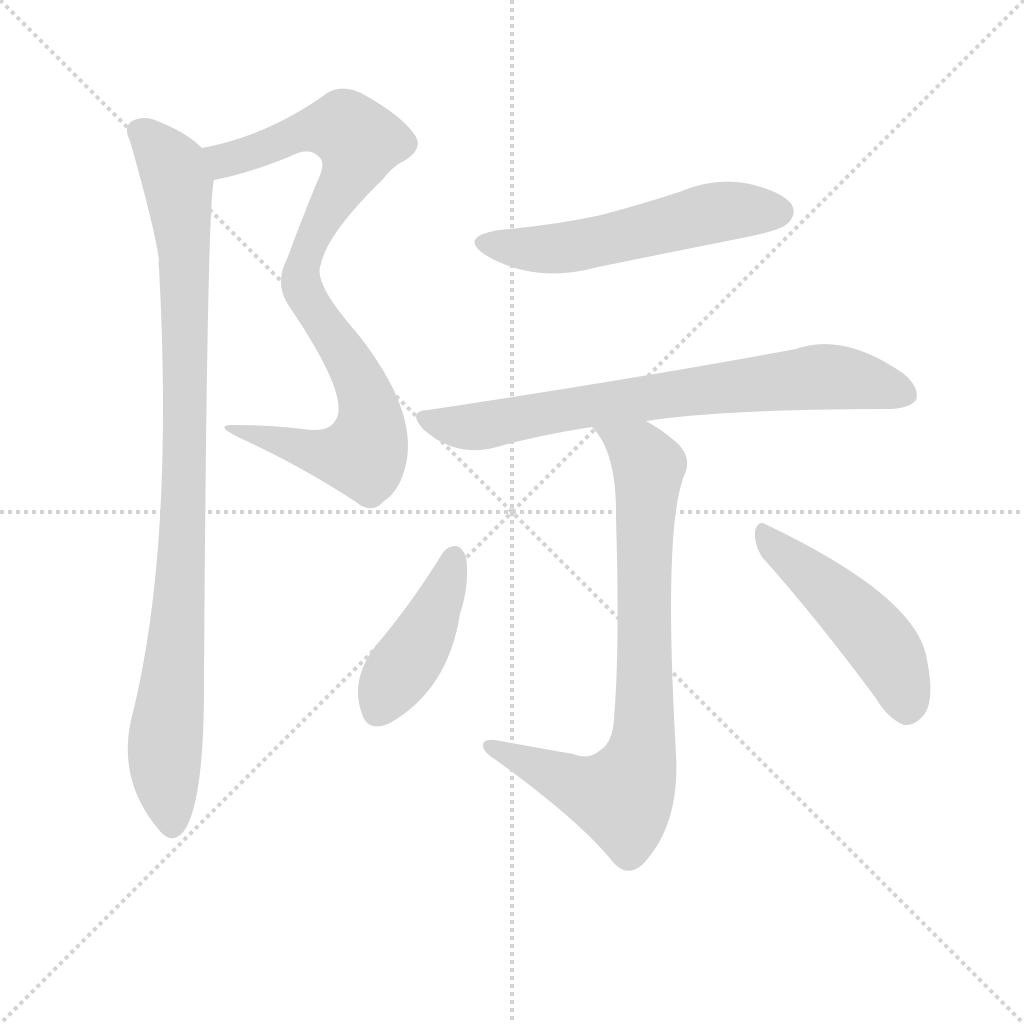
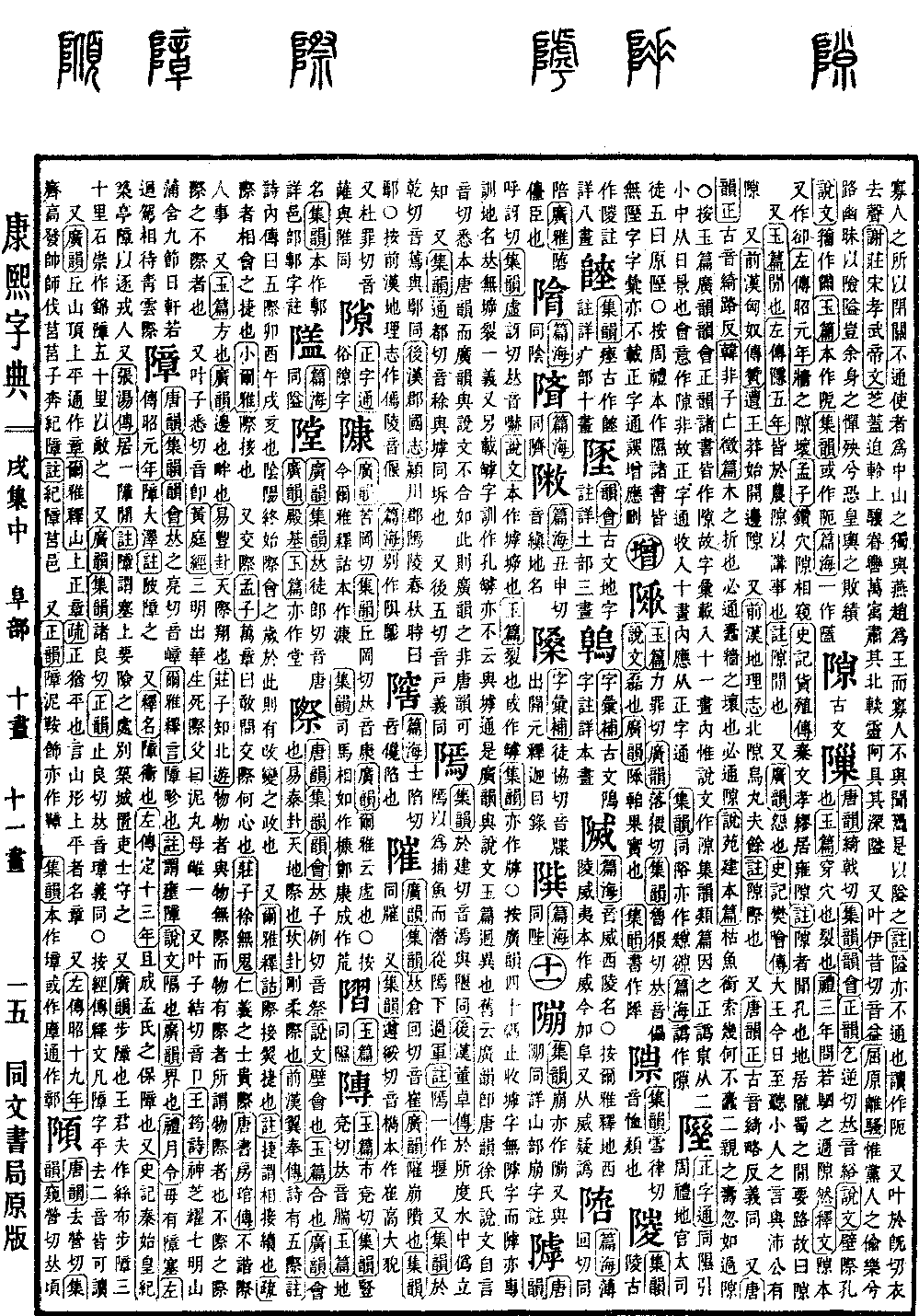
Xu Collection, Middle Volume, Radical: Mound (fù)
Page 1359, Entry 19
Pronounced ji (falling tone)
Meaning: The place where walls meet. Also, to meet, to join. As in "the place where heaven and earth meet" — Book of Changes (Yijing). Also, "the place where the firm and the yielding connect" — Book of Changes (Yijing). "In the Book of Odes there are five junctures (ji)" — Hanshu. Note: The commentary states that the five junctures refer to the hours of Mao, You, Wu, Xu, and Hai. These are years when yin and yang meet and begin anew, leading to political changes. Also, "juncture," "connection," and "swiftness" all mean rapid. Note: Swiftness refers to continuous connection. Commentary: Juncture means swiftness when meeting. Also, it refers to social interaction and dealing with people. Mencius: Wan Zhang asked, "What attitude should one adopt when interacting with others?" Zhuangzi: Those who practice benevolence and righteousness value social connections. Tangshu: He was not adept at handling interpersonal relationships. Also, it refers to direction or location. It refers to the edge or boundary. "Flying at the edge of the sky" — Book of Changes (Yijing). Zhuangzi: The Dao that creates all things is without boundary in relation to them, yet all things have boundaries. This is called the boundary of things. The boundary without boundary is the boundless within the boundary.
Also pronounced ji (entering tone)
Meaning: "The three luminaries emerge from the boundary of life and death; the father is the cinnabar pill, the mother is the female one." — Huangtingjing.
Also pronounced jie (falling tone)
Meaning: "Magical ganoderma shines with seven lights, mountain potherbs contain nine nodes. The sun's chariot seems to turn back, waiting at the edge of the blue clouds." — Wang Yunshi.